
Wyvern
Wyvern
About
- Username
- Wyvern
- Joined
- Visits
- 3,266
- Last Active
- Roles
- Member
- Points
- 5,585
- Rank
- Cartographer
- Badges
- 24
Latest Images
-
Expansion to Ellis Prybylski Watercolor Style
Yes please to the Elf, Dwarf, Halfling and Orc structures, plus ruins, ships, icy elements, a volcano-mountain, variant settlement features (including for different cultures)! And after those, also perhaps:
- Magical site markers
- Battlefield marker, and a more general flag-style marker, to highlight important sites that don't fit to specific structure types.
- Oasis symbols for the deserts.
- Two more bridges at different angles to the current one - one running straight down the page, the other angled down from top left to lower right.
- I really like the Henge and Tomb hill markers, as they look good on any terrain. Another such marker with a cave mouth would be very useful.
- Some Mountain Peak symbols without the snowy tops (so grey mountains, just no white caps).
- Seeing the animal and creature comments, just the actual creature without any associated terrain would be better, as usable anywhere. Snag is, going down this route is liable to lead to requests for a lot more "resources" style markers - domesticated creatures and crops, minerals, etc.
- Some jungle-style trees, perhaps including mangroves, as well as the fruit trees Monsen mentioned.
I'll probably think of others later, but these are what're coming to mind right away. It's a wonderful style, and it would be excellent to see it expanded as far as possible in future, I think.
And thank you very much for creating it!



-
Community Atlas: Embra - Watery Places
Stepping things up a little, for all the map is still a reduced-size one, Watery Place two is Bright-Eye Well:
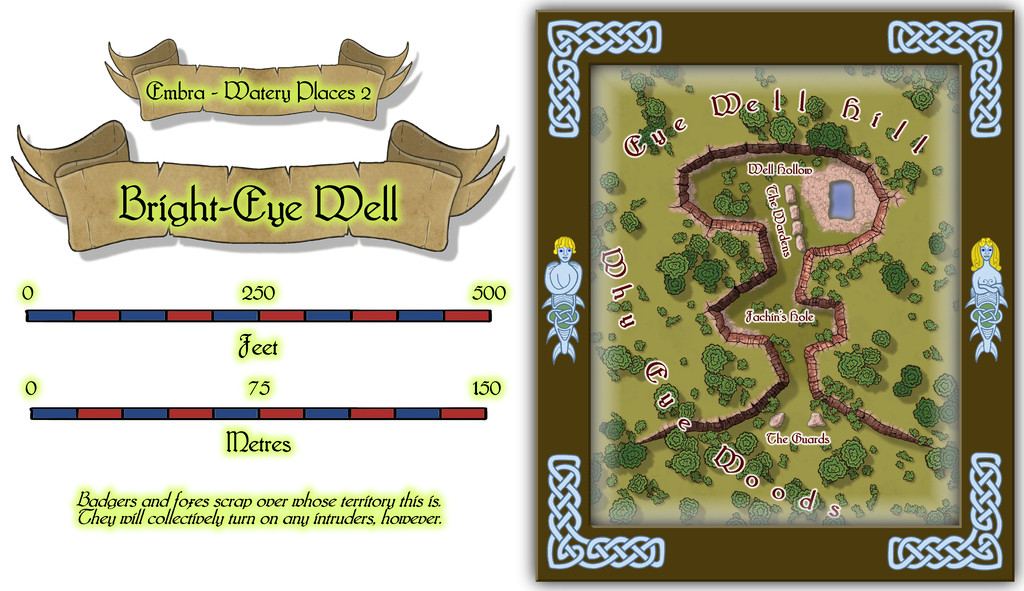
Coming up with a magical well is a bit "shooting fish in a barrel" for RPG scenario-writers, but using details from the original base-map (which was actually for a subterranean barrow tomb) meant I could add some extra interest here, along with making it an open-air feature, a partly natural, partly quarried, hollow in the edge of a hillside. Not quite sure what it is about red and pink rocks that have held a long fascination for me, but I made an early decision that one of the main rock types that was going to keep recurring at Embra was red sandstone. And as luck had it, the second of @Loopysue's excellent sets of City Cliffs symbols comes with a set of red sandstone symbols and fills! So that was an easy choice.
There's a knack to using connecting symbols effectively. Sometimes that means turning-off their ability to connect, and placing them individually. Sometimes you can just let them "have their head" as it were, and make whatever pattern they will. Usually, that latter works fine for straight, gently undulating, or long curving lines. When it comes to more intricate structures, it can be better to opt for individual symbol placement. Here though, despite the strongly curving lines in a short space, I decided to try using the connecting-symbol option, and see what happened, because this area was meant to look as if it had been straight-edge carve-quarried in places. It took a couple of tries to get something close to what I wanted, and then a lot more tinkering to get the shadow effects to work OK (don't look too closely behind a couple of strategically-placed trees, that's all!).
Those familiar with northern English dialect may appreciate a couple of the more curious map labels, although the Fachin's Hole name derives from real-world folklore, as something I'd decided from soon after the shape of the base map for this drawing had been chosen. A Fachin is a Scots' Gaelic fearsome Faerie creature, with one leg, one hand that protrudes from its chest, a single eye and rough, spiky hair. Sometimes considered of giant size, its preferred lairs are lonely gorges and lakes. That overall shape seemed to fit with the cliff-line being a loose, crude profile image of such a creature, with the Well as its eye.

![[Deleted User]](https://secure.gravatar.com/avatar/c75d9a245b74d9c59be0999ea81ca541/?default=https%3A%2F%2Fvanillicon.com%2F92add7f8c954488718110edc4896ad39_200.png&rating=g&size=200)
-
Community Atlas: Embra - Hilly Places
Miller Hill as Place 4 seemed an obvious choice for a Hilly site. However, as stated already, y'know, Embra. So this is a water mill at the top of a hill, with a stream that runs uphill to the mill pond on the summit, runs the water wheel, and then descends down the other side of the hill again! Naturally, no one here thinks this is anything unusual - how could the mill run without a water source, is the primary response to those who might seek to question the setting:
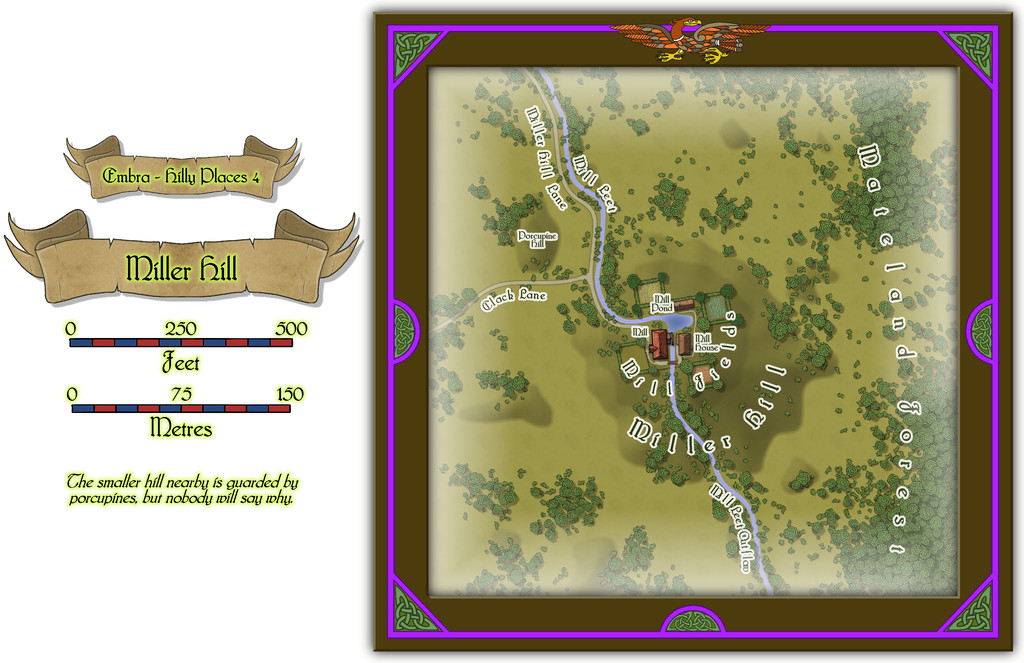
There are some buildings on this map too, for once in the "Hilly" selection, which have interiors that can be viewed using the toggle in the FCW file in the Atlas, all being well:
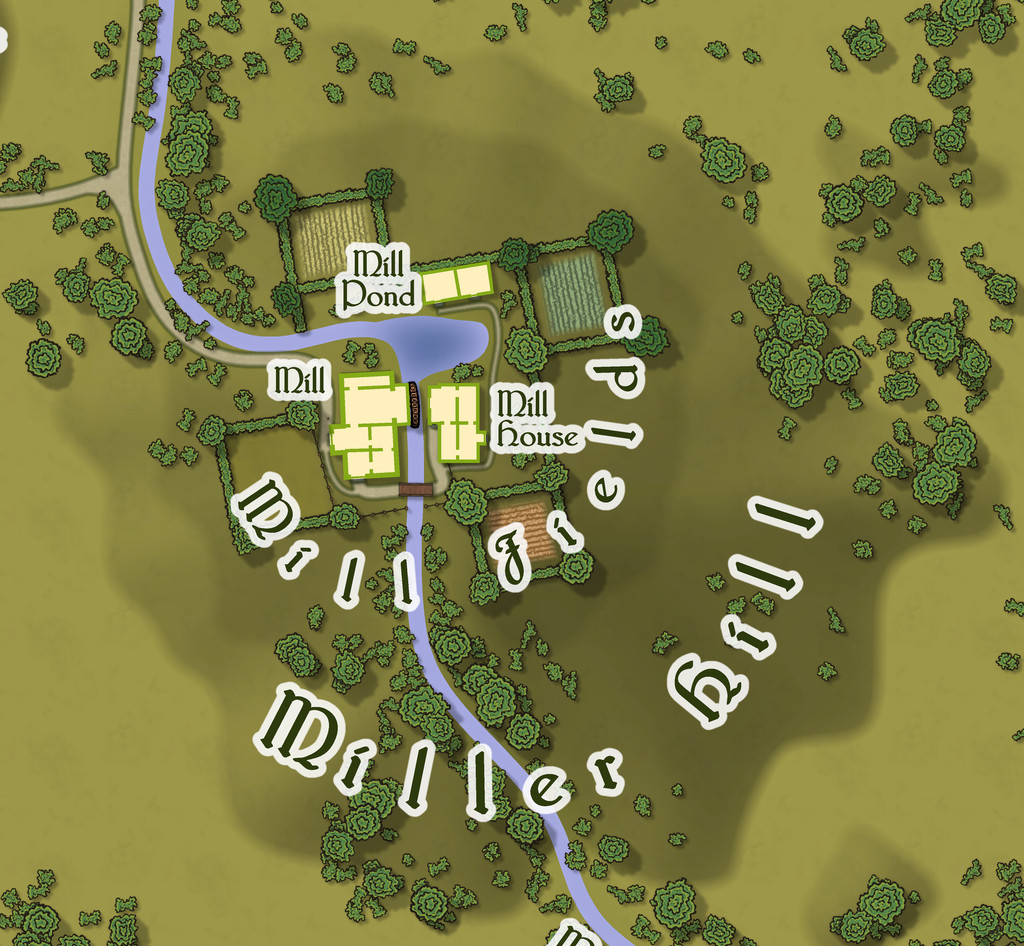
It has to be said I was delighted to see the random base map options had provided one that so obviously fitted the nature of a mill site of this, shall we say unusual, kind - those four square fields looking like the sails on a windmill. So there's a note in the PDF and text files for this map suggesting GMs could have the four fields, and their hedge/fence lines, rotate, flowing over the land surface like cloth, carrying anyone in one of the fields along with them, but only when the wind blows strongly. Everything else of course stands quite still; and not entirely by chance, the rotation centres more or less on the axle of the mill-wheel, where else?
-
Community Atlas: Embra - Wooded Places
Wooded Place 2 is the Elfin Stone Ruins, now with extra map-border creatures (don't you just love "Mirror Copy" sometimes?):
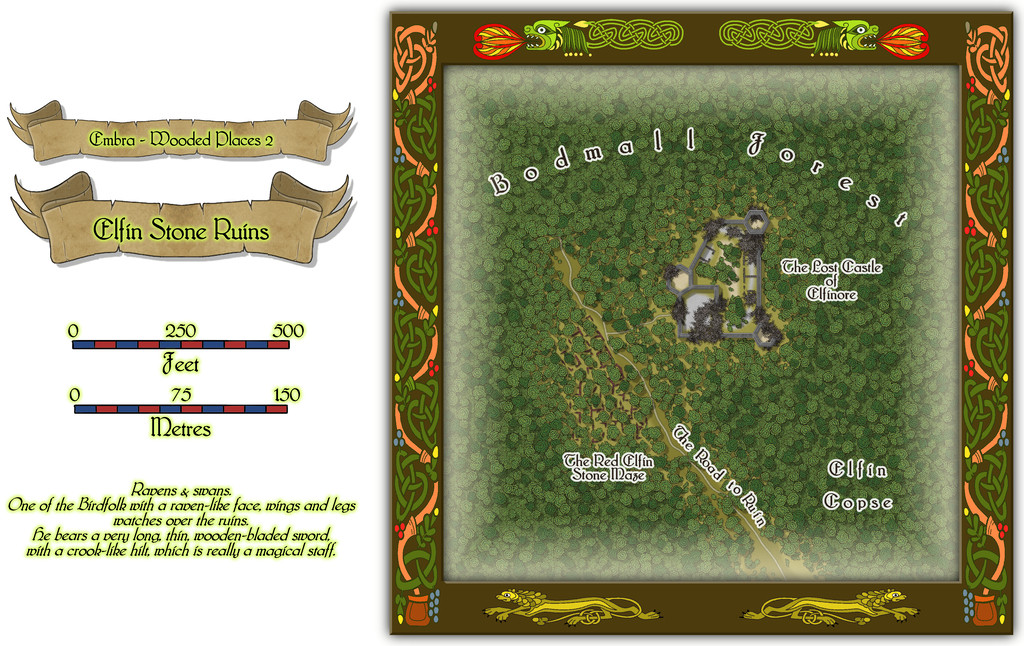
Which also shows I finally gave-in and decided to actually map one of the castles from the original base map as a genuine castle for once - or rather, a ruined version of one. Sort of... As a close inspection will suggest though, the castle doesn't seem to have had an actual gateway. A slightly better resolution image may help:
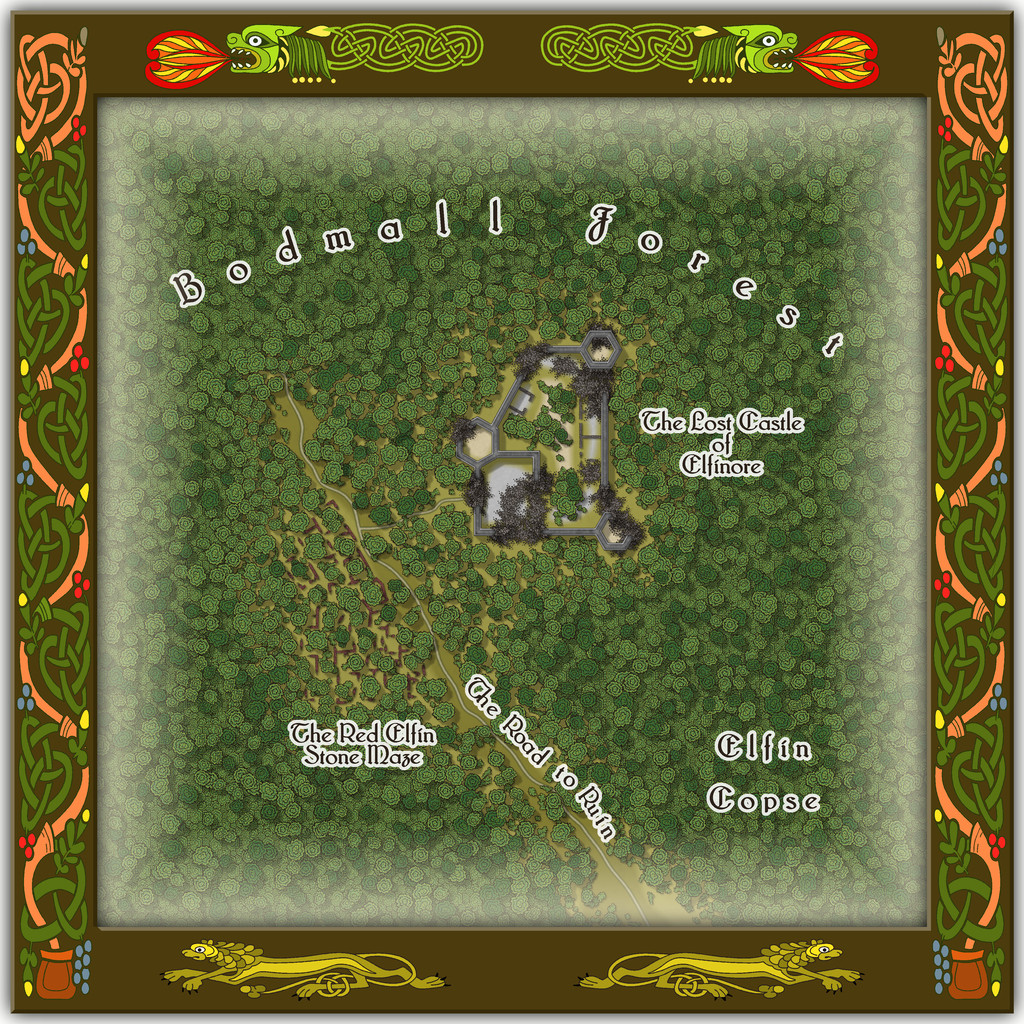
As for The Red Elfin Stone Maze, that's difficult enough to see on the actual CC3+ map, albeit quite deliberately so, since the adaptation of the original base map's features here called for something odder than just ruined walls of somewhat poorly-constructed peasant housing (my reasoning behind the wall-lines on the hand-drawn JG original not being entirely straight in places). If the ruins give the impression they may have been built that way, and are not of earlier buildings that have decayed and fallen apart, that might well be correct.
Oh, and there really is nothing to distinguish that part of the dense woods labelled "Elfin Copse" from any other part of the Forest nearby, incidentally. Come on - this IS Faerie, after all!
-
Ancient maps
That 22-foot Roman Empire map is the Peutinger Table, aka Tabula Peutingeriana, and the Wikipedia page includes a high-res complete image of the whole - may take a while to load, however, as the full-size JPG is about 15 MB. This is the direct link to that Wikimedia image.

-
Community Atlas: Embra - Wooded Places
Wooded Place 5 is Wistful Hollow Chapel:
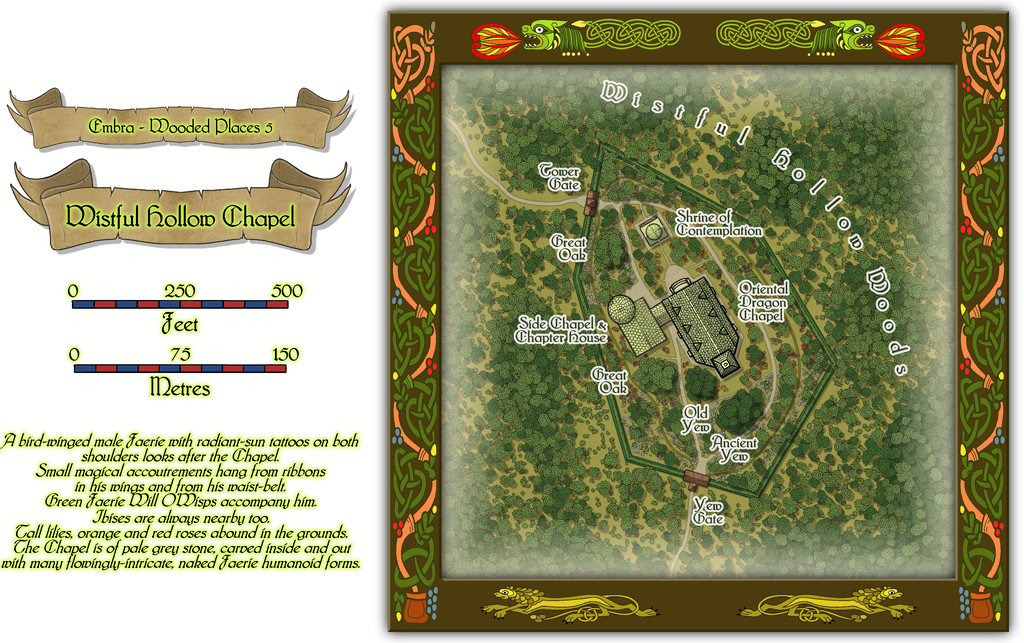
This was naturally somewhat easier as a drawing, with more random than planned vegetation, if still with a few substantial trees, and a lavish scattering of flowers across the Chapel's grounds. I picked the base map - yet another castle-form, who'd have guessed? - because the outline for what became the grounds looked like a very sketchy drawing of a prehistoric stone hand-axe, even though that has no bearing on the map or its contents at all!
Indeed, the Chapel's primary inhabitant (not even mentioned in the featured text) is a living, golden, Oriental Dragon that provides advice to the deserving who come here. That wasn't simply on a whim, but because there's a genuine church (the High Kirk of St. Giles) at the real-world city of Edinburgh that has a Chinese Dragon decoration in it. It wasn't hard to see that Embra needed something similar.
The map ended-up looking rather different to a lot of the larger Embra maps too, as the size of the buildings needed to be on a suitable "draconic" scale, so they almost look as if the map's in one of the smaller border frames, for all the map scales alongside clearly show it isn't.
Not all the illustrated structures are full buildings, as the "Interiors" toggle view demonstrates:
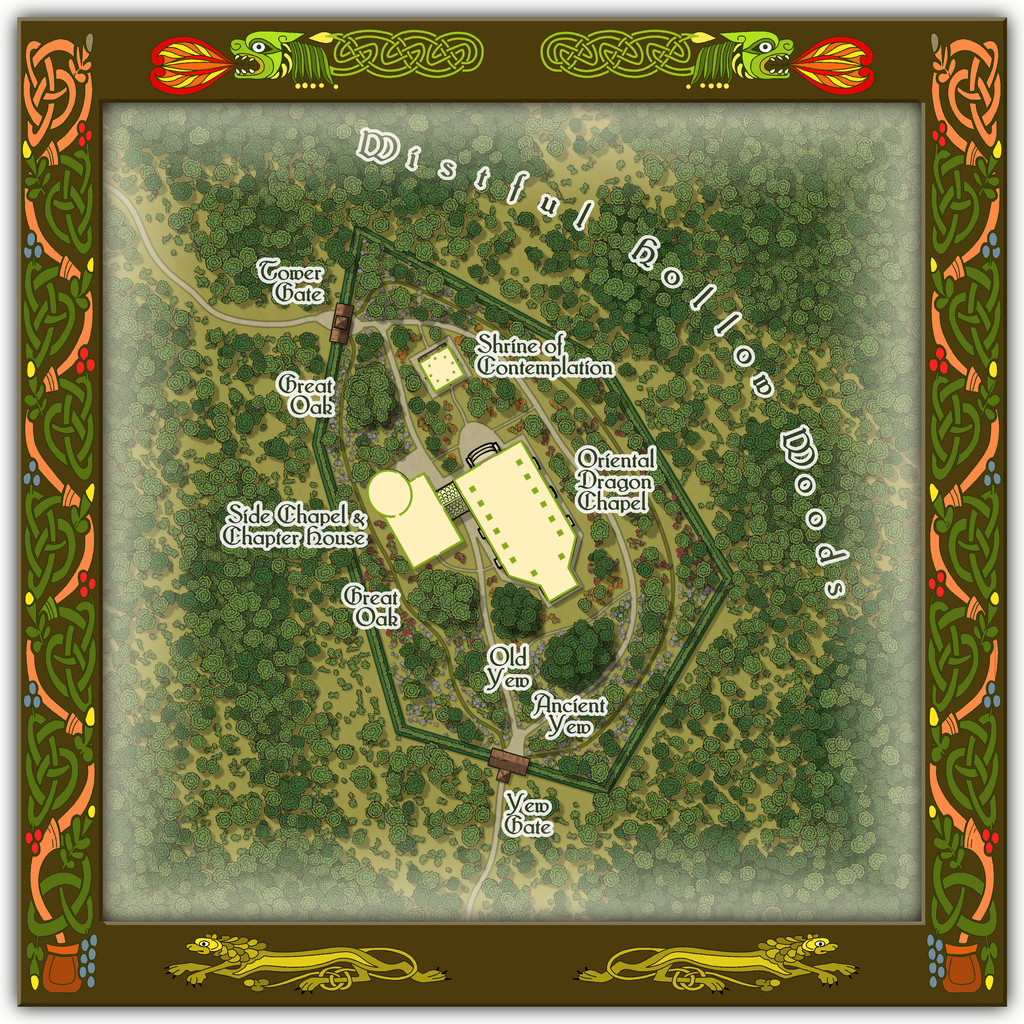
The Gates to the grounds are simply covered gateways, lychgate-style, while there's a tiled-roof walkway crossing the path between the Chapel and Side Chapel, not a linking building.

-
Community Atlas: Embra - Constructed Places
Constructed Places map 1 is that for the ruler's Crepuscular Palace at Embra. Well, I say "ruler", but she's actually more the physical embodiment of Embra made magically real and living, The Verdant Sorceress, who flies on wings made of summer flowers. Something like the Archfey of D&D, though really more like the deity of/being who is Embra in power and abilities here. The name and flower-wings came from random rolls using tables in A Wanderer's Guide to the Feywild, by Heavenly Spoon, available on the DM's Guild download site (Pay-What-You-Want). The rest is more "me", however. I'd added some details to the PDF and text files for the Crepuscular Palace map before I realised it would be feasible to provide a CA3 drawing of the Sorceress for the Atlas as well, something that needed quite a bit of late revision of both texts and the Palace map. Although there wasn't space to add the full CA3 drawing to the Palace one, I did want to add a suitable link-spot by it. So this is the final Palace map:
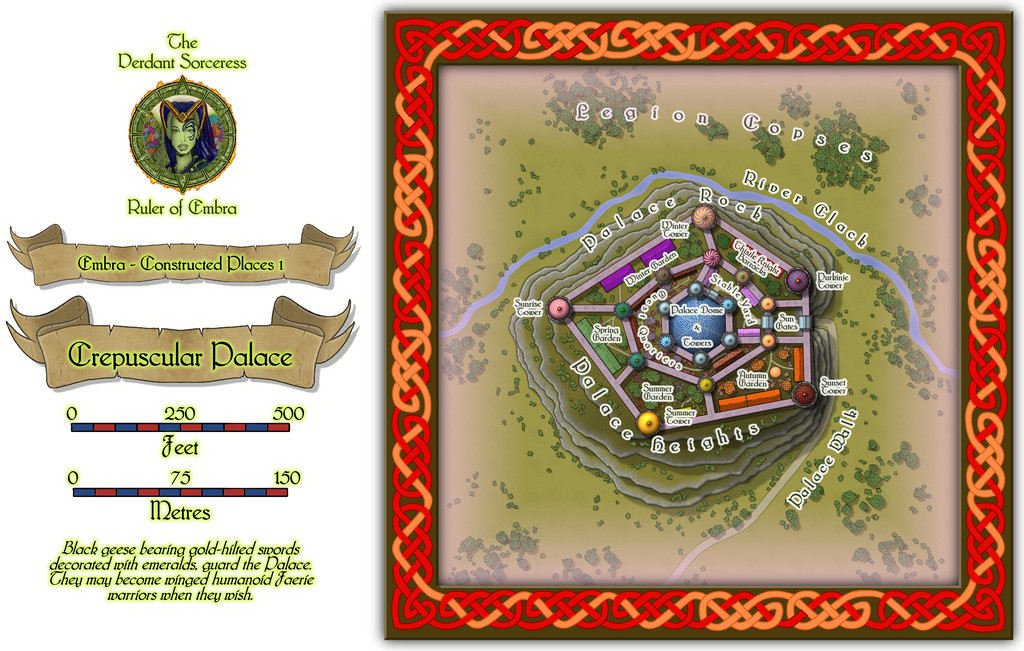
And this is the lady herself:
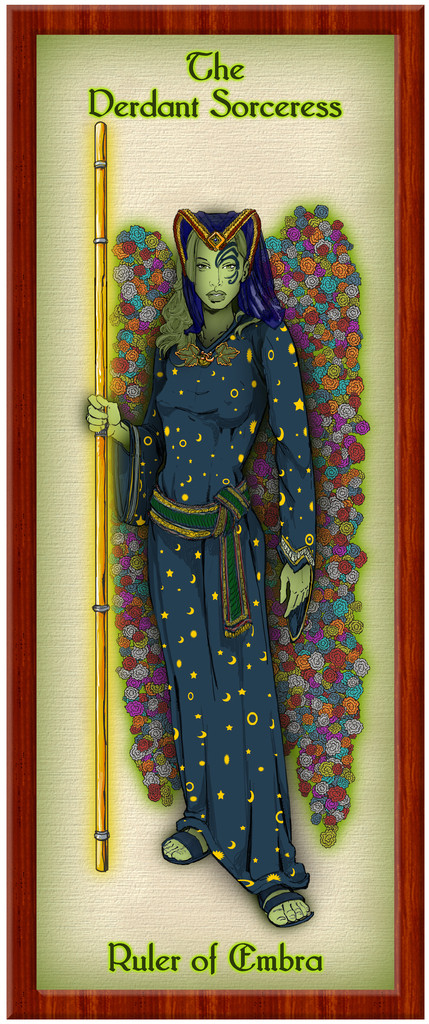
Of course, this is only how she appears in her Elf-like humanoid form, when out and about meeting people, and not trying to terrify visitors unnecessarily. She could seem equally to be anyone else in Embra, or anything at the city - such as a flower, a shrub, a tree, a building, a pond, a floral meadow, a path, a hill, a forest, a cloud, a rainbow, colours in a cloud, the River Clack, or a blade of grass. In a real sense, she IS Embra, in all its aspects, positive and negative. (Oh, and this means the final tally of Embra drawings for the Atlas is now 58, not 57...)
Those who've been following this lengthy series of posts regarding my Embra mapping closely may recall the Palace Heights map among the Hilly Places, and spot the resemblance to this Crepuscular Palace one. That would be scarcely surprising, as they're the same place, here with the Palace a living, still fully extant, building, rather than grassed-over ruins. With an interior:
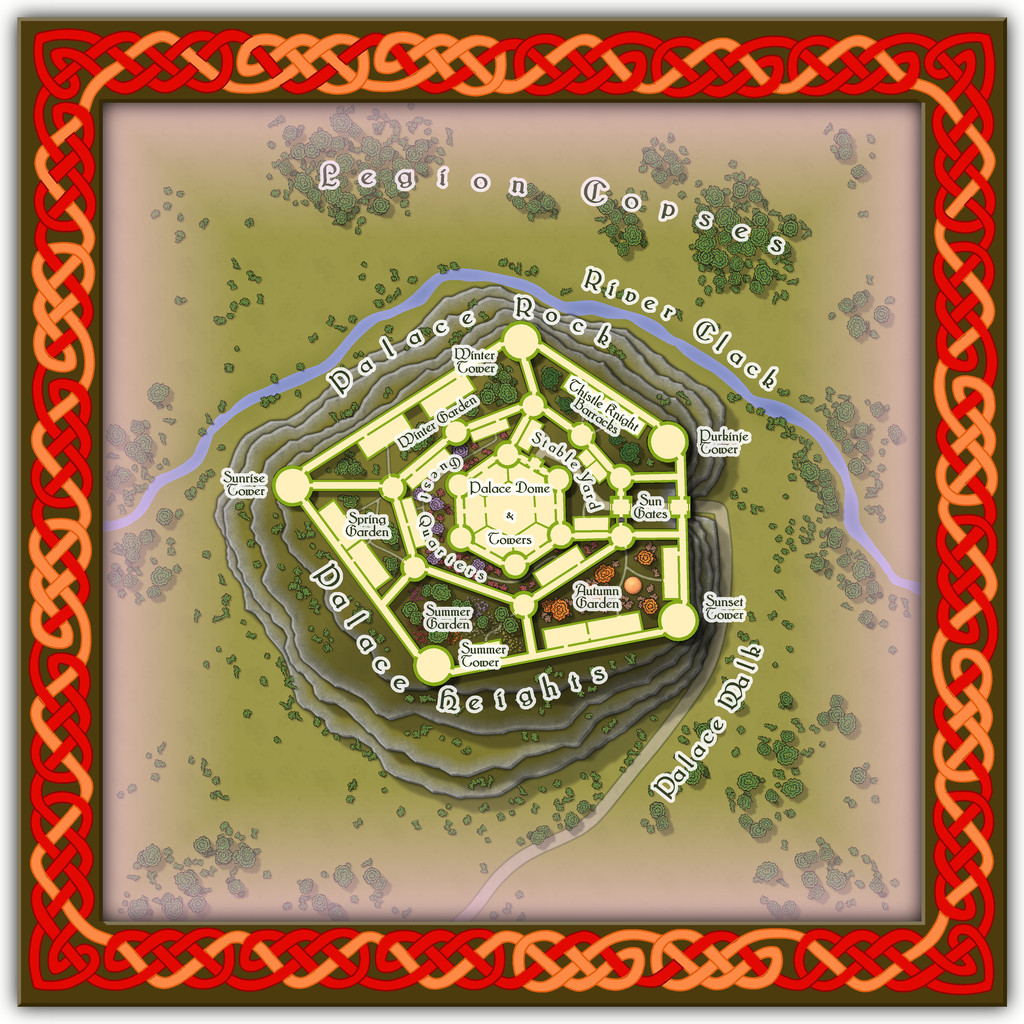
However, the interior is shown only for the ground level. The upper storeys - which all the towers, walls and great central dome have - are left for GMs to determine, if required, as the elements in it change from time to time.
-
Mythic Carpathia map by Free League Games
There's a good reason for that. It is!

-
Sinister Sewers - Style Development Thread (CA207)
@thehawk makes a good point about ancient sewer systems. I think the earliest definite sewer pipes date to around 4000 BCE in what's now southern Iraq, at the ancient cities of Eshnunna and Uruk, although more sophisticated sewer systems survive archaeologically from the Indus Valley civilization around a millennium later (c. 2300-1800 BCE). Most were of brick or clay construction in various forms.
-
Community Atlas: Embra - Wooded Places
The third map in the Wooded Places set gave me an opportunity to try something I've wanted to do for a long time, map some spiral patterns in woodland. Those sufficiently familiar with fantasy fiction might guess the idea originated in the "Mythago Wood" tales by Robert Holdstock (the original novel, "Mythago Wood", was published first in 1984), which made a lasting impression on me from when I read them back then. The final map though bore only a mild, passing resemblance to its original base. Thus came to be Spiral Glade Park:
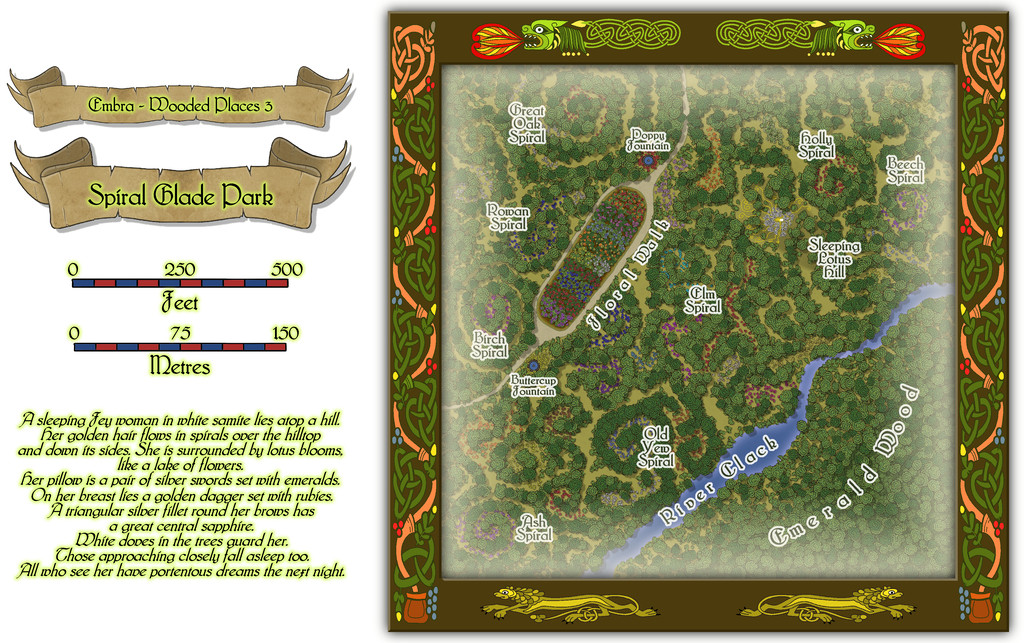
The details are a little tricky to see at this resolution, so again, we can try a somewhat closer view of just the map part:
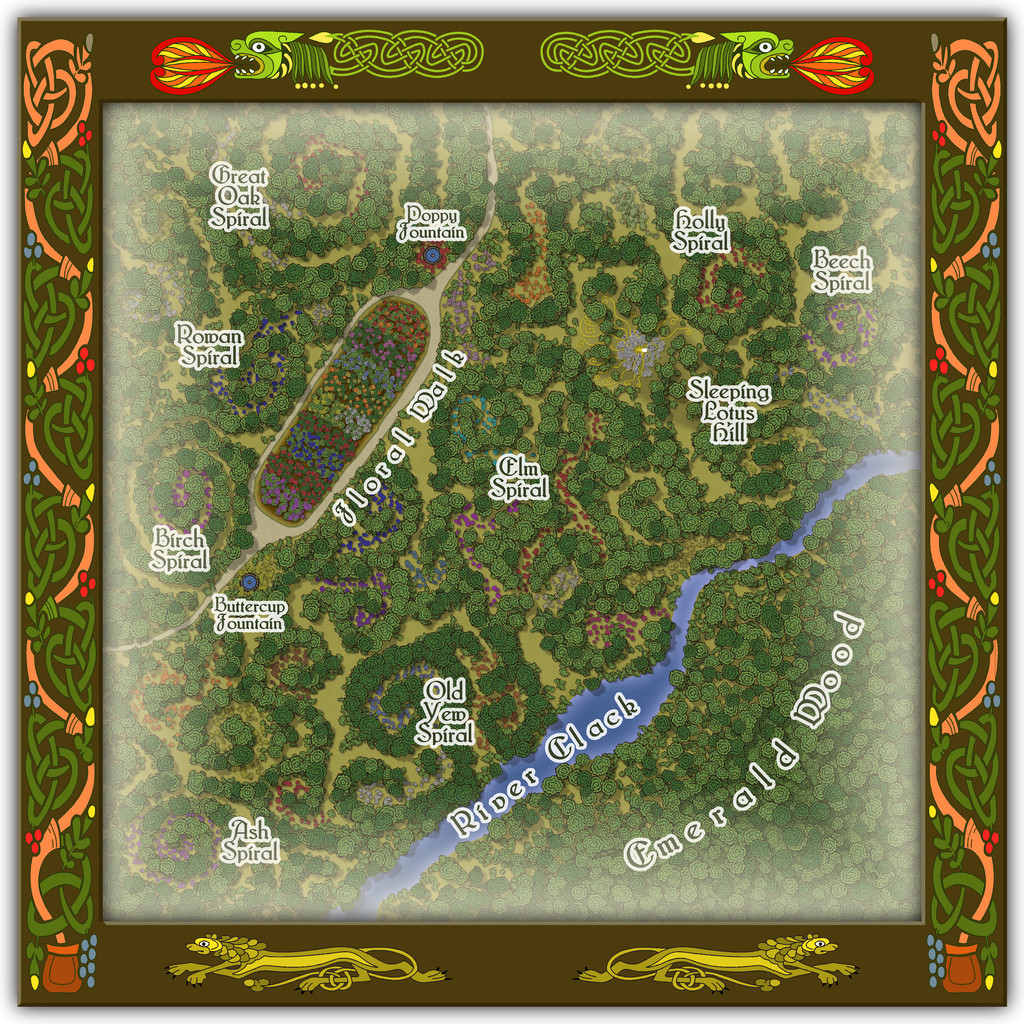
For those wondering, yes, Sleeping Lotus Hill does have a simple sketch of the sleeping Fey woman in white of the map's featured text, and her spiralling golden hair, surrounded by lotus blossoms. There are also a lot more flowers scattered across this map, as with several other of the Embra Places, of course. The PDF and text file notes suggest some possible benefits from traversing the spirals, and a warning regarding the curious grassy hummocks mostly hidden by the lotuses...