
Wyvern
Wyvern
About
- Username
- Wyvern
- Joined
- Visits
- 3,303
- Last Active
- Roles
- Member
- Points
- 5,647
- Rank
- Cartographer
- Badges
- 24
Latest Images
-
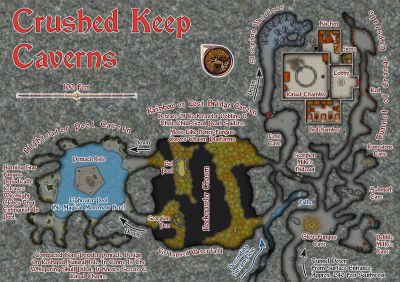
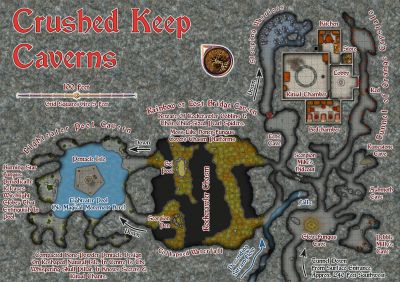
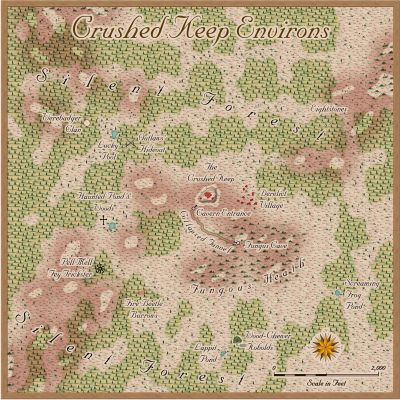
Community Atlas: Monseignor District in Kentoria
The reason I opted for a monochrome style for the overland map was that I'd already chosen the Annual 48 Dungeon Black & White style for the underground map. Even if technically, it's not truly underground at all, as it's set into the gigantic dolerite mesa-like rock pillar which is what's actually called "Melgore", with its entrances at surface level on the north side of the pillar, by the rocky beach leading down to the nearby River Wisper, and which extends up into the pillar a short way (a total of less than 40 feet, 12 metres, given the pillar is roughly 500 ft tall, 150 m). Thus the Necropolis map:
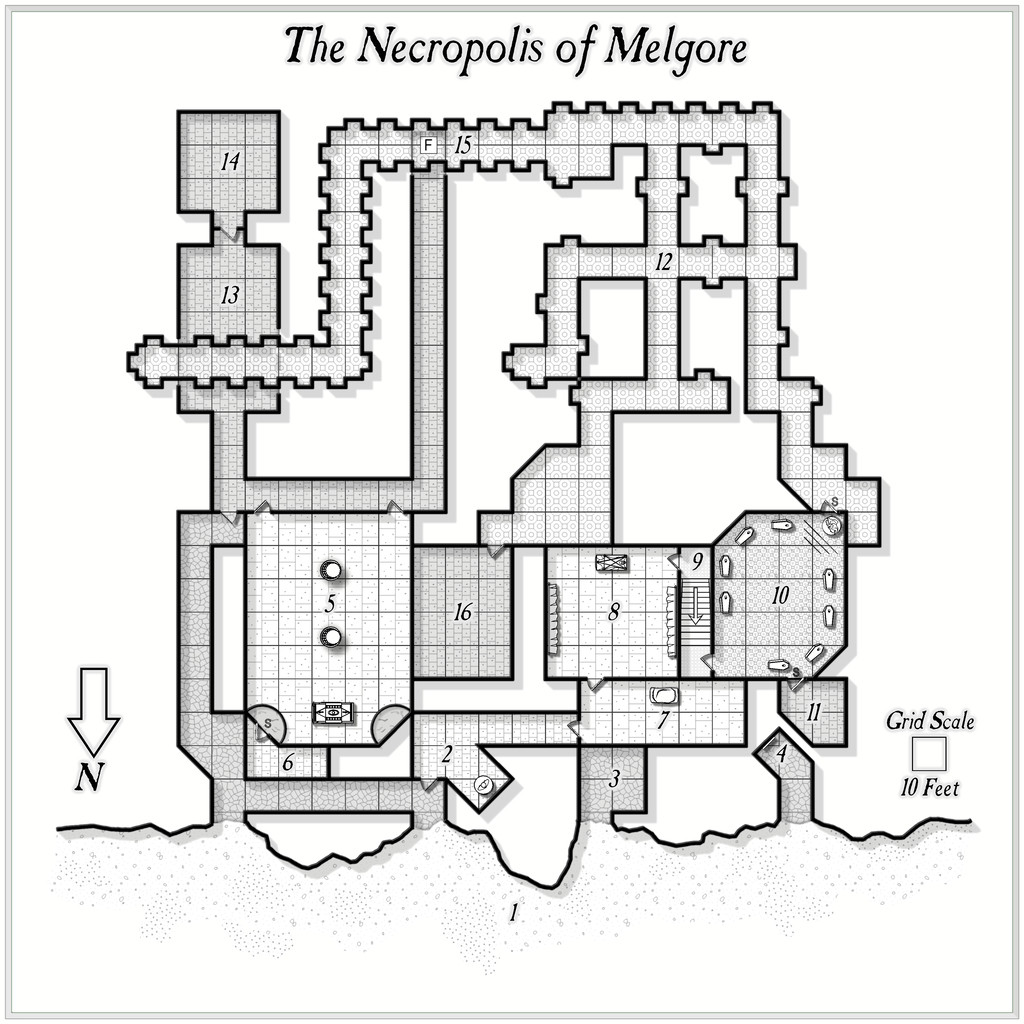
There are, of course, PDF and text descriptions for both maps to go into the Atlas, to provide more flavour and notes on what's where, and what's going on in both. Some of these ideas came from various random design lists, published and personal, although I also drew on inspiration from the book description available from Inkwell Ideas for the "Crypts" dice set used to create the Necropolis map, adapted and amended somewhat here.
Plus the original dice-map was amended, to remove unnecessary blind passages that didn't link together, and to stop the whole from having too much of a "geomorphic dice edge" look in places. In other sections a few new features were added - corridors or rooms extended, shortened or linked, with new doors or secret doors added as well, as my thoughts about what was here developed during the whole mapping process, much as normal.
I wasn't sure at first about leaving the wall shadows visible into the surrounding rock, although this is what the style was designed to show. However, I became quite attached to this look during the mapping, which, with the crispness of the style, gave me the impression of looking at a map set into a sheet of crystal-clear glass. I did a brief experiment with a wall mask to hide the shadows in fact, as part of the process in concealing the bits of the grid that weren't needed, but found that hid too much of the wall lines, and made the whole thing look rather flat overall.
Higher-res copies of both maps are in my Gallery as well, for those wishing them.
My intention is to keep trying out different mapping styles during this project, albeit I am inclined to attempt to retain a stylistic theme where two (or more) maps need to be nested into one, as in this case.
If all goes to plan, I'm next heading off to a continent that's eluded me till now - the tropical heat of Kumarikandam!



-
Community Atlas: The Hall of the Seer, Glaciär Kristol, Ezrute
As I mentioned last time, this little trio of maps all grew up together, and not altogether in the neat order presented here. Realising early on that the underground complex was set to have a pair of entrances, reminded me that one of the still-to-come dice-design maps also had a couple of cave mouths in a cliff. Although that was from one of the "Ruins" dice, those designs also feature on the "Cities" dice set, die 6R from that (6R* in the Ruins set), without the ruined buildings, fallen trees, and so forth. So rather than use the Shadowdark settlement design rules to create the settlement, I simply reused that Cities dice layout, with a few tweaks, instead, to create Seer's Hall Village:

The mapping style was chosen a while ago for the ten small settlements in the Whispering Wastes of Peredur, which was reused here, with a variant design for the roads and paths, to give them their rough stone-edged, gravelly look, as distinct from the ice and snow elsewhere (one advantage of a B&W style!). I made the chimneys more prominent, given the high-southerly latitude, and adjusted the property sizes a little, as the inhabitants here are primarily Ice Dwarfs, a cold-immune, stocky folk, able to change into small animals and back when they wish (based on the Dverg from the Cursed Scroll #3 zine, writ larger, given the Dvergs are essentially arctic gnomes). In addition, the folk here also have pet Arctic Mastiffs, for a little more colour (cold-immune dogs, basically).
Part of the Village contents were determined from the Shadowdark rules, as before in Peredur, with some tweaks to fit the established setting here, given the whole place is only where it is because of the Hall of the Seer inside the large ice hill to the settlement's north. That cliff-line, with its entrances and stairway, and the two pylons on the hilltop were all from the dice design, like the placement of the buildings and the road layout, again with some adjustments to fit how the road was on the Plain map, as illustrated previously. Indeed, this map was changed partway through to accommodate elements of what the Plain map showed, including the Ley Line.
I tried fitting the existing cliff symbols from this style for the Great Ice Cliff, but ran into the same problem with these as previously in Peredur, where the lines won't fit to a suitable concave form. So I just drew the cliff as a polygon - well, actually two lines, mirror-copied to give a symmetrical four, and then added a shaded polygon by hand-tracing the lines. Dot-shading gravel symbols and fractal lines were then added to give it more of a "cliff" feel. The cave mouth was mirror-copied too, to look more or less identical, while the stairs reused a symbol and railing lines already drawn for the underground map, just copied across from that. The hilltop platform was an addition though, to give some purpose for the pylons and stairs, a place where the locals hold ceremonies at midwinter, midsummer, first sunrise, last sunset, and whenever the aurora is particularly strong overhead. Ceremony Hall has the feasting tables for such events, to be set up at the northern end of Pylon Way.
Next time, into Seer's Hill.



-
Community Atlas 1000th map Competition - with Prizes [August/September]
Map four of my ten small settlements is Toresk Village:
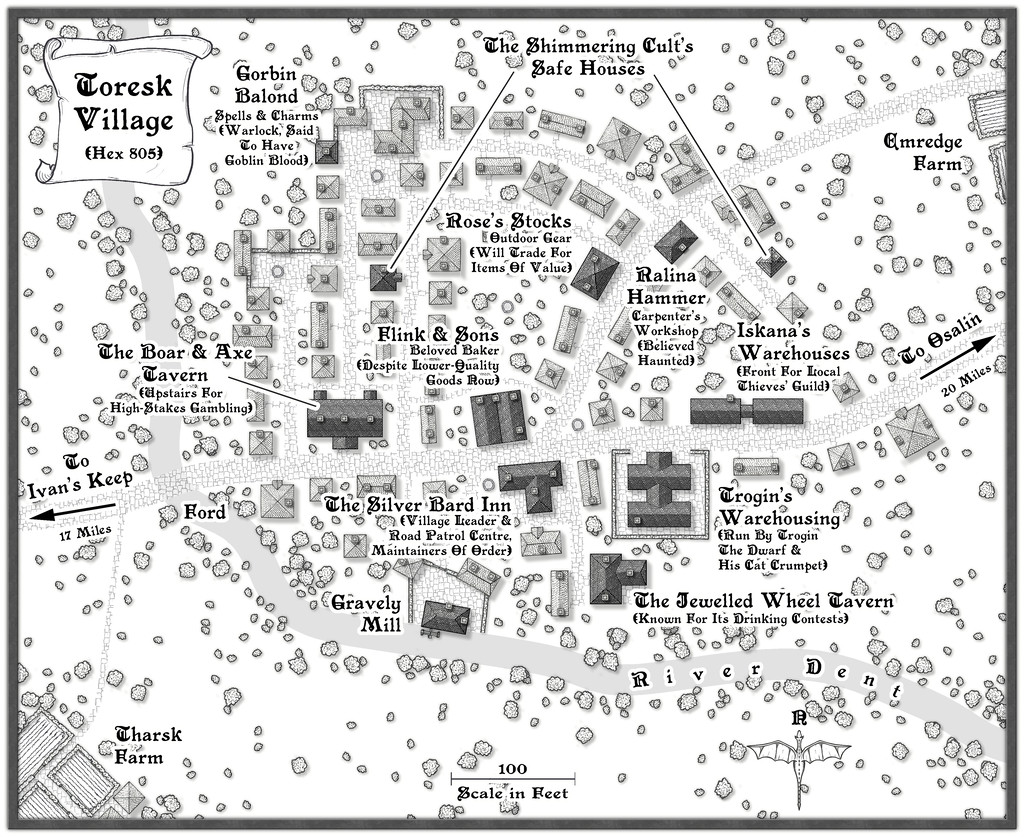
I've updated my WIP topic with this map today too, and there's a higher-res version in my Gallery as well. The FCW and PDF notes follow:

-
[WIP] Community Atlas August Mapping Contest: Cloven House
Although I've already posted about this in the contest topic, to round-off this WIP topic too, here are the final versions of Cloven House, without and with its secret Cellar cave, now with added cupboard under the Cellar stairs:
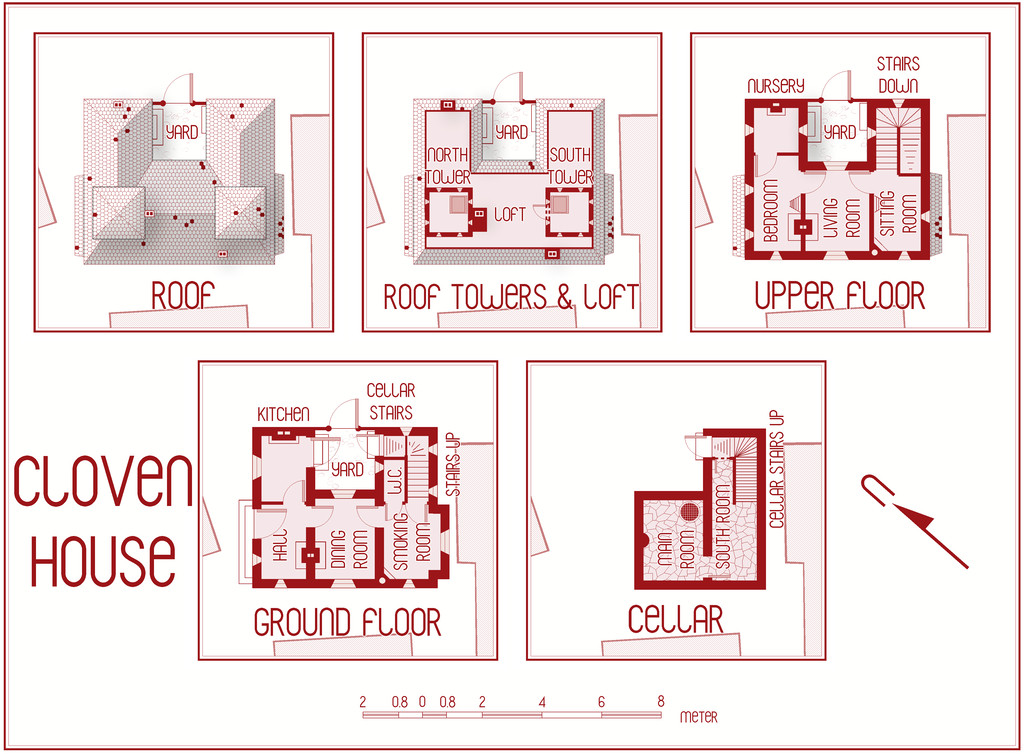
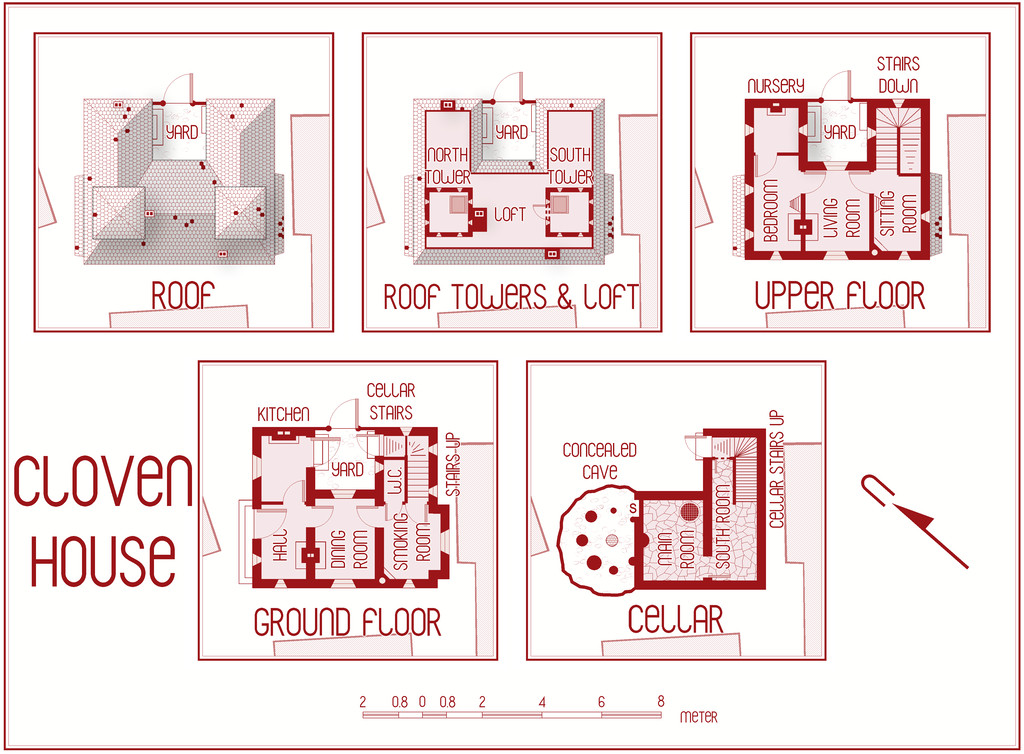
For those who might be interested, and again something that's in the contest entry topic too, I've attached here the PDF notes for the map, which will be in the Atlas version in the fullness of time, for those wanting an early preview of this little haunted house:
Do be aware that there's a hint of "adults only" about a couple of the potential apparitions and other ghoulish elements in these notes. Nothing too salacious, just something to be aware of.
Incidentally, anyone thinking I might have abandoned my preference for random design mechanics in devising my Atlas maps in this instance, might be reassured that there were hints of that in selecting what ghostly items to pick from in constructing this description (I have a long list drawn from numerous past sources and ideas!). Such a mechanism was used less here than in other features I've designed previously, however.
And good luck to all the other contest entrants, especially those struggling to get things finished by the deadline!

-
Developing a map loosely based on Bronze-Age Mesopotamia
As you'll likely be aware already @aulyre, there's a vast and still-growing literature on the archaeo-historical aspects of the region, and you could easily spend years simply wading through as much of that as you'd care to - I have, certainly, starting back in the 1990s!
Of my own maps of this region, I posted a selection just over a year ago on the Forum here. Unfortunately, this was shortly before the Forum underwent a major revamp to its current incarnation, so the post now looks rather a mess, as we had to embed images rather differently then, using an "[Image_12345]" coding notation, but the images are all still there, just no longer where they were meant to be in relation to the text, so you have to hop up and down to get the full gist properly.
As for references, a couple of atlases I found extremely helpful when I was starting out might be of interest, if you haven't come across them yourself as yet, and a couple of texts.
- Michael Roaf's Cultural Atlas of Mesopotamia and the Ancient Near East (published in 1990), which I was thrilled to discover on checking this evening is NOW FREELY AVAILABLE TO DOWNLOAD COMPLETE (!!!), and with a string of appended corrections, thanks to the kind offices of its author, via the Academia website, as of 2017! Link. I think you will need a (free to join) Academia membership to download the full PDF, but that isn't too onerous. For all its date, it is an astonishingly inspirational work in my opinion.
- The Barrington Atlas of the Greek and Roman World edited by Richard Talbert (2000), which unfortunately isn't available online yet, though it is available for iPad as a download (as of 2013). Otherwise, the hardback version is available to purchase alternatively, which I think still comes with an additional CD-ROM, according to some comments I found online (the library copy I borrowed more than a decade ago had one), including this Wikipedia page, although some of the links from that are now broken. GBP prices (brace yourself!) for the hardback start at about 265 GBP (Amazon UK lists), but the iPad version is a less fearsome circa 15 GBP instead (albeit you'll also need an iPad, so swings and roundabouts...). The Princeton University Press pages for these are here: hardback version -- iPad version. The related Ancient World Mapping Centre website is probably worth a visit as well, albeit they've been having major site issues this year, so a number of links don't work currently. Most of their Free Map pages are still functioning, however, and are certainly worth a look too. The Atlas is another astonishing work, if for a somewhat later period than Roaf's text.
- Civilizations of the Ancient Near East edited by Jack Sasson (1995) is a monumental four-volume collection of specialist essays on all manner of topics for the region. The length and quality of individual contributions can be variable at times, but it is a wonderful means to find out at least some basics on a vast array of topics, with follow-up references to help get you started looking for more. Irritatingly, I can't even find an online description or a complete review of it, though I suspect barring extreme good fortune, it will mean accessing a library copy now anyway.
- Ancient Iraq by Georges Roux (1993) is probably THE classic single-volume introductory text to the region and period. It is, incredibly, and despite its date, still currently in print! You can also find it available to borrow or purchase via the Internet Archive here (limited preview version otherwise).
This has taken a lot longer than I'd expected to compile today, so I won't try to say more; there's enough to be going on with already, I suspect in this little lot!
![[Deleted User]](https://secure.gravatar.com/avatar/c75d9a245b74d9c59be0999ea81ca541/?default=https%3A%2F%2Fvanillicon.com%2F92add7f8c954488718110edc4896ad39_200.png&rating=g&size=200)

-
Community Atlas competition entry: The Summer Palace of the Winter Queen
Thanks folks!
@Fersus - Yes, I wondered about a hexagonal grid. However, over the past year, I've been involved in discussions about the use of movement grids in RPGs more generally elsewhere, and the consensus has been almost exclusively for square grids (or occasionally none at all). They're such a feature of most published dungeon maps, it's hard to break away from that, I suspect. Plus because hexes don't scale equally in all dimensions, a square grid works better for estimating distances for the GM by-eye.
Given the whole point about participating in the Atlas, and contests like this too, is to try different things, at least from time to time, my intention was to try to make each of the ten Palace maps different. So for the second one, I picked the Old School Blue style from CA12 (also known as the Create Your Own Style pack). Blue, ice, seemed apt!
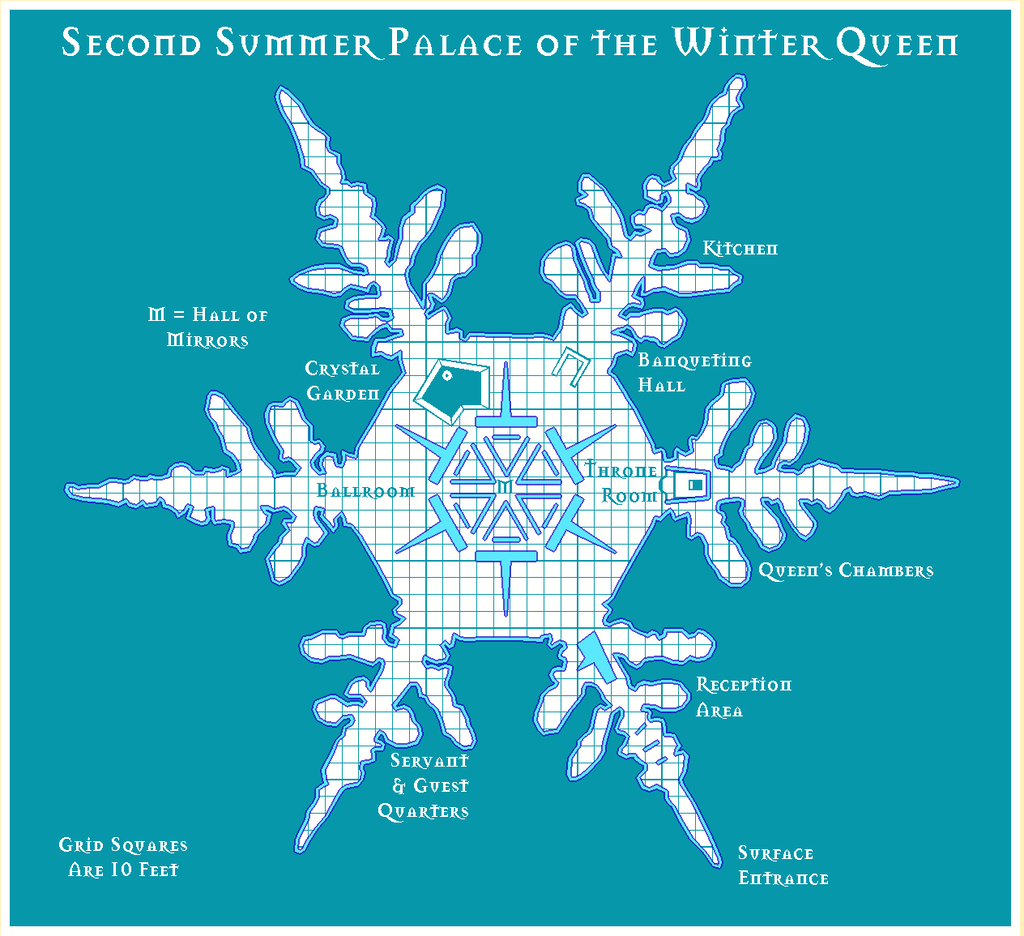
For continuity, I've decided to stick with the Mason Serif Bold font that comes with CC3+, however.

-
Community Atlas: Embra - Enclosed Places
The final Enclosed Places map condenses the remaining five Places, all streets, into a single drawing:
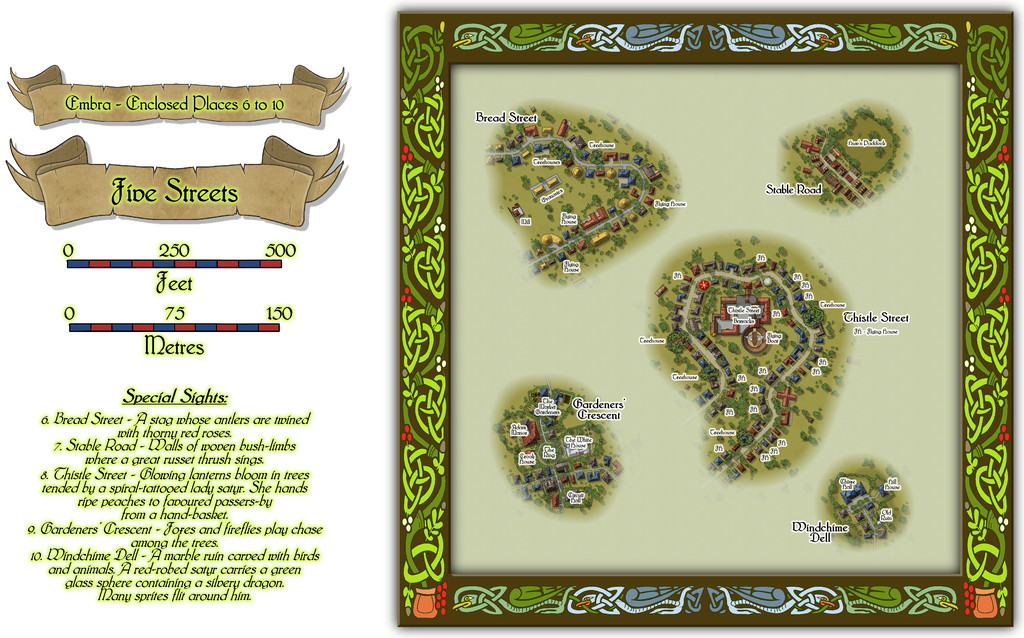
Lots to see here, so let's try a closer view of just the streets:
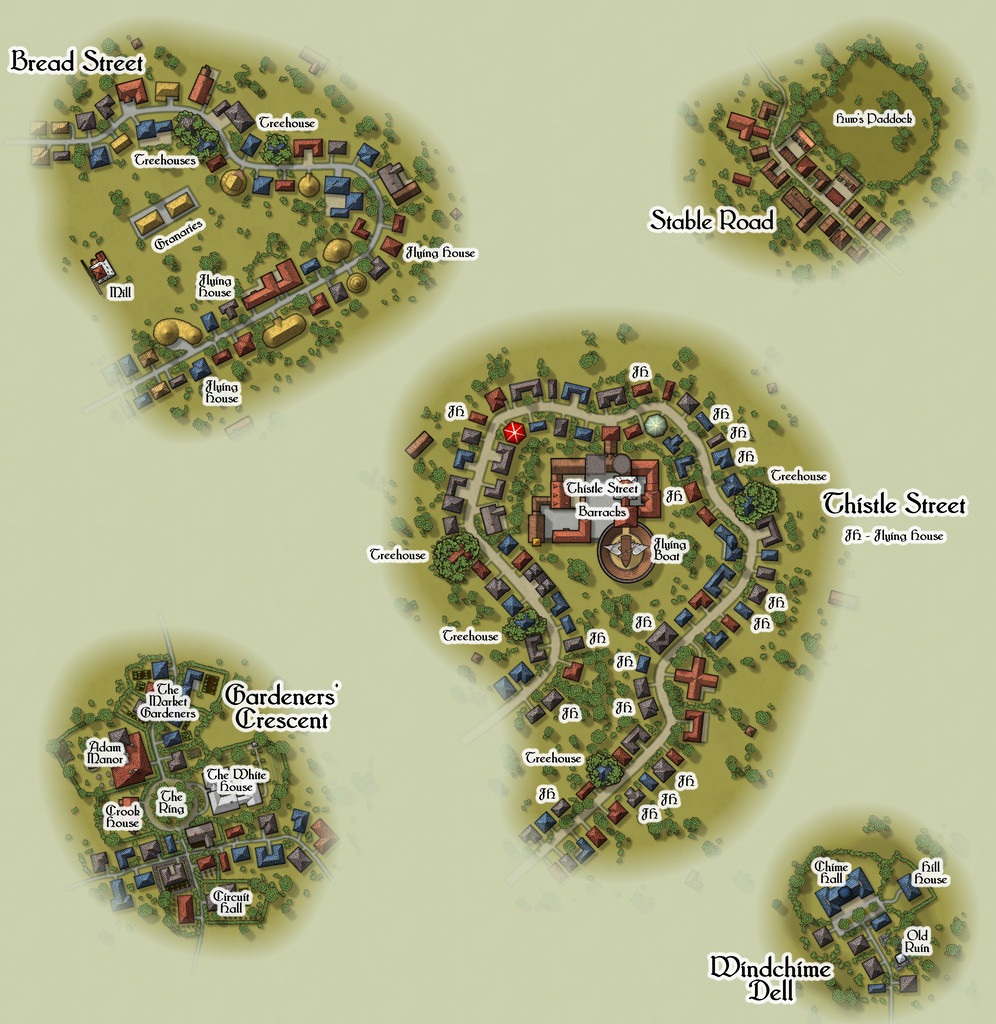
All the streets had to be designed in a rather different way to the other Places of course, as there were no Judges Guild products that provided plans for such things in isolation. As I noted previously, instead I reworked a set of tables for randomly generating caves and mines from another old Judges Guild text to decide on their lengths, widths, types and layouts, although that system ultimately was more "me" than "JG". Once the base layouts were designed and drawn into the CC3+ map, the streets were redrawn as proper CC3+ streets of the appropriate width and character, and then the CD3 random street options were used to populate them with a range of houses suitable for their overall names and natures.
The streets I came up with were often quite curvy, and the CD3 random street tool isn't too keen on curves and turns, and it can't really cope with junctions at all, so some of the random properties had to be moved, or removed, or adjusted, and sometimes redrawn using a combination of the base shapes that had been generated. Occasionally, some were swapped out for symbols, particularly where I wanted specific or important structures to be. I also decided early on that it wasn't going to be practical to provide interior drawings for all the properties involved - there were simply too many, and that ran the further risk of making them too much alike without a lot of care. I did contemplate doing interiors for selected properties, only to finally decide against that too. So if you need interiors, you'll have to come up with your own for these!
I'll not go into detail here as to what some of the items on these mapped streets are. The PDF and text files in the Atlas should help in that respect. However, it is worth drawing attention to the most significant structure, the Thistle Street Barracks, home to the Knights of the Thistle, Embra's military and police-force, in as much as any Faerie settlement needs such things. These Knights are not entirely my own invention either, as real-world Scottish knights of the realm are known as "Knights of the Thistle" too, though Embra's are naturally of a more magically Faerie kind.
As with all the other individual Places, the idea is these streets can be linked as loosely and in whatever ways GMs may desire to create fresh interpretations of Embra city.
And this is only the first collection of Places in Embra. There are six more such sets still to come!
-
Community Atlas: Map for the Duin Elisyr area, Doriant
So at last, everything's ready, and has now been submitted to the Atlas. This is the final version of the Evth Pass map (higher res version in my Gallery):
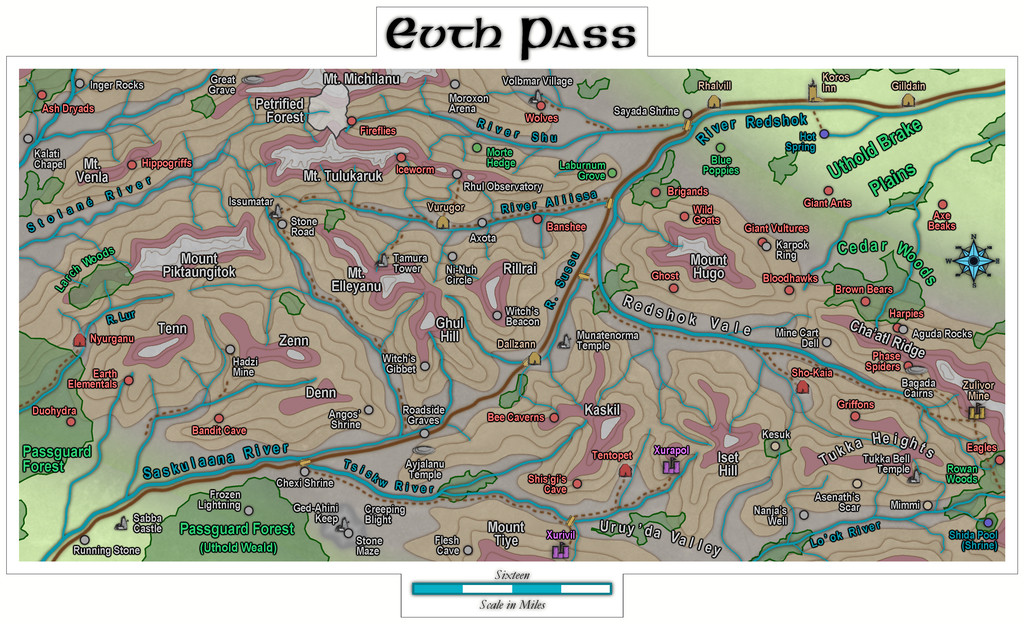
Quite a journey from those three rolled dice that began it all!
Next time, the deities of randomness seem to be dictating a return to Peredur, in its northeastern part, somewhere in the Godtagel area, apparently...
-
Community Atlas: Petroc Hills area, North Central Alarius
The basis behind the Inkwell Ideas setting that I wanted to reuse here was as a sort-of druidic experimental station, a series of caves magically enhanced to allow the growing of normal surface food crops underground, protected from conditions outside, and defended by a group of willingly-summoned elementals. This seemed very suitable for this area, with its short summers and long winters, and although not illustrated specifically on the map, the notes for the area indicate there are a lot of other small caves across the Petroc Hills, which might also be used in future, if the experiment here works. It's all being done in secret for now though, in case something goes wrong, hence the defences. I tweaked a few items, added one or two more, and decided, partly based on the general layout, that it had originally been one of the old Hill Dwarf mines of the district. It's often amazing how much just seems to come together from a couple of initial thoughts in this way. I even contemplated having it be set-up just for growing grain crops for a different flavour of whisky at one point, but decided against that eventually. If they can grow the food underground, that'll leave more field space for cereal crops to make whisky outdoors, after all!
As indicated earlier, I'd be opting for the Jon Roberts Dungeon style from Annual 54 for the mapping of the Caverns, and although I had to make use of a couple of DD3 symbols to round-out what was needed, most of what was required could be found, or repurposed, from that style alone. So to the map:
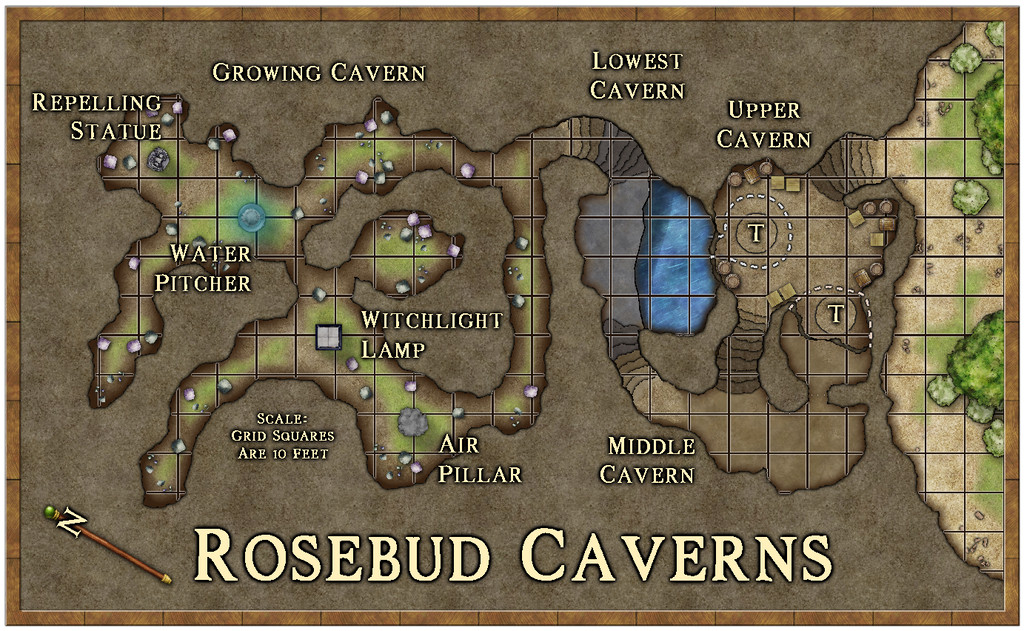
The earthy colouring worked to reinforce the whole "druidic growth" concept, and it's a style that works well in showing what's outside and inside, as having greenery, bushes and trees available. To keep the interior clear enough for GM use though, I decided against adding specific plants there, just some fungi (which are one key aspect of the Growing Cavern area), and also went with a quite strong scaling grid, as distances here can be important. I continued the grid over the water, because half of Lowest Cavern is underwater, and characters could well end up stuck there (the underwater areas including the annexe chamber beneath Upper Cavern - the dashed white lines show bits of the lower caves under Upper Cavern). Those circled "T's" in Upper Cavern are indeed rotating Dwarf-made round trapdoors, dropping down to the barred-cell cave off Middle Cavern, and into the plunge-pool off Lowest Cavern. In Growing Cavern, the four labelled statue-like features are the magical items that keep the place functioning, as explained in the map notes, and which again have vaguely elemental aspects to them.
Probably the biggest mapping challenge was constructing the steps, which did start to feel a little as if they were having to be carved from the native stone by hand for a while! Each has to be on a separate sheet to enable the effects on them to be adjusted to create the illusion of showing which are higher and lower, with the added pain of trying to hide the dark glow at the "back" edge of the top step. They're not perfect, but to my eye at least, they seem perfectly functional to show what they are on the map.
One further troublesome aspect was the abysmally slow redraw times when using the "Trace" command here, because the caves are all drawn as fractal polygons. For reasons I won't pretend to understand, the command insisted on repeatedly following the entire Caverns outline every time it was used, regardless of which way I'd told it to go, or how small an area I was trying to trace. There wasn't any choice though, as aside from needing different floor textures in places, I had to create masks to Color Key cut-out the unneeded segments of the grid, due to the way caves are drawn in this style. Worked in the end, but quick it ain't!
A useful feature of the Inkwell Delver dice set is that one of the six dice is designed to show entrances to the subterranean systems. So for the first time in this mapping project, rather than simply devising a suitable way in to the dungeon or caves separately, the first segment of this map - from the exterior through to that first long, straighter, northeast-southwest passageway in Growing Cavern - came directly from the dice design. We'll get the chance to see another of these entrances in action next time.
As for next time, a new continent beckons, the largest on Nibirum, Doriant, and a location somewhere in the Duin Elisyr region...

-
Community Atlas competition entry: The Summer Palace of the Winter Queen
Thanks Quenten! I started trying to analyse what the influences had been on this set, and while some were obvious enough, the more I thought it over, the more came to mind, mostly from folklore, mythology and fantasy fiction (which latter tends to rely heavily on both the former, of course). Plus as I said back when I started mapping "my" bit of Alarius a couple of years back, I've been working on parts of what was to go into that for decades, and the same is true here too, as essentially another part of the same thing.
Meanwhile, back to Palace 8, which is finally completed. This is it:
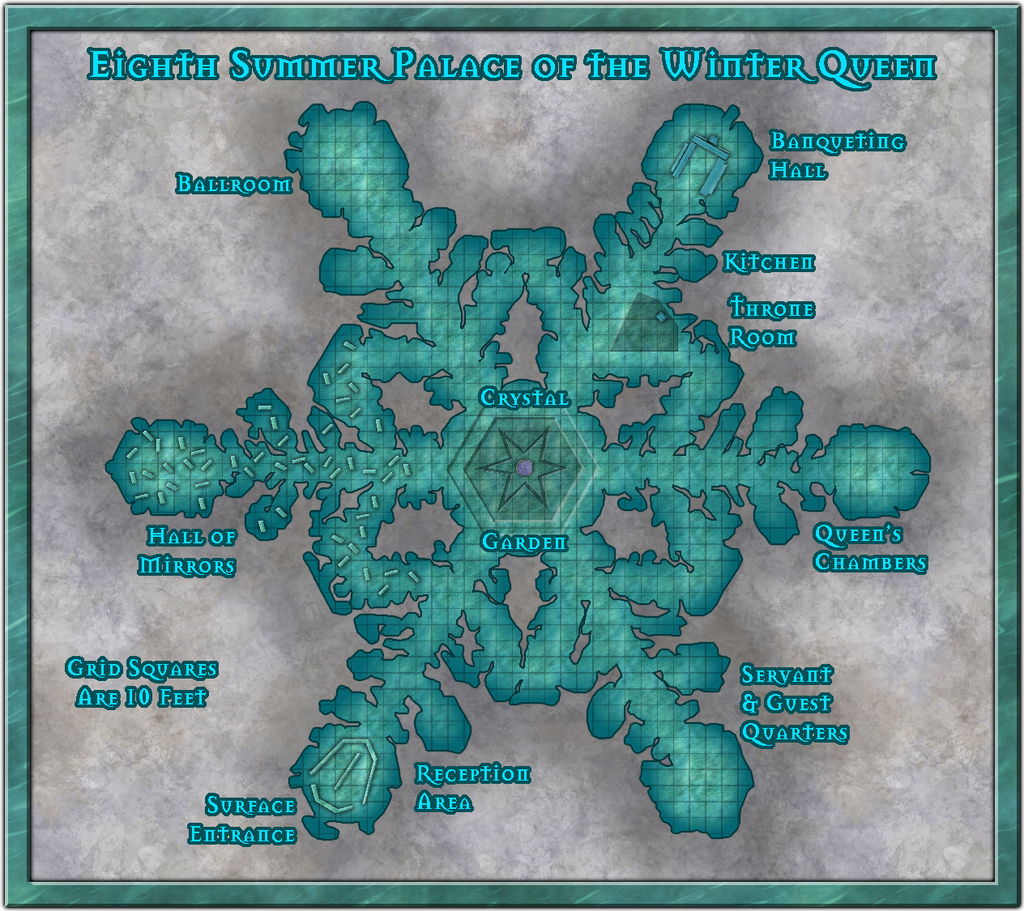
There have been a number of additions and amendments, mostly of a cosmetic nature, beyond the anticipated scattering of symbols and other internal additions, and the labelling, of course. The most substantial change was probably to reduce the overall size of the map somewhat, as the whole felt a little unbalanced at the top and base of the drawing once everything had been added. That was a bit fiddly, because there are always quite a number of entities to amend on the Map Border and Screen Sheets, as well as things like the Background Sheet, whose rectangle was also then too large.
I then had to change the fill for the frame. For all it might be thought a little incongruous as not having a very icy/snowy look, I rather liked the default wood-block pattern on the earlier version, and it looked a serious contender to remain, right up until the point where I adjusted the size of said frame. At which point, the lower border (only) suddenly had a dark horizontal line running right through it, because of the way the fill fits itself into drawings at the scale it had. And that quickly became A Distraction, so sadly it had to go.
The new fill for the frame is Water Green from this CA54 style, scaled-up to prevent it tiling, and holding up remarkably well in doing so, I thought. I was really just experimenting with it, but as soon as it dropped in with the light Bevel Effect, I knew it had to be The One!