
Wyvern
Wyvern
About
- Username
- Wyvern
- Joined
- Visits
- 3,267
- Last Active
- Roles
- Member
- Points
- 5,585
- Rank
- Cartographer
- Badges
- 24
Latest Images
-
Seeking map of Burgundy
Hi @Johann !
My recommendation would be to try to see the Barrington Atlas of the Greek and Roman World (Wikipedia link). This has details on the landscape and landforms in contour maps and text descriptions, with lists of identified places known to have existed in specific periods (including late antiquity, which is where c.450 CE would fall in their categorisation). Where this can be established, changes in landforms (coasts and river courses primarily) have been allowed-for, though I don't think the area of Germania Superior that you're interested in features in that too much, as little work has been done on things like the ancient river courses in this area, unfortunately.

-
Dungeon Designer 3 Light Tutorial?
I think the third video @roflo1 was meaning was this one by Remy Monsen (it's on Remy's YouTube channel, rather than the main ProFantasy one):


-
John Speed Victory
I think it's this one Sue? :CC2MODEPT:
[EDIT - Ooh, it worked! First time I've tried this on the Forum!]
-
Mushroom Symbols
If you can live with top-down view of mushrooms, there are plenty of options among the Dungeon Designer symbols for CC3+, and the add-ons for DD3 from various issues of the Cartographer's Annual. You should also check out the free downloadable Vintyri symbol collections as well.
If you want side-on views, that may be more difficult. However, Symbol Set 1 has a couple of options among its Handdrawn symbols, and there may be a few more elsewhere that I've not come across yet. You could also look at some of the styles with simpler tree drawings, and experiment with varicolor versions of those that look sufficiently mushroom-like. Might have to get creative though!


-
Coastline
I note how short this stretch of coastline is, presumably as a contrast against the Truly Evil and Impenetrable Coast around the rest of the continent, lost in the mists of the map here to lull the players into a false sense of security.
😉
-
How do I _actually_ edit a Scale Bar?
When you say "edit a Scale Bar" do you mean you need to change the number at the end of the bar from what you originally set when you placed the symbol, or do you want to make changes to various elements of the Scale Bar symbol itself beyond this?
I ask, because if you need to just change the number you typed in, if it was wrong, say, I think the only way to do that is erase the original symbol and add a new one, with the correct number for the length of Bar you need typed in.
If you want to make more changes to other elements of the Scale Bar symbol, you can go to Symbols -> Symbol Manager... from the drop-down menus, select the Scale Bar symbol from the illustrated list there (assumes you have already used the Scale Bar in your CC3+ drawing, however - if not, do that first!) and then use the Edit button. This asks you to draw a new window on-screen, and when you've done that, the symbol will appear in that and you can edit any part of it, just as you would with any other drawn element in CC3+. Depending on the style, there may be limits to what you can change (you can't edit the look of a bitmap fill style used in the symbol like this, as far as I know, for instance), but it should let you make some changes at least.
When you're done, click the little "X" box in the top right of the editing window, and you'll be asked if it's OK to keep the changes you made to the symbol. It also has the slightly disturbing note "This is NOT undoable", but this will only change that specific symbol in your current drawing if you save it this way, not in the main symbols catalogue for that style.
That will change the symbol(s) used in your current drawing to whatever your edited symbol looks like, and any fresh versions of the same symbol you use in it.
Hope this helps.


-
"Dimensional" Trees
Yes, it's possible to do this with quite a number of the top-down tree symbols, adjusting the sizes sometimes, and to slot in other symbols - such as houses (or use wooden docks as aerial walkways, for instance) - so they end up partly hidden because they're "partway" up the tree too. Worth seeing of the style you're using has any smaller bush and shrub symbols as well, as they can add extra interest. And if you want something unusual, try making any varicolor tree or shrub symbols much smaller than usual, and in bright colours, to look like flowers - perhaps like orchids, say - half-hidden among the greenery.

-
Canvas map development
I seem to vaguely recall we may have had this conversation previously, but the mountains look a little insubstantial right now, as if many of the arête limbs are only paper thin. I appreciate that wasn't necessarily what you were asking about right now, but it is what first occurred to me!
Zooming-in to the enlarged image, I agree with the notes made earlier, where it looks as if the canvas effect is more pronounced on the paler colours, and not at all (as far as I can tell) on the water. Oddly though, the effect is quite obvious on the tree symbols, which is a curiosity, given they're the darkest objects on the whole map. That could suggest it may be more an issue with the texture on some of the bitmap fills which is causing the canvas effect to disappear, rather than simply the darkness of the hues.
I'd agree that it would be useful to have the canvas effect as an option, rather than a fixed default.
Just to be contrary (well, not JUST...) I rather like the pale desert, but then I can see that would be interesting to use as a cloudscape texture (especially the way the mountain peak seems to be coming up through it), which I suspect may not be everyone's first choice as a setting.
☁️🏰☁️
-
WIP Inside a giant tree
Assuming the tunnels and caves have been burrowed into the tree, you might want to start with a blank sheet and draw the tree-rings onto that first (and maybe add the current outer bark layer as well, to fix the tree's size), so it doesn't look as if the rings have somehow retrospectively fitted themselves around what would have been nonexistent internal features when they were laid-down. (As drawn, the web and misty (?) caves would have been in the air outside the original tree when the rings were being laid-down, which would have been tricky at least, I'd suggest!)

-
more DD3 dungeon floor templates?
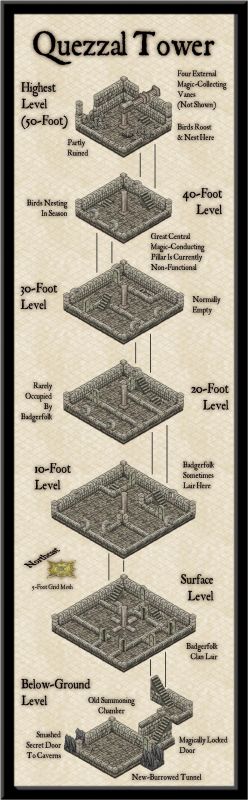
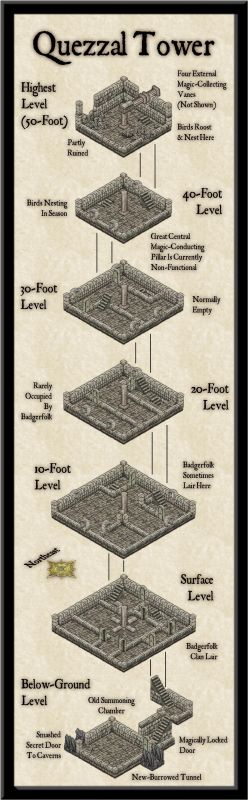
Looking over the various CC3+ fills available for dungeon/battlemap use (in the Bitmaps/Tiles/Dungeon folder of CC3+), it seems although there are a number of random stonework options including in DD3 already, as well as the Bogie and Dundjinni free collections, something like the cobblestone arcs isn't. There are a few options for adding patterned stonework floor textures (there's a herringbone brickwork option in DD3, for example), and rather more for using individual patterned tiles that can be fitted together in squares separately (think medieval cathedral floors), but I suspect the arcs make creating a seamless texture that will properly tile too difficult. Or at least, nobody seems to have done it till now. I could have missed something though, so please feel free to leap in to say so!