
Wyvern
Wyvern
About
- Username
- Wyvern
- Joined
- Visits
- 3,267
- Last Active
- Roles
- Member
- Points
- 5,585
- Rank
- Cartographer
- Badges
- 24
Latest Images
-
Real World Overlays
@roflo1 commented: "I was browsing the Annuals pages, and stumbled upon this:
https://www.profantasy.com/annual/2014/august14.html
I don't own that annual, but perhaps someone else can comment on it?"
This is the Annual issue 92 Quenten referred in his Oct 22 note above (only obvious if you can convert the month and year into a number correctly for the Annuals, however, so no blame attaches!).
The issue covers importing and converting real-world vector data from the free-access Natural Earth website (there's a link from the Aug 2014 Annual page) into CC3, and comes with a group of so-converted FCW sample maps of the world. It especially concentrates on converting the continent of South America into a standard CC3-look overland map as its worked example, albeit with just the coastline and rivers illustrated (you get three FCW maps showing the process). There are also files with the 1:10 million vector data that were used to create the various CC3 maps with the issue.
Can't really say much more, as although I've had it for some time, I've never used this particular issue of the Annual, and it could be a while before Ralf gets round to demonstrating it in his weekly YouTube live-streams, unfortunately, as last week's covered issue 15!
It does seem as if it should be possible to prepare the sort of map @serious77 was wanting using it though.


-
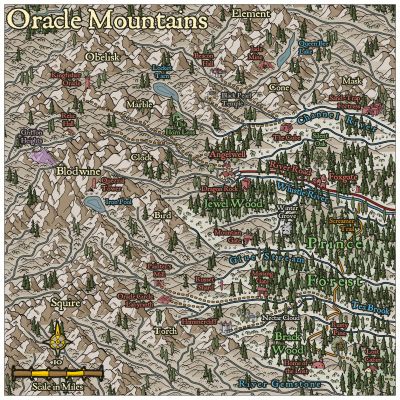
World of Myirandios - Mivlis-Gyaflaggio region (400 x 400 km)
Lot of detail there, certainly!
If this was going into the Atlas, I'd suggest a rethink on some of the labelling, as to my eye much of it's getting lost amongst the terrain in places (using the larger Gallery version to check this). Indeed, there are labels visible on that version that I didn't spot on the Forum one. Since it's for personal use, that's probably less of an issue though!
![[Deleted User]](https://secure.gravatar.com/avatar/c75d9a245b74d9c59be0999ea81ca541/?default=https%3A%2F%2Fvanillicon.com%2F92add7f8c954488718110edc4896ad39_200.png&rating=g&size=200)
-
WIP: Fane of the Swamp People...
Looking a lot better now!
Yes, I think the walls would work very nicely for ruins too.
If the stepped outer surface was full regulated, it would also work for buildings such as ancient Mesopotamian temples, which had deliberately constructed outside walls that had this kind of "vertical recesses" patterning all round them. I've had to draw these before, both by hand and on computer, and it can be pretty tedious for a larger building plan!

-
[WIP] Community Atlas - Eknapata Desert
Sometimes getting things to stand out more means just changing the colour or line thickness a little (or font size for text). An outer glow of some kind can help, but it can also make things look too misty, which I think it what's happening with some of the smaller text labels presently. I'm not sure that brown colouring on the labels is working well enough, and even the grey labels could be a little clearer.
The general textures seem fine, although the desert edge is maybe a bit too abrupt (very obvious where the green coloration alongside the river ends currently). That seems to be accentuated by the line of desert-edge dunes north of the river too. The more wavy edge of the dunes south of the river looks more natural to my eye at least.


-
Where can I find great resources for the creation of a subterranean world?
For the crystal city concept, it may depend exactly how you envisage it. For a large-area map such as the Dungeon Worlds Annual will let you create, you could perhaps repurpose some of the standard CC3+ overland map symbols, like glaciers or icebergs (though you may have to get creative about hiding what are intended as water lines for the latter!), and making use of the varicolor options to recolour other features - and also with CD3 house symbols, for instance, if you wanted to map the city itself, or parts of it, in more detail.
It's definitely worthwhile to take some time to look through all the symbol catalogues you have available, and make a note of any symbols that might work in such map creation, even if that's a long way from what the symbol was originally meant to be! As you can resize any symbol in CC3+, imagine too how it might look if a given symbol were larger or smaller, or a different colour (which you can set and see while you're browsing through each symbol catalogue that includes varicolor symbols).


-
CA style development - "Darklands City" (issues for September and December 2021)
Looks like Wyvern dropped off the end of the page.
Just as well Wyverns can fly 😎🐲

-
Sticky Note Dungeon
And now the Sticky Dungeon has been released into the wild, as the October 2024 Cartographer's Annual issue!
Many congratulations to C.C. for this fantastic achievement!
-
WIP: Mega-dungeon, Dorag Skel Level 1A
As you might tell from my frequent use of random options in my Community Atlas maps, I've been a long-time fan of such random design systems, for all they can need a bit of nudging sometimes to get things to work out OK. I've not used the 5E system as yet, though almost exactly 20 years ago (July-August 2001), I created a classic 12-level dungeon using the random system in the original (1979) AD&D DMs Guide, each level filling an A4 page of graph paper. All done by-hand then, however. I did make a start converting it to CC3 not long after I got the program, around 2014 or 2015, I think, but that was very slow going, as I hadn't the option then to scan the hand-drawn maps to trace in CC3.
Have to say that your map looks a lot more elegant and less cluttered than any of my old ones from that dungeon set, so the 5E system may be something I should experiment with in future, perhaps...

-
Install Order?
Can't really do more than reiterate what Sue's said already re you and your mother's ongoing situation, and to hope things settle for you very soon.
With CC3+, I think we all feel for you too. Even a short spell away, and I find I've forgotten something critical... If time and circumstances allow, it might be worth checking-in on one or two of the live PF mapping sessions on YouTube - or checking them later as VOD - as Ralf usually goes through all the basics of setting up a new map, as well as whatever the session's about, for instance, which might help get you back in the swing of things a bit quicker.

-
WIP Ruins of Charn
One alternative you might try would be not using the RGB Matrix effect, but setting up a simple rectangular polygon that covers all the map on its own, new, sheet, setting the polygon to have a solid red colour, and then adding a Transparency effect to that sheet. If you move the sheet to be below the text, but above the rest of the map sheets, that might work. You'll probably need to keep adjusting the Transparency, and probably also the colour of the polygon (likely somewhere in the reds and oranges range) to get to something you're happy with. Not guaranteed to work ideally, but it should give you more control over the final colour of your text, at least.