

Wyvern
Wyvern
About
- Username
- Wyvern
- Joined
- Visits
- 3,266
- Last Active
- Roles
- Member
- Points
- 5,584
- Rank
- Cartographer
- Badges
- 24
Latest Images
-
[WIP] Community Atlas: Snakeden Swamp, Lizard Isle, Alarius - Dedicated to JimP
With the location selected, I extracted details from both map versions, as shown by the following pair of images covering just that 20-mile area, now gridded-up into number-labelled one-mile squares. The red dots indicate which were to be randomly allocated some new feature or other. The red star is where the main 6R* map will be going eventually, more or less in the centre of the ruin symbol (as in my previous post, the SS1 map is again the lower of the pair):
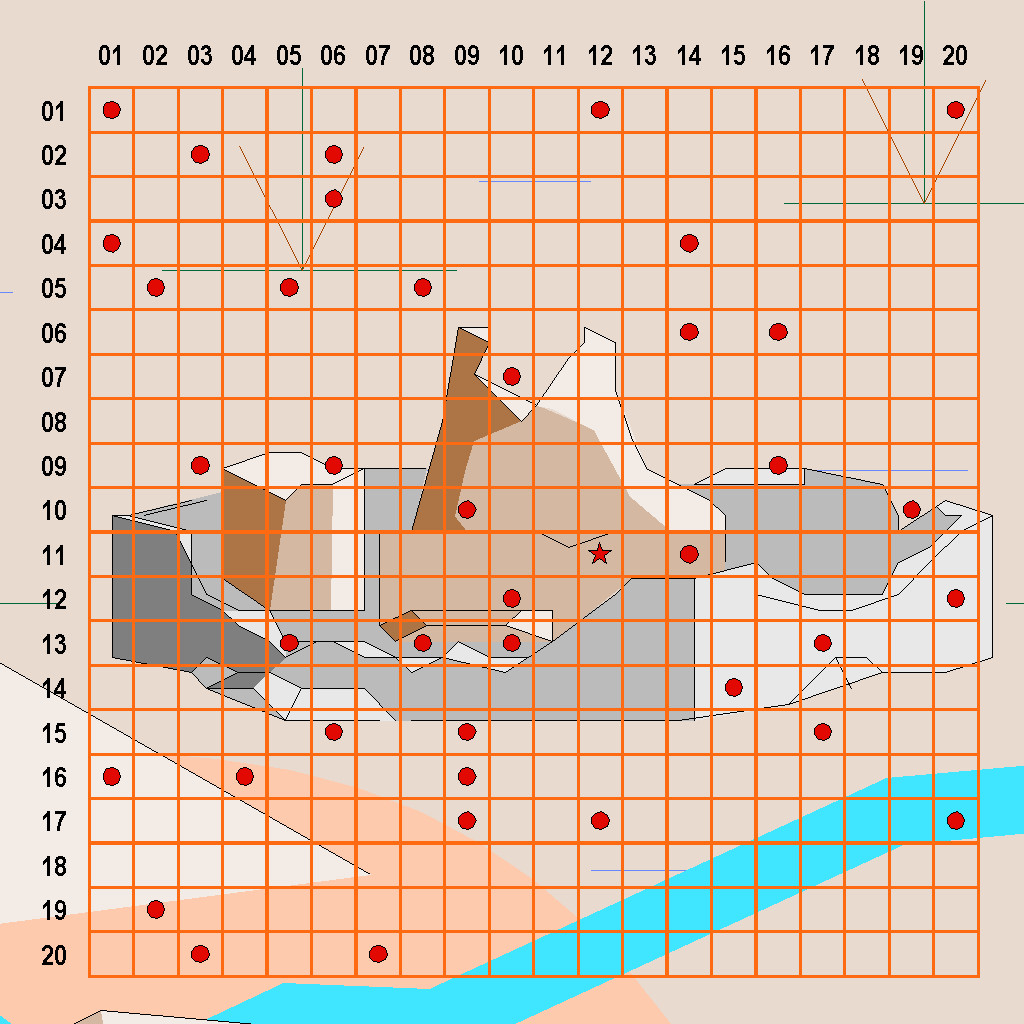
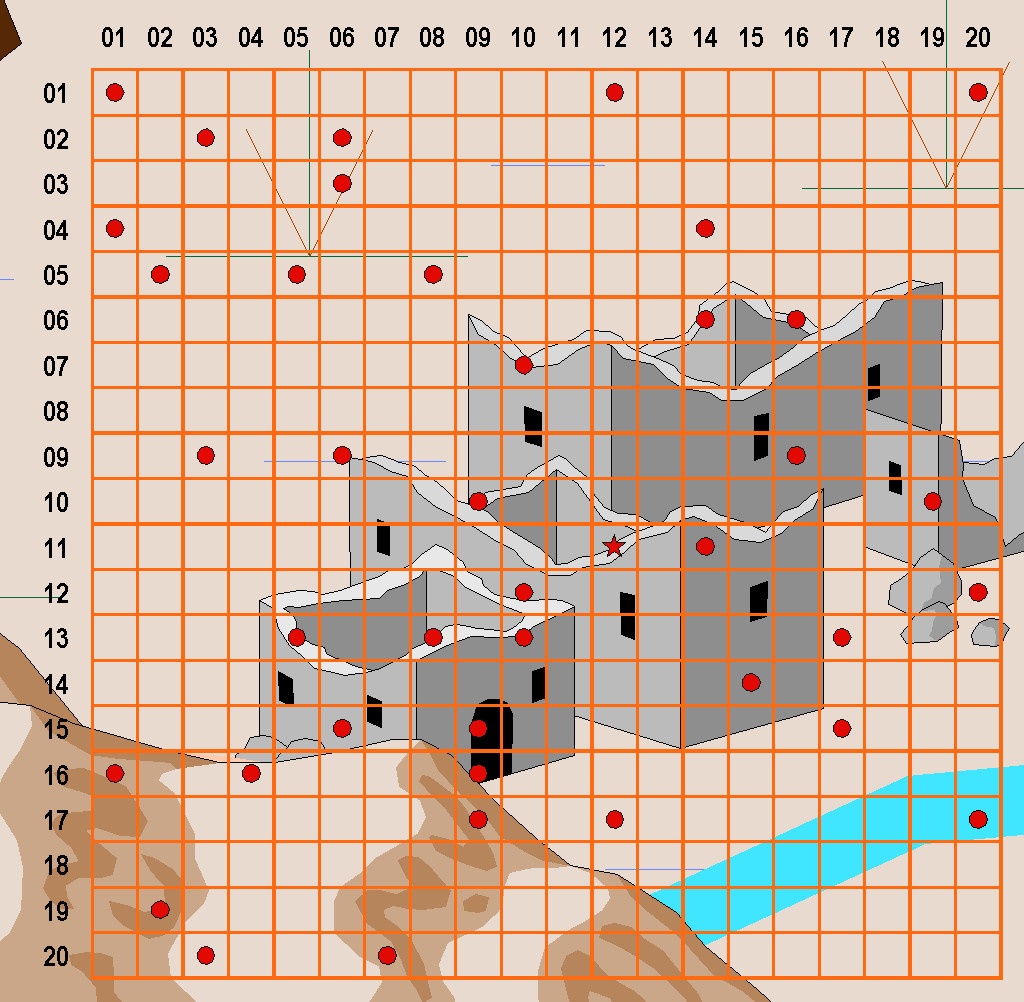
I prepared these two versions, as it wasn't always clear when zoomed-in this far where some of the pre-mapped features were, aside from the variation in shape and size of the ruin symbols in each. Much of the area is covered with swamplands, and as the location is at roughly 7°N latitude (the equator line is shown on both versions of the full island map), that means equatorial-tropical conditions. There are though hills to the southwest, and a major river to the southeast, plus of course that "huge" ruin.
From early on, I felt Lizardfolk would be the suitable main humanoids here, largely from the island's name and location, coupled with what some of the random-feature rolls had indicated. I was using a combination of items determined from tables in "Dread Thingonomicon" and "Dread Laironomicon" by Raging Swan Press, as also for the recent Artemisia maps, and some from Atelier Clandestin's "Sandbox Generator" and supplements, that I've used from time to time in this project before. Plus I'd also been thinking a lot about Lizardfolk more generally because of the set of Artemisia swampland maps, as they were the dominant humanoids there.
Oversized symbols are a fact of life with many fantasy mapping styles. There's often a general assumption that the actual feature illustrated will be located around the mid-point of that object on the map, and not be of the same apparent scale-size as shown by the map. Even so, it can be interesting to think beyond this sometimes. I did that with the weirdly gigantic barrows in Feralwood Forest elsewhere in Alarius earlier in this project, for instance. Here, the fact both symbols chosen for the ruins were town-sized, and not something smaller, set me thinking that scattered over a roughly 20-mile-square area, this might once have been the site of a city-state-sized realm, and so maybe there'd be other ruins besides the main "central" one I'd be mapping later, in other parts of the area occupied by the original symbol. Random-feature table options were then selected appropriately for that idea, as I came to think it would be interesting if outsiders might get the mistaken impression this had once been a gigantic settlement of some kind. The surrounding swamplands create an ideal means to mask that former reality here, if it was, of course.
With the preliminaries sorted, it was time to start mapping - next time!


-
Community Atlas: Embra - Watery Places
For anyone concerned the Watery Places maps have been quite simple, easy-going, places, let us now move on to the part of the Twilight Market among this group, Wave Crest Market:
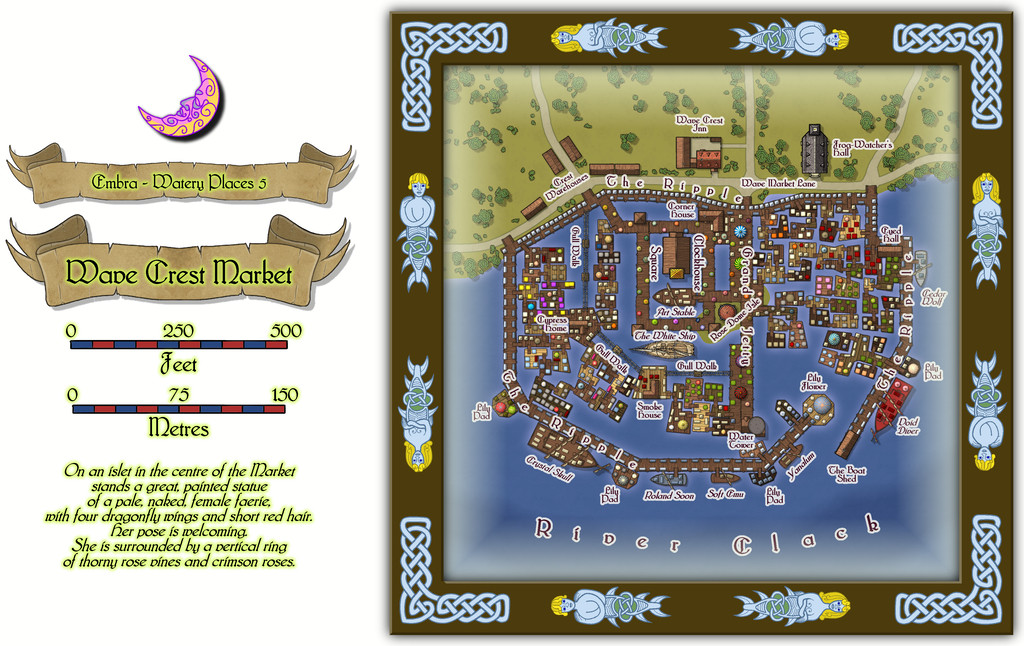
This gives the variable appearance of the River Clack another kick entirely, to the point where the far bank doesn't even make it onto the map at all! And while the shape may (correctly) suggest another, if much more substantial, castle map was at the base of this one, it's always interesting to see what can be done by using the shape, but converting the purpose to something quite different.
I always intended this part of the Twilight Market to be quite a complex mapping project, after seeing the original plan I'd be working to, though this one grew into a larger undertaking than I'd expected. Indeed it was one of the maps that took the greatest amount of time to complete, just setting-up all those floating platforms, market stalls/tents, and making sure there were walkway links to all the separate parts on the river.
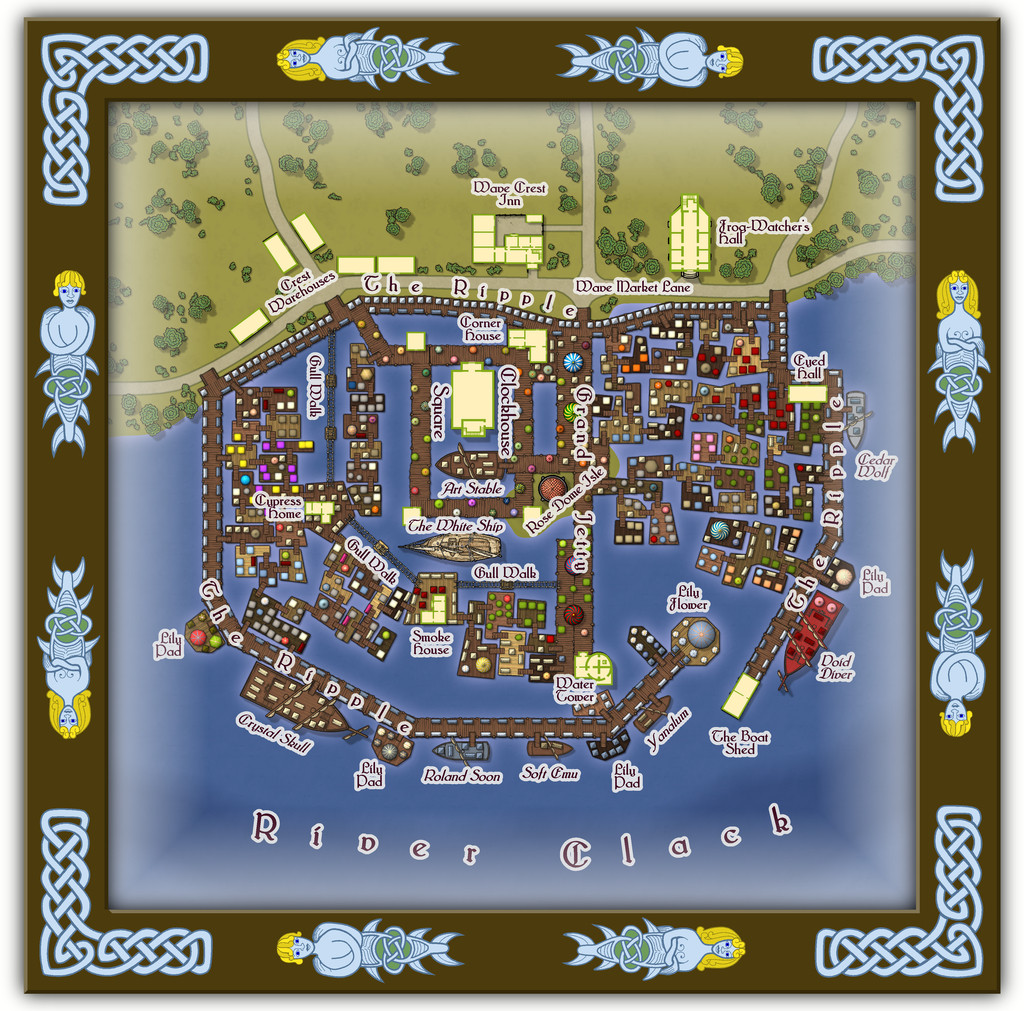
There are buildings here as well, and not simply on land:
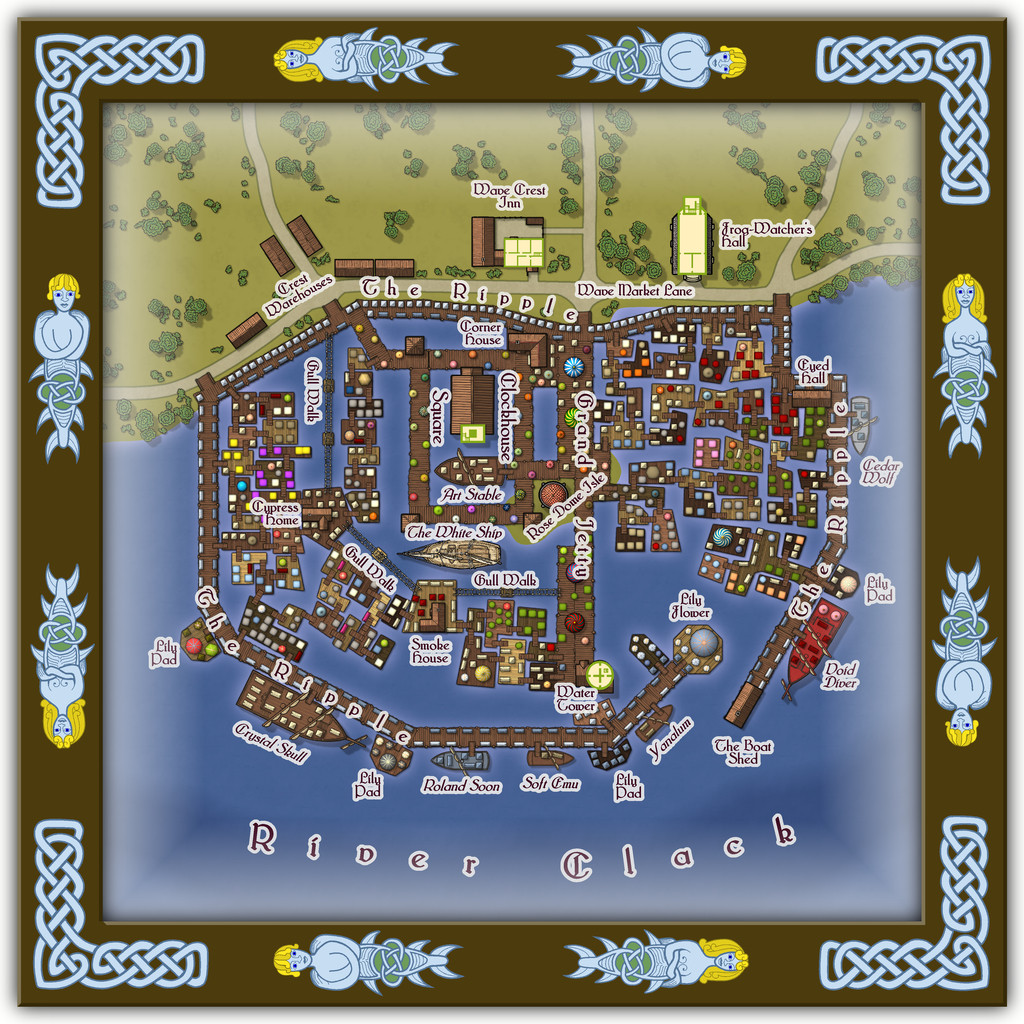
Some of which have a second storey:
One even has a further upper storey (close-up on the northeastern part of the map now):
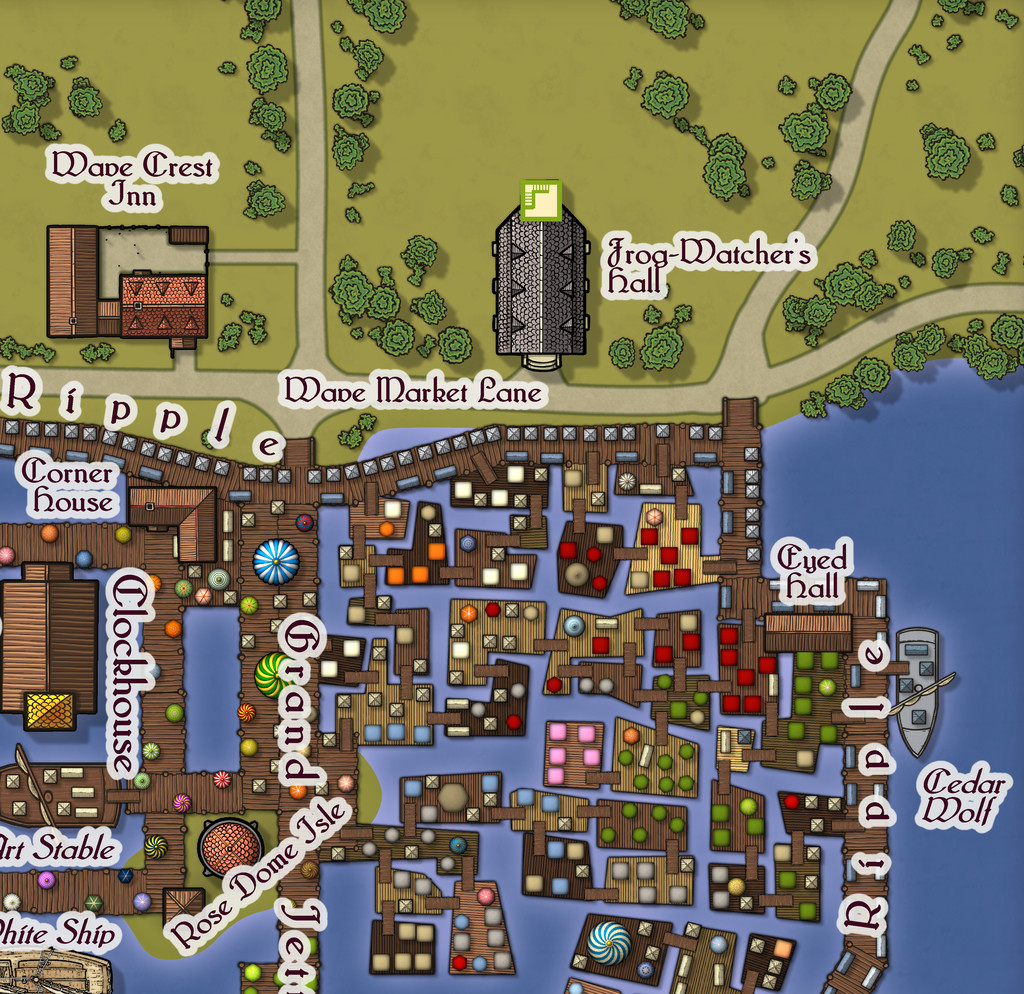
This latter image has the advantage of giving a better view too of how the floating platforms, gangways, ramps, tents and stalls have been applied, as well as showing the great dome on the little island in the Clack, covering the statue which is mentioned in the featured text for the Market. There's a detailed set of PDF and text-file notes to go with this map, as might be anticipated.

![[Deleted User]](https://secure.gravatar.com/avatar/c75d9a245b74d9c59be0999ea81ca541/?default=https%3A%2F%2Fvanillicon.com%2F92add7f8c954488718110edc4896ad39_200.png&rating=g&size=200)
-
How long have you been using Campaign Cartographer?
Monsen asked: Do you remember why you went for the DOS version at that time?
To paraphrase from "The Simpsons" TV show, obviously...
"C:/DOS
"C:/DOS/RUN
"RUN/DOS/RUN"
😁



-
[WIP] Community Atlas - River Watch - Druid villages
While these are fascinating explorations of different seasonal map depictions, are they really appropriate for a site around 25°N latitude on Nibirum? This puts the locations near the northern limit of the tropics for the planet (equivalent to the Tropic of Cancer on Earth). This would also mean the snowy mountains are a little too prevalent, I suspect.
Sorry if this is a bit late to be useful. I've not been paying as much attention to the Forum here recently as I might, so it's only just dawned on me.

-
Town Map for a Cthulhu Game
Not sure why you had to use Photoshop for any of this, as from the looks, the whole could have been achieved in CC3+ too. Appreciate that if you're more familiar with Photoshop, that could have been the reason though!
Regardless, nice-looking map. Not keen on the newcomer to town though...


-
Community Atlas 1000th map Competition - with Prizes [August/September]
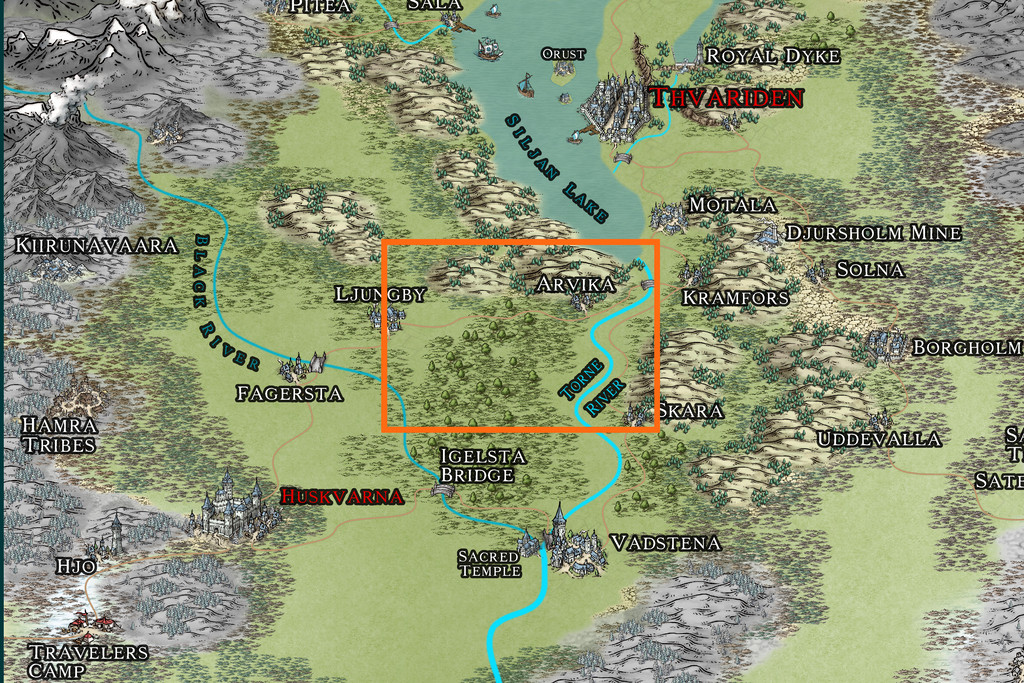
Having already reserved the orange-highlighted area below in Haddmark, Peredur to place the next small dungeon map in my ongoing mapping project this year, I'd already completed the map for it before the contest was announced.
While it's not been submitted for the Atlas yet (it will be later), this is the map I've prepared, called The Whispering Wastes:
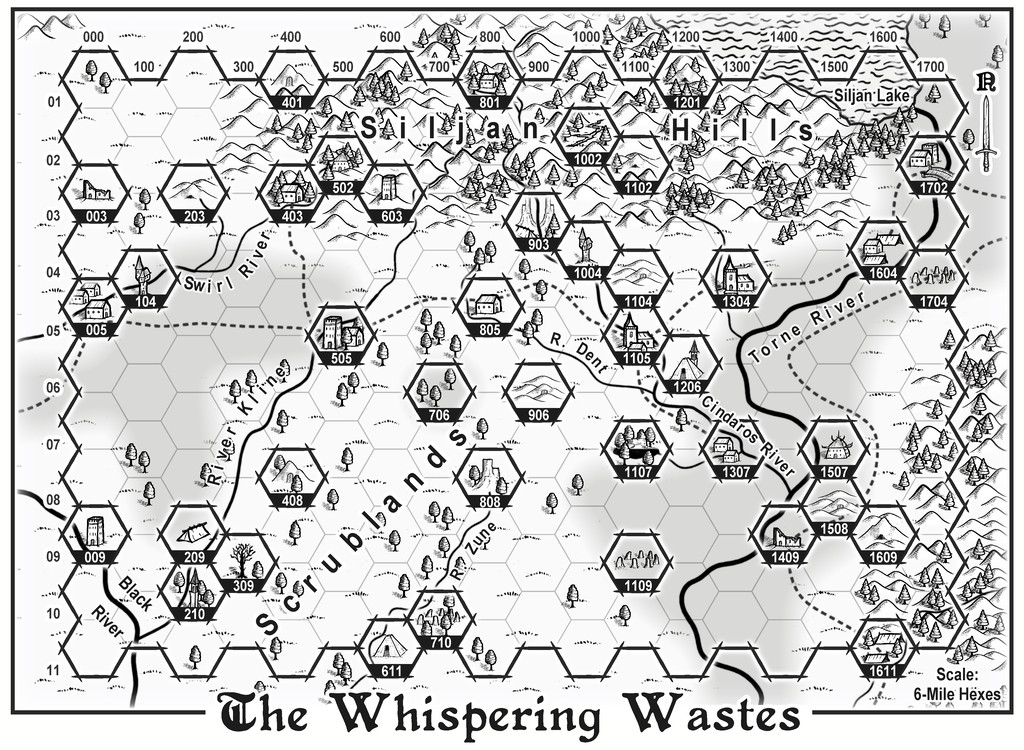
I've explored why it is as it is elsewhere on the Forum, including how I'd had the crazy notion at one point to prepare maps for all 41 features in the labelled hexes. I'd even worked-up details for most, including the ten small settlements. I'll not be doing all that. However, I have decided to try mapping the ten little settlements, although whether I'll finish them all by the end of September is another matter!
The list of settlements, and the theoretical order in which I'm hoping to map them, is as follows:
- Ljungby Village (Hex 005)
- Bruga's Hold (Logging Hamlet, Hex 403)
- Ivan's Keep (Defended Village, Hex 505)
- The Village of Toresk (Hex 805)
- Osalin (Necropolis Village, Hex 1105)
- Arvika (Bridge Hamlet, Hex 1304)
- Rularn (Isolated Hamlet, Hex 1307)
- Brightlawn (Watery Hamlet, Hex 1604)
- Fairbridge (Torne Crossing Village, Hex 1702)
- Skara (Farming & Logging Hamlet, Hex 1611)


-
Community Atlas: Embra - Watery Places
The first two Watery Places were drawn as smaller maps than usual, based on the reduced-size template designed for the Lawn Market map. This was because, as with Lawn Market, both base maps were generated from randomly-selected maps in the old Judges Guild "Temples Book I". As noted previously, this book used a much smaller scaling than the other old JG works I was drawing on for inspiration in creating the Embra maps. The first of the Watery Places then is the Bittersweet Basin Swimming Pool:
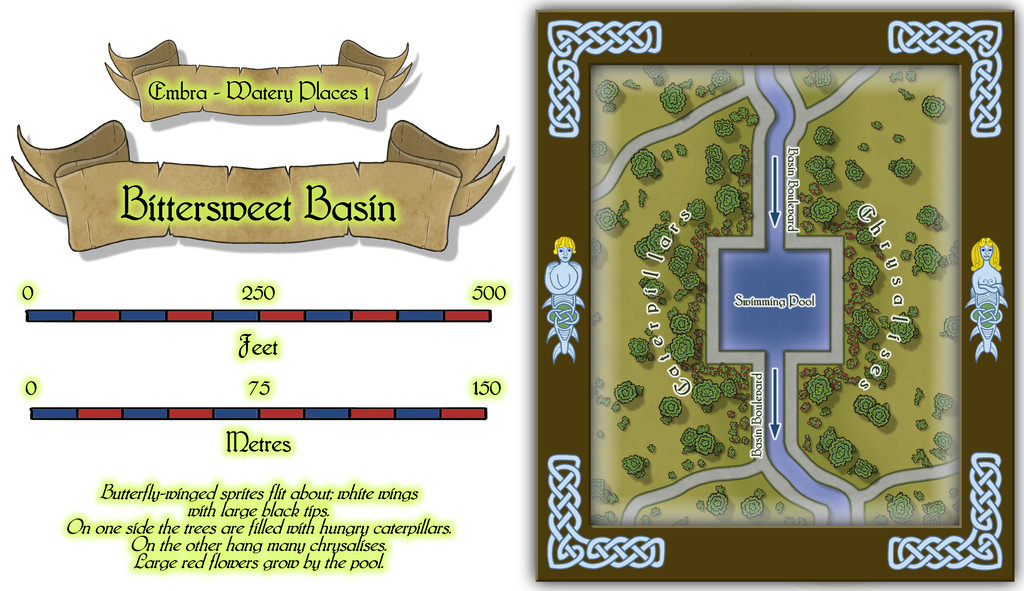
This is a remarkably simple area by comparison with many of the previous Embra Places maps, though of course variety is important in constructing an array of maps of this kind, to prevent things becoming too predictable. The featured text notes were used to add to the details shown here, without taking away any of their oddness. It's perhaps worth noting that as a mapper, it's equally important to have a few maps that are easier to produce like this, again helping avoid things becoming too stale and "samey". Especially as not all the Watery Places maps were going to be so "quick and easy"...
-
Community Atlas: Embra - Watery Places
Last among the Watery Places maps is one condensing the final five streets into one drawing, the second illustration below showing just the streets for a bit better clarity at the normal Forum resolution:
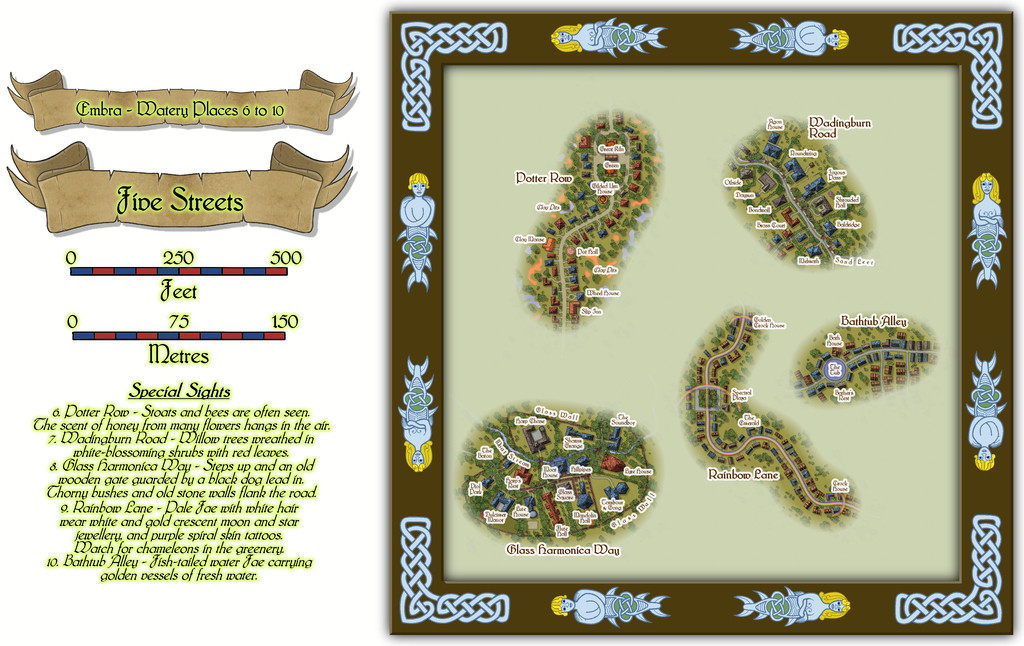
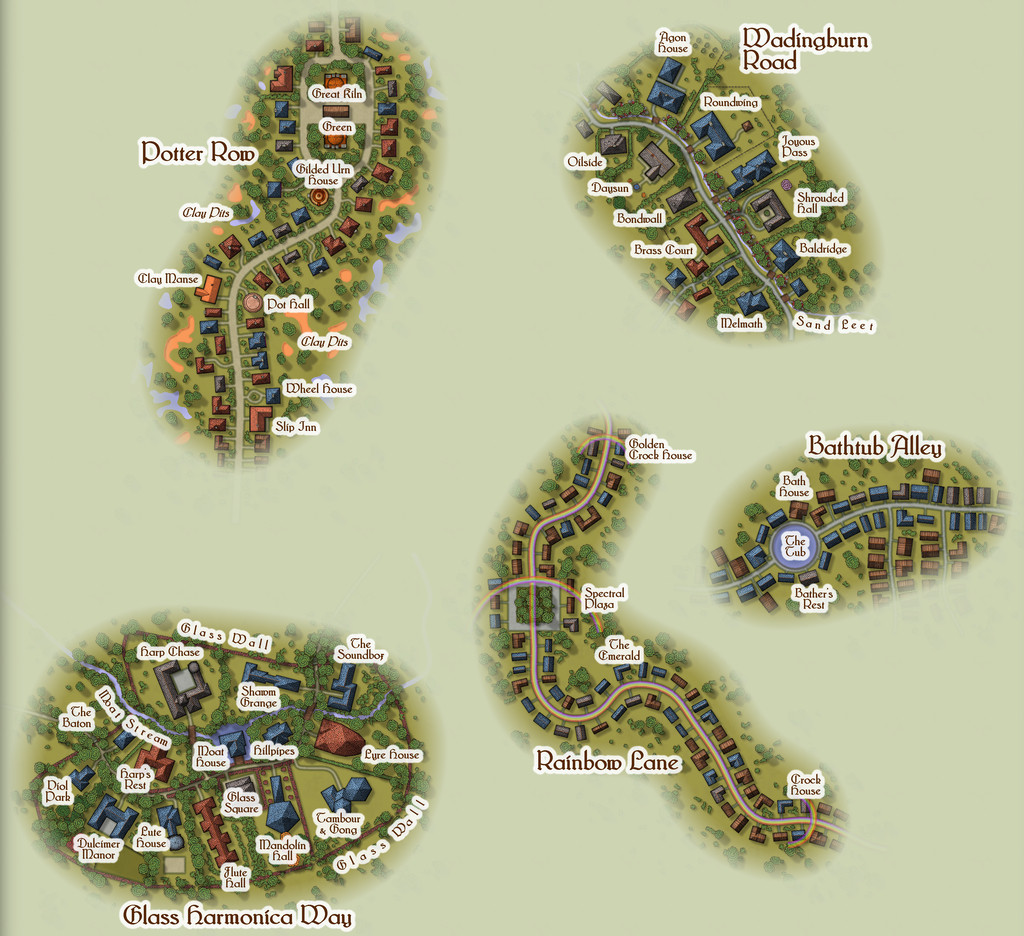
The roadways were constructed randomly, as described in the Enclosed Places Forum notes, with the final appearances and features determined sometimes by the street names, sometimes by other factors. Potter Row is of course where the great ceramic craftsfolk live and work, several in houses built of pottery - a couple even in the form of gigantic pots (this is Faerie, after all). The featured text for Wadingburn Road suggested a willow-lined stream, and fancier properties. Rainbow Lane had to have rainbows along it - even to the roadway itself - while Bathtub Alley cried out for a large pond or pool to be added for those water faeries to be in. And then we have Glass Harmonica Way...
I mentioned in the introductory Embra topic that music had been one of my primary influences on how a Faerie city should be presented, and maybe one of the most "faerie" real-world instruments should be the glass harmonica, as well as being one that requires extraordinary skill and ability to play. So having come up with the street name near the start of developing Embra, it was always clear this was going to be a community of musicians, instrument makers, composers, and the like. The random nature of my street design mechanism meant the available area was smaller than I might have preferred initially, though the whole point of using random systems is to work with whatever that may throw at you, and adapt accordingly. The featured text provided an interesting adjunct, suggesting this wasn't going to be an ordinary street at all, but one closer to a gated community in the real-world, and from that everything else simply flowed (appropriately for a Watery Place, perhaps!). The one downside to the final map is that because I wanted everything clearly labelled, the small area meant the labels ended up concealing quite a lot of the area's character. However, the toggle option in the FCW Atlas file to turn off the place-names means it is possible to get a better view of the whole:
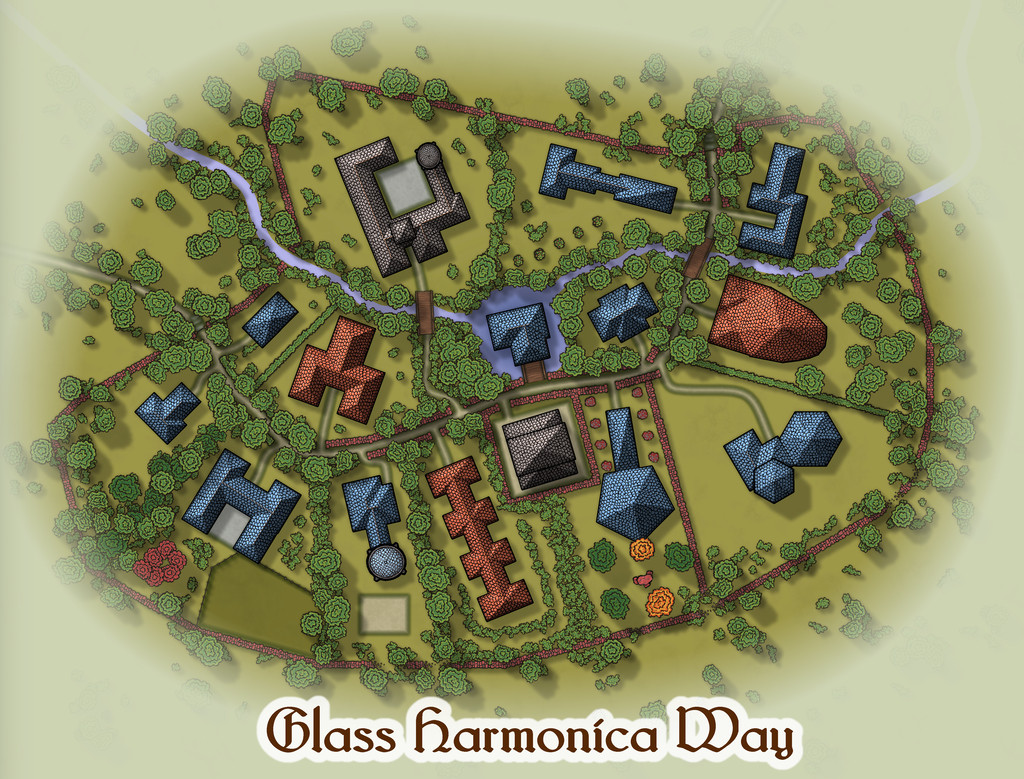
From which we can all again play "spot the red sandstone components" - and hopefully get a clearer impression of the final layout. And yes, the street was originally populated with random CD3 houses, which then got moved, adapted, redrawn and converted to their final shapes here.
-
Community Atlas: Embra - Travelling Places
Moving on swiftly from the dubious delights of Toll Cross brings us to the cheerier Travelling Places segment of the Twilight Market, Market Row:
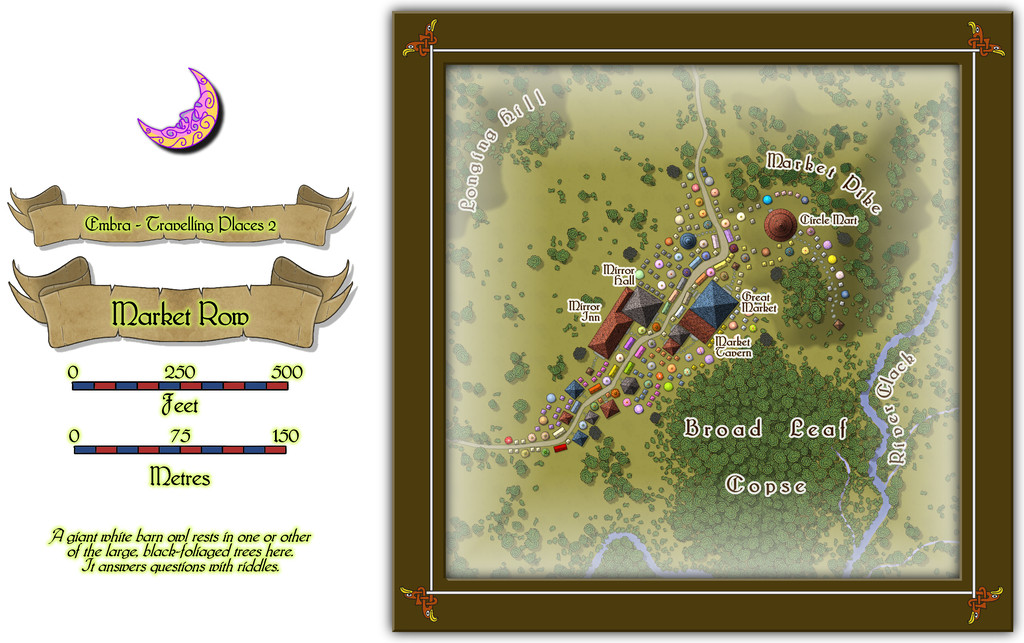
A colourful scatter of tents, wagons and stalls spills along and beyond the road here, and there's even a group of buildings, since for once, there is a more fixed settlement alongside the Market (or perhaps it grew up because the Market was here). Though the footprint of several buildings is large, particularly when contrasted against the much smaller market stalls, I opted to make them all merely single-storey structures, so the Market didn't get lost among the houses. Only the buildings have been provided with internal floorplans, which also helps clarify which they are, of course:
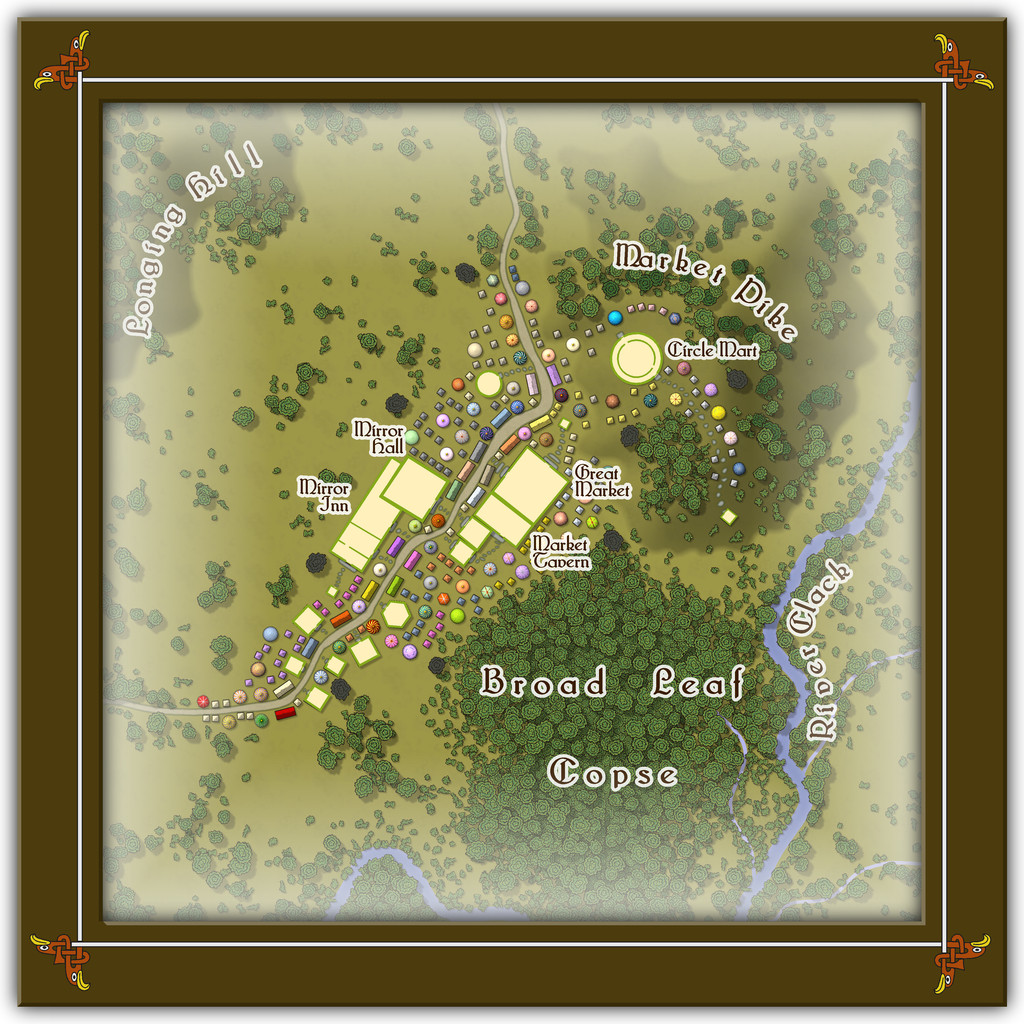
The individual darker trees are to match with the featured text notes, and I think something of the strangeness of Toll Cross lingered with me, as I decided not to name the open land between the two "Mirror" properties and the foot of Longing Hill, which the Market also seems to avoid, and simply kept it as an empty place the locals become evasive about if anyone asks. Quite why I've left for GMs to determine, however...
-
Community Atlas 500th Map Voting Thread - Please vote
I second Sue's comments; this was an extremely difficult vote, as there are just so many fascinating maps produced in such different styles.
Hopefully, everyone contributing enjoyed their mapping, and perhaps learnt something fresh along the way.
It's certainly been a delight reviewing them all again now!
Get voting folks!