

Royal Scribe
Royal Scribe
About
- Username
- Royal Scribe
- Joined
- Visits
- 9,946
- Last Active
- Roles
- Member
- Points
- 3,480
- Birthday
- February 5, 1968
- Location
- San Francisco, California
- Website
- https://legacy.drivethrurpg.com/browse/pub/31814/Royal-Scribe-Imaginarium
- Real Name
- Kevin
- Rank
- Mapmaker
- Badges
- 16
Latest Images
Reactions
-
[WIP] Villa Citri (Roman-style villa)
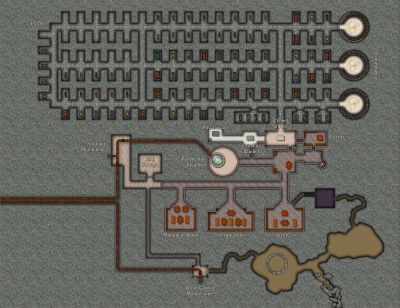
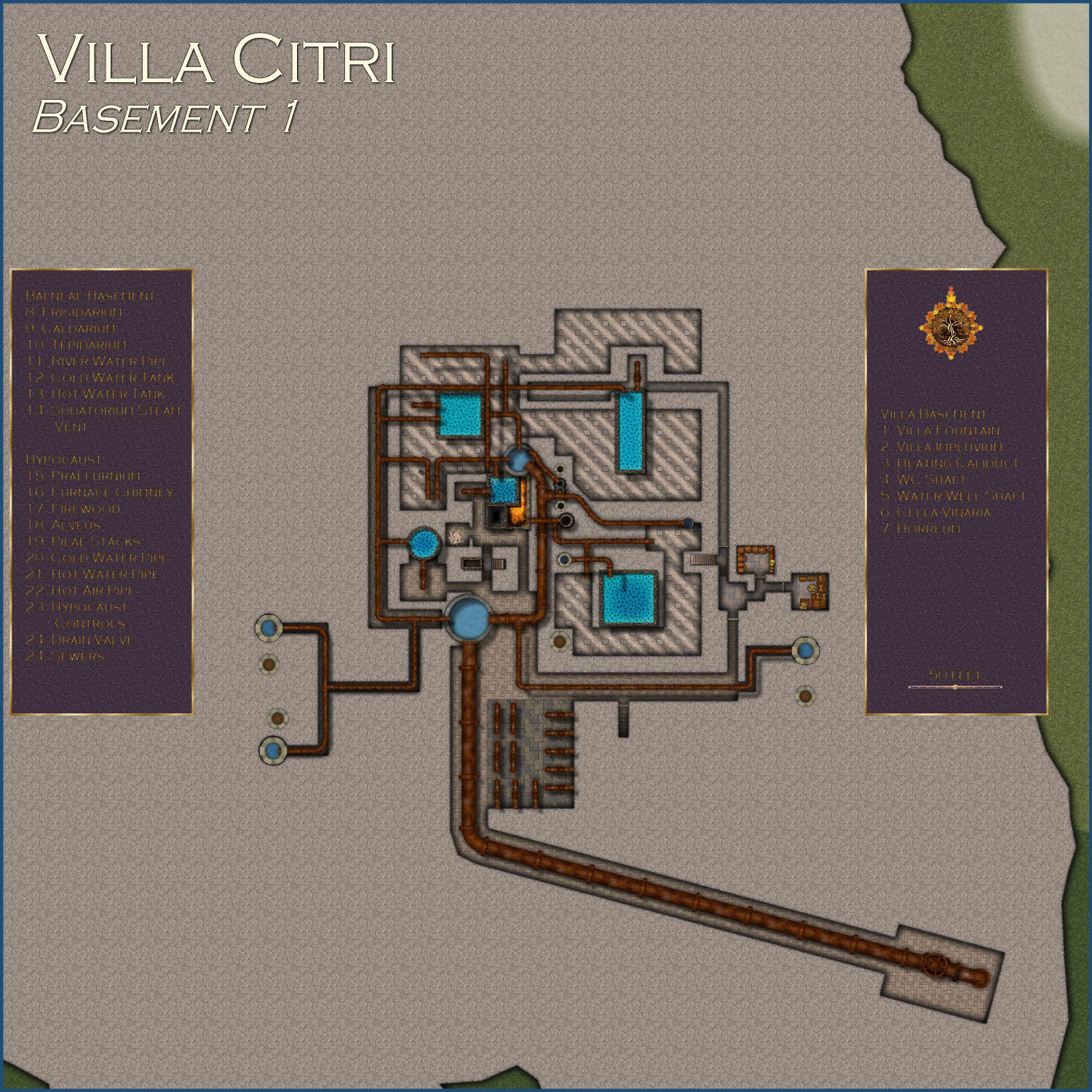
I finished the basement with the hypocaust. This level required extensive plotting to make sure the pipes went to the right places.
First, here it is unlabeled so you can actually see everything, because there are a lot of labels. Note that the pools are supposed to be elevated (hence the drop shadows on them), as this is the lower portion of the pools where water is piped in and drained out.
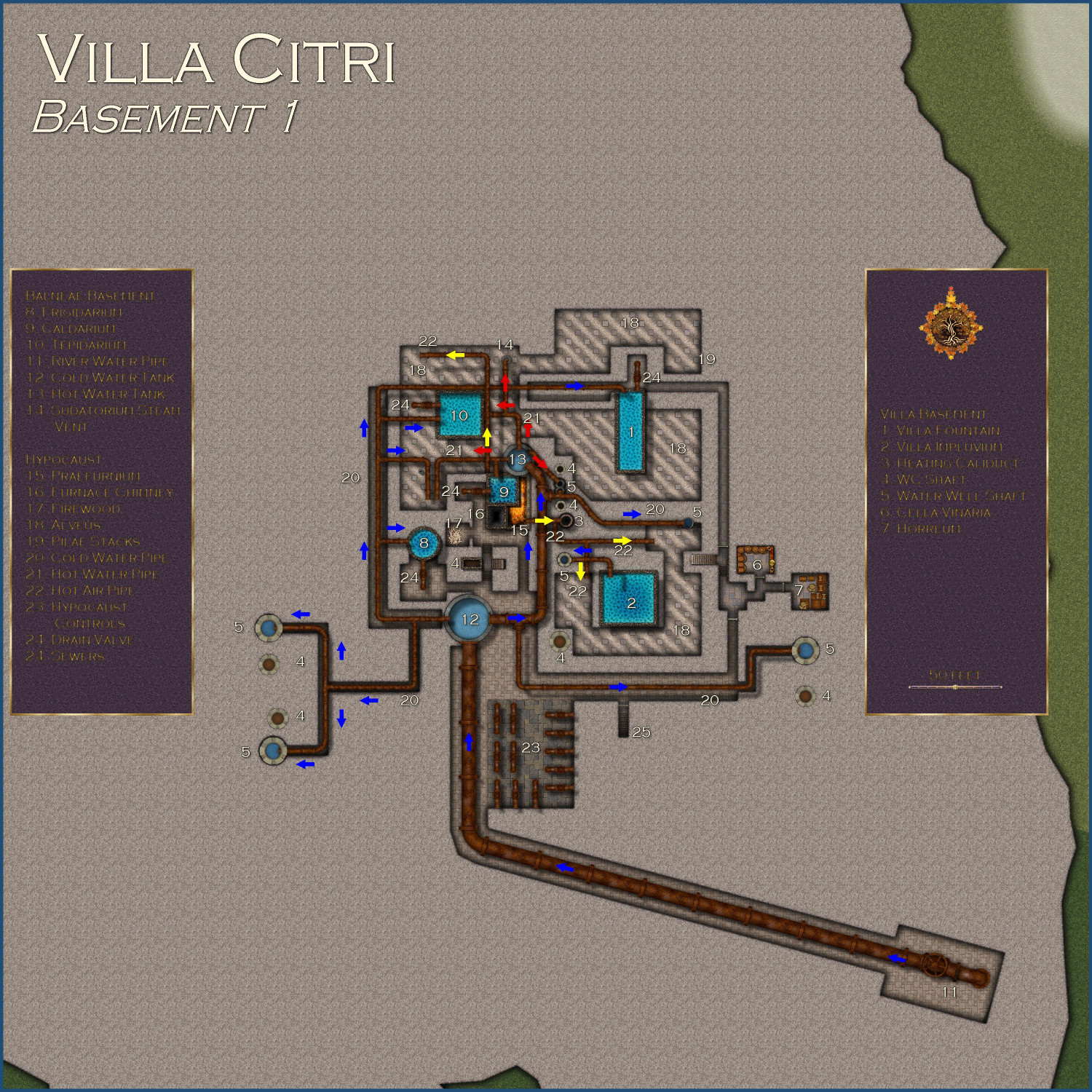
And here it is labeled. The labels include arrows indicating flow: blue for cold water, red for hot water, and yellow for warm air. The labels and the arrows are on separate layers to allow them to be independently hidden or revealed.
A giant furnace (called a Praefurnium) is used to heat water and air. Here it is covered, and then uncovered.
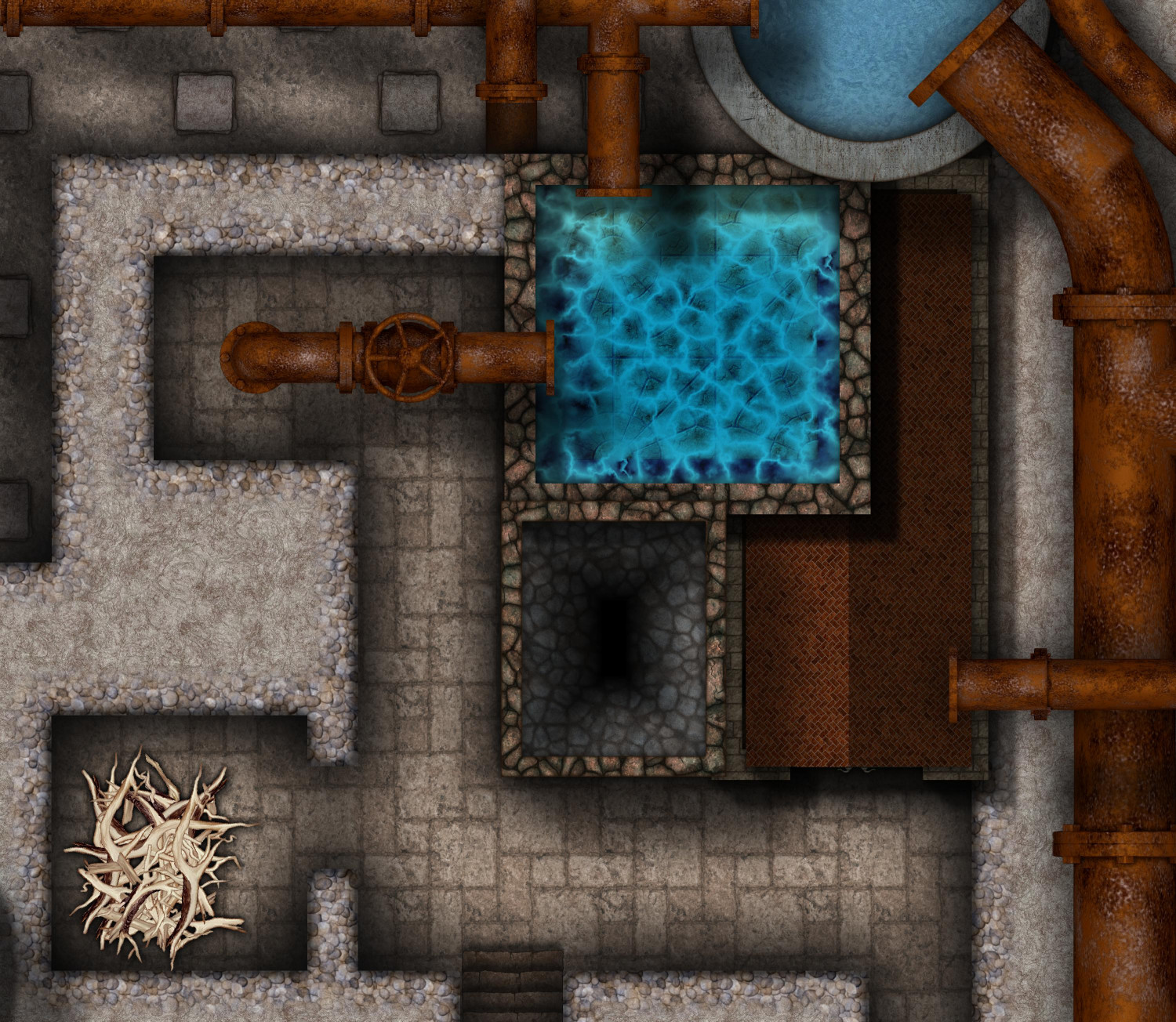
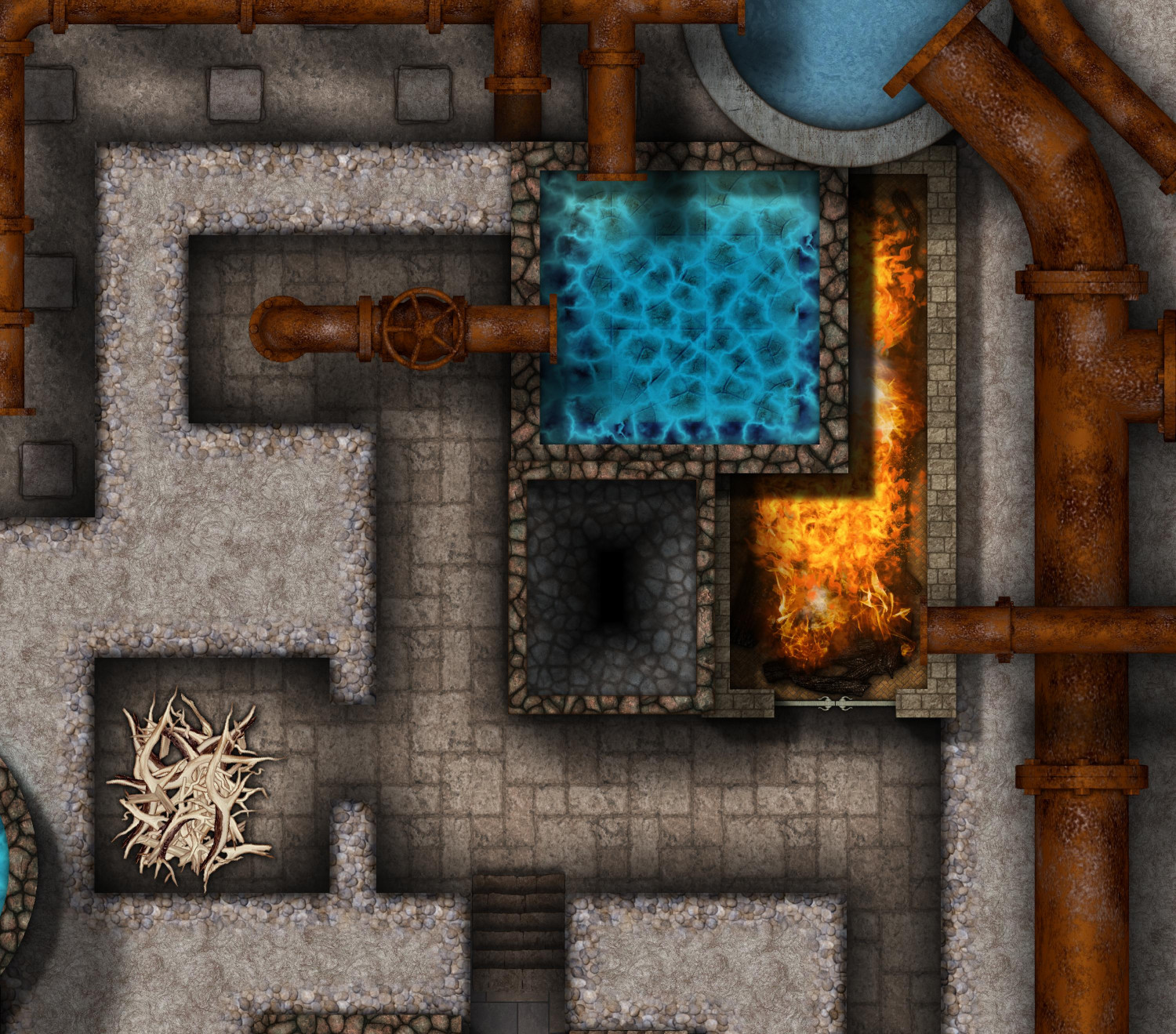
The hypocaust itself is basically a series of chambers through which hot air can flow, warming the floors for the level above, with vents that can bring warm air up to the upper stories of multistory buildings. These chambers are called Alveus. Within these chambers are stacked tiles made into pillars, called Pilae or Pilae Stacks, used to support the roof of the hypocaust as well as to conduct heat to the floors above. (This screengrab also illustrates the technique I used for the subterranean walls, using the cutout effects that Sue developed for Creepy Crypts, but using the stone and pebble fills she developed for Marine Dungeons.)
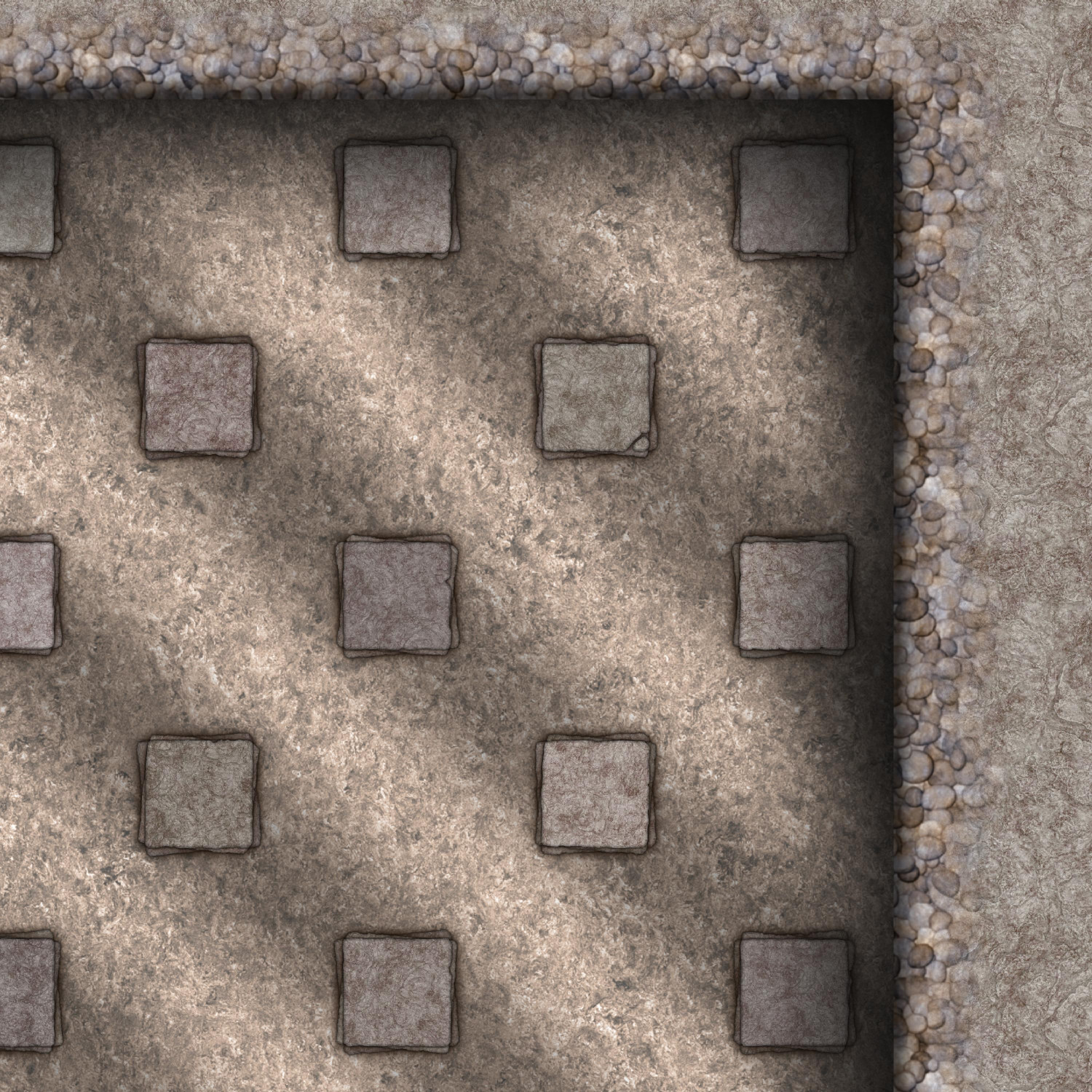
The Pilae Stacks have a wall shadow on them, but I guess it would make more sense to use an outer glow instead since they're underground.
When I was about 10 or 11, I first read about hypocausts from Mary Stewart's The Crystal Cave, the first in her Merlin-focused Arthurian novels. Young Merlin used the abandoned hypocaust on his family's estate as a hideout, inadvertently eavesdropping on adult conversations in the process. I'm delighted to finally be able to design one.


-
Tell me all about your DnD campaigns!
@KertDawg I haven’t really given it thought. I’ve never played with people where I wasn’t already friends with at least most of them in real life. Maybe! I will see how much time this Pathfinder game takes first.
-
Tell me all about your DnD campaigns!
I have played D&D off and on since around 1980, but the last longer campaign I was in ended around 2009 or so. Some time around 2016, I decided to start building my campaign world in preparation for getting a new group together. I spent some time researching mapping software before settling on Campaign Cartographer. In the years between buying the software and finally learning how to use it, I was writing up a lot of the lore for my campaign world, first in MS Word before finding a few Wiki plugin for my WordPress website. Lots done in the Religion section, along with some in History and Geoscience.
Still haven't actually DM'd in this world yet. Another group of friends who I had never played with invited me to join a campaign they were launching. We had a few sessions before COVID hit, and then tried one remote session on Discord that was a complete disaster, and everything fell apart. So I got back into my own worldbuilding (which can be a fun activity in its own right), and then started getting into map-making. I admit that Campaign Cartographer has taken over my hobby time and I've neglected the world-building.
Meanwhile, the old group that I played with in the early 2000s is getting back together. One friend who was part of that group, and whom I've played with off and on since 1989, moved back from New York and decided to DM a Pathfinder campaign for us. So my world is still off on its own as I dive into his world...but my Wiki still exists. And so I present to you: the World of Adnati.
-
[WIP] Villa Citri (Roman-style villa)
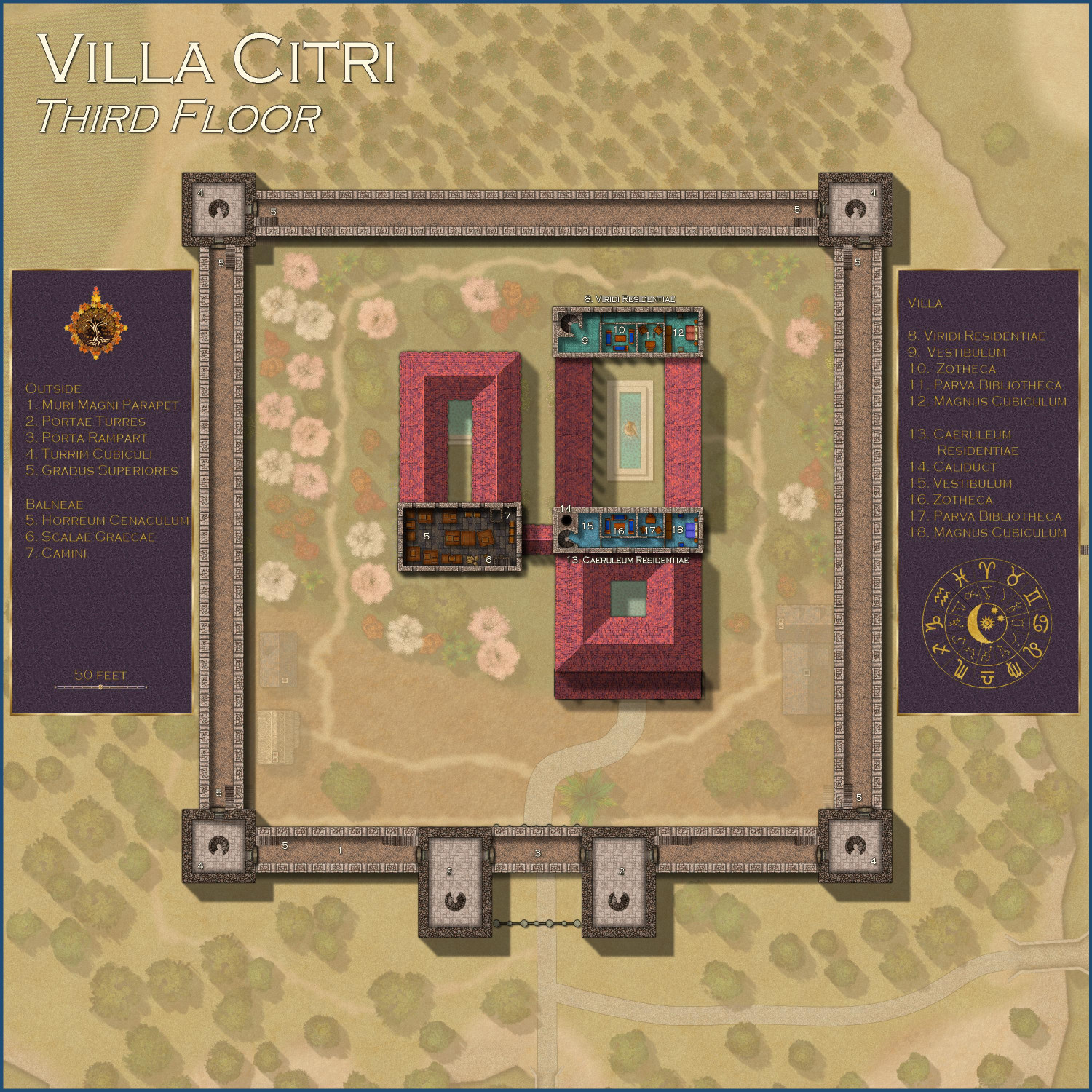
Here's the third floor.
The outer walls here are accessed through the spiral staircases in the gatehouse towers and the corner towers. From there, arched doorways secured with metal doors provide access to the parapets of the outer walls. Stairs on these parapets lead to the top of the towers.
The main villa has two disconnected suites on this floor, nicknamed the Green Apartments and the Blue Apartments because of the color of the tiles. Each is accessed by separate spiral staircases from the second floor. Each has an outer reception room, a private dining/lounge area, an office, and a relatively spacious bedrooms. In previous generations, the Lord and Lady of the manor had separate suites. It is currently occupied by the Dowager Countess of (I forget), who resides in the Caeruleum Residentiae (the blue suite), as it is heated by the hypocaust's flue and the other apartment is not. The other suite is the guest quarters for her son, the current Earl of (I forget) when he visits.
The upper floor is the bathhouse is currently used for storage.




-
[WIP] Villa Citri (Roman-style villa)
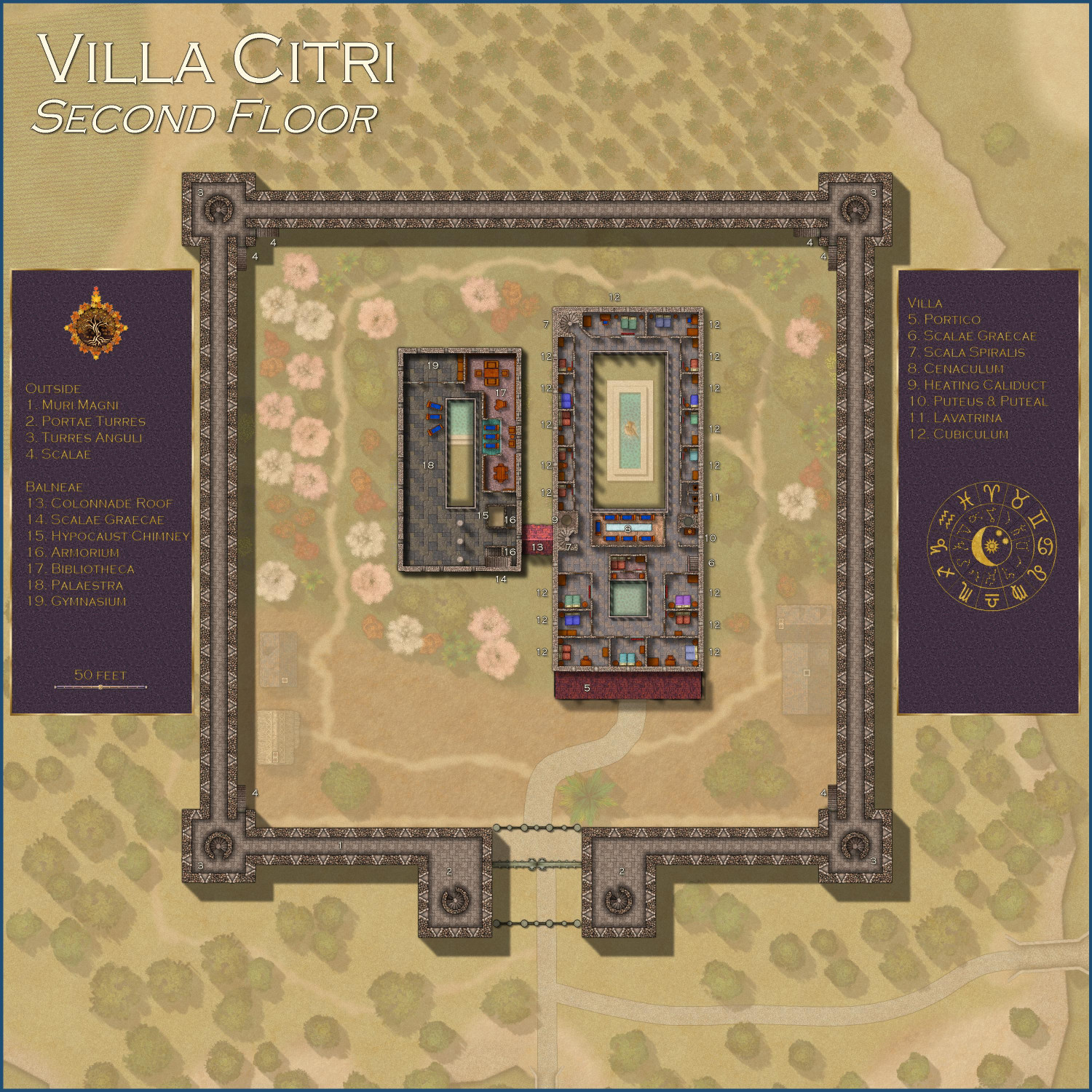
Okay, here's the second floor again with the courtyards with the same parchment mask as the rest of the outside. There's actually just one mask over the entire thing, but I punched a hole in it with the color key cutout effect. I guess I was thinking "inside v. outside" instead of "this floor v. lower floors." The magenta polygon is now on a COURTYARD layer, so it can be turned on or off depending on which approach is preferred.