
Monsen
Monsen
About
- Username
- Monsen
- Joined
- Visits
- 723
- Last Active
- Roles
- Administrator
- Points
- 9,029
- Birthday
- May 14, 1976
- Location
- Bergen, Norway
- Website
- https://atlas.monsen.cc
- Real Name
- Remy Monsen
- Rank
- Cartographer
- Badges
- 27
Latest Images
-
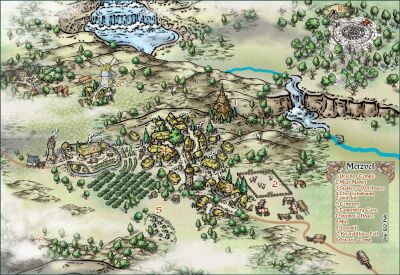
WIP: The World of Elric, Classic Fantasy Style
The article is found in annual 129 - Large exports.
Not sure about the line in the compass. almost look like a miter line, caused by sharp turns between two nodes, maybe some overflow happens with the calculation at that export resolution?

-
How to Zoom to a specific %
You can't zoom to a specific % because that concept doesn't really exist in CC3+. CC3+ is CAD software, and the content is always rendered to whatever size you select, there isn't a "full", "print" or "actual" size.
With an image editor, zooming to 100% makes sense, because that means that each pixel in your image is being showed as the same size as a pixel on your screen, but CC3+ maps aren't expressed in pixels.
For print size, that really depends on what scale and paper size you want to print at. As with showing on screen, print isn't a fixed size, CC3+ renders the output to match your print settings.
Considering your screen is likely to be much larger than a sheet of paper (unless you are working on a laptop screen), zooming to show the same content that will be on your paper wouldn't really give a perfect view of how it looks on paper anyway, since the paper is so much smaller.



-
What is Steampunk...
I think I like contraptions to be plausible, which is a definite drawback in this case.
That's a drawback whenever you deal with fantasy. In classic fantasy, one has to suspend disbelief a bit in the face of magic, which can do stuff not normally possible. In steampunk, one kind of have to accept the same of their steam technology. It's basically their "magic". I guess it is quite similar as to how utterly unbelievable our modern world would be to a renaissance person (It's just that our version turned out to be possible under the laws of physics)
Interesting that Lego actually got involved.
It's not that lego got involved (AFAIK), it's just peoples tendency to build everything out of lego. Lego is a great outlet for creativity, you don't need the lego company to make a set for you to be able to make nice things. These days, you can even build lego online on their website, making designs without owning a single brick.
-
What is Steampunk...
I think it is important to realize Steampunk is fantasy though. And with that I mean, they do fantastic things with the steam that isn't possible at all under real world physics. In many cases, you see them approaching semi-modern concepts (while still being in the Victorian age) but using steam instead of electricity and more practical fuels. So when drawing steampunk, it isn't "will this be possible using steam", but more "does this seem cool and somewhat plausible if we ignore actual physics?" all the way to "this doesn't seem plausible at all, but it is damn cool".
Many steampunk settings uses things like automatons, which are large steam-powered robots, both "human-like" and "this-is-a-big-machine" like. Sometimes intelligent, self-operating, in other settings controlled by an operator.
I like the city-building computer game Frostpunk for it's visuals. It' is basically Steampunk in the cold (concept art) (automatons)
Another interesting omputer game that takes the concept pretty far and some more, is Sunless Skies. Here you pilot a flying locomotive through the void between the remains of a broken world floating as islands in the void. Even the sun itself is an artificial steam-powered contraption.
For overland maps, I think the difference lies much in the symbology used. Steampunk likes to say, "Hey, here I am!". A typical steampunk map would be something in between a modern map and a fantasy map, and would use symbols and map decorations with a steampunk flair. Symbols would look more like the fantasy symbols, i.e. drawn from an isometric view, not the minimalist top-down symbols on modern maps. Instead of a caravan representing a trade route, you would see a train symbol, you may have dirigibles instead of ships, the city symbols would probably have some smoke stacks and visible pipework in the artwork, and so on.



-
Converting B&W to Colour Map
Are you using "change like draw tool" when converting those entities? If you just use change properties and change the fill, you won't get that automatically, but if you use the change like draw tool command instead (found by right clicking change properties) it sets up things correctly.
As an alternative, you can also set up an outer glow using effects, that can often give a neater result (but not the exact same though)