
Wyvern
Wyvern
About
- Username
- Wyvern
- Joined
- Visits
- 3,237
- Last Active
- Roles
- Member
- Points
- 5,515
- Rank
- Cartographer
- Badges
- 24
Latest Images
-
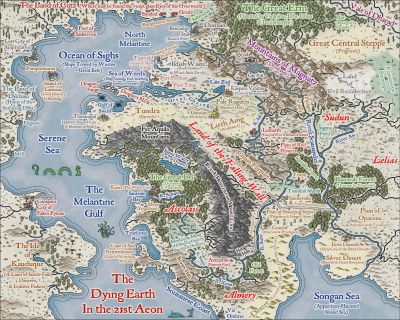
Community Atlas: Kara's Vale, Ethra, Doriant
And so finally...
My original idea was to set this dungeon map up as a cellar to the Tower. However, the use of portals to navigate between the main Tower maps, suggested this one could be set up instead as a further level, whose separate nature, while hinted-at by the need to use the golden talisman from Level Seven to operate the portal from Level Nine to it, would only become fully obvious once it began to be explored. It also leaves open the question as to whether this is genuinely just another main Tower level, one with a more secure, semi-secret accessway, and even whether most of the Tower levels might be on a completely different plane of existence to the outside that connects with Level Five.
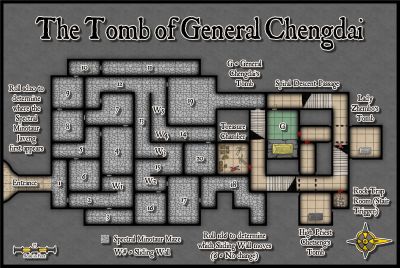
Regardless of that, this is the final map, whose base was generated by a trio of the Inkwell Ideas Dungeonmorph dice faces from the Adventurer set, here with a few minor tweaks and adjustments:
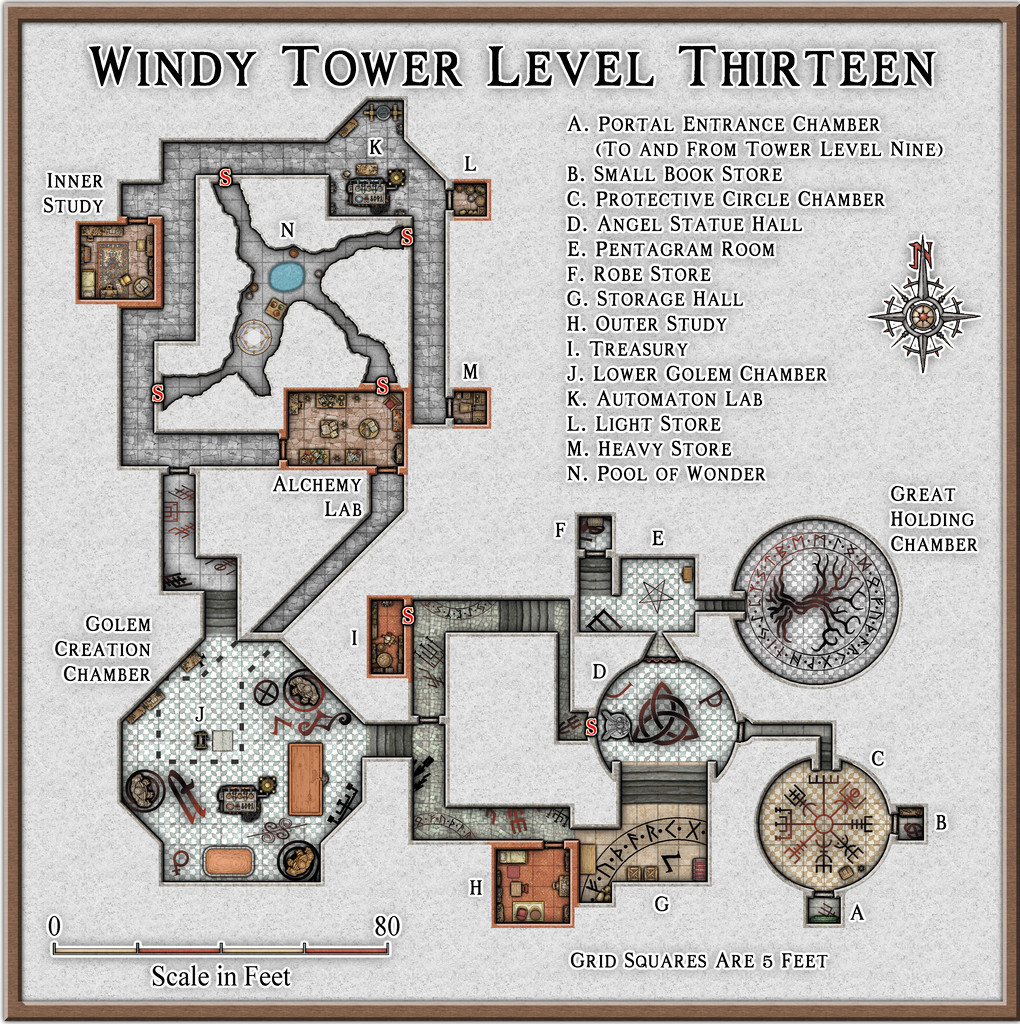
As the labels indicate, there are alchemical aspects here that survived from my initial thoughts on this layout, now added-to by golems - and there are several of those here, including some variant levitating Iron Golems that can also freely teleport within this Level (only). There's also something horrifyingly vast and terrible magically held in stasis in the Great Holding Chamber. You'll have to read the notes in the Atlas version to find out more, but it's known as The Devourer of Deserts (no, not "Desserts"...) thanks to The Story Engine card draws.
There's a lot more weirdness here, including what seem to be randomly inlaid dark metal symbols in the floors, walls and ceilings in places (another card-generated idea), as well as more conventional dark metal inlay designs, courtesy of our own Loopysue's Marine Dungeons! Some of the accessways are incredibly narrow (that between chambers D and E is barely 18 inches, 45 cm, wide, for instance), raising questions as to how some of the large, bulky equipment ever got into the inner western and northern parts of this complex. Which is just as it should be for what's clearly an anciently-created place belonging to a highly powerful magic-using person/creature. Who seems to be nowhere at all in the complex currently...
The golems are intended to function much like the other guardians elsewhere in the Tower, in stasis until required to tackle intruders, except here, there are often passwords required to stop them activating, not to mention the silver amulet needed to open the door to and from the Entrance Chamber (A). The whole Windy Tower project was though a fascinatingly creative exercise, tying-together (sometimes very loosely!) the randomly-generated card-draw concepts, as well as the oddities of the dungeon layout.
One final piece of weirdness I only found an explanation for after consultations with Loopysue and, indirectly, Remy Monsen. It's been a very long while since I mapped using the Mike Schley Dungeon SS4 style. When I came to draw the Level Thirteen map, as usual, I imported a JPG version of the hand-redrawn dice design as a base to work from in CC3+. I always check the sizing of that, and adjust it when done if needed, using the drop-down Info menu's Distance command, measuring the separation of the graph-paper grid lines using the ortho setting. Ordinarily, that calls up an information panel that looks something like this (I'm just picking random points here to demonstrate):
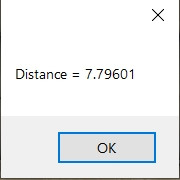
However, what came up was this:
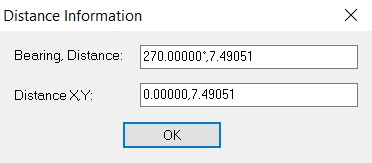
I thought I must have hit some unrecognised shortcut key by mistake, but then I couldn't find a way to reset it, either using the CC3+ Help menu, or anything in the Tome.
It turns out though that there are actually two commands you can type into the command line to find distances like this, DISTANCE (which gets you the first panel above) and DIST2 (which gets you the lower panel). Now quite why DIST2 has been set as the default in SS4 is a mystery nobody seems able to resolve, given that (thankfully!) it isn't used anywhere else like this. There probably are circumstances where being able to measure both bearing and distance together might be useful, and also the vertical and horizontal distances simultaneously, but it is appallingly confusing to have this thrown at you when all you want is a straight distance measurement. In this instance, it's fairly obvious, if not intuitively so, as to which is the correct value for what was being measured, although that wouldn't necessarily be so obvious under different circumstances. Something to be aware of when using SS4, though - and if you do just need a "normal" distance measurement, simply type-in DISTANCE to get it!
Now it's time to leave Doriant for the time being, and head off to Lanka in Kumarikandam for the next maps in this project...


-
Community Atlas: Kara's Vale, Ethra, Doriant
Well, as it's turned out, not quite "next time" for Level Thirteen after all!
As I was drawing the various Tower levels, and especially when setting-up the cross-level hyperlinks, it soon became obvious I was relying on my own hand-scrawled schematic showing how all the levels connected with one another to manage that. This suggested a further such properly mapped schematic might be helpful for GMs trying to run the Tower with the portals active in the sequence shown on the maps. Thus we also have the Windy Tower GM's Guide map:
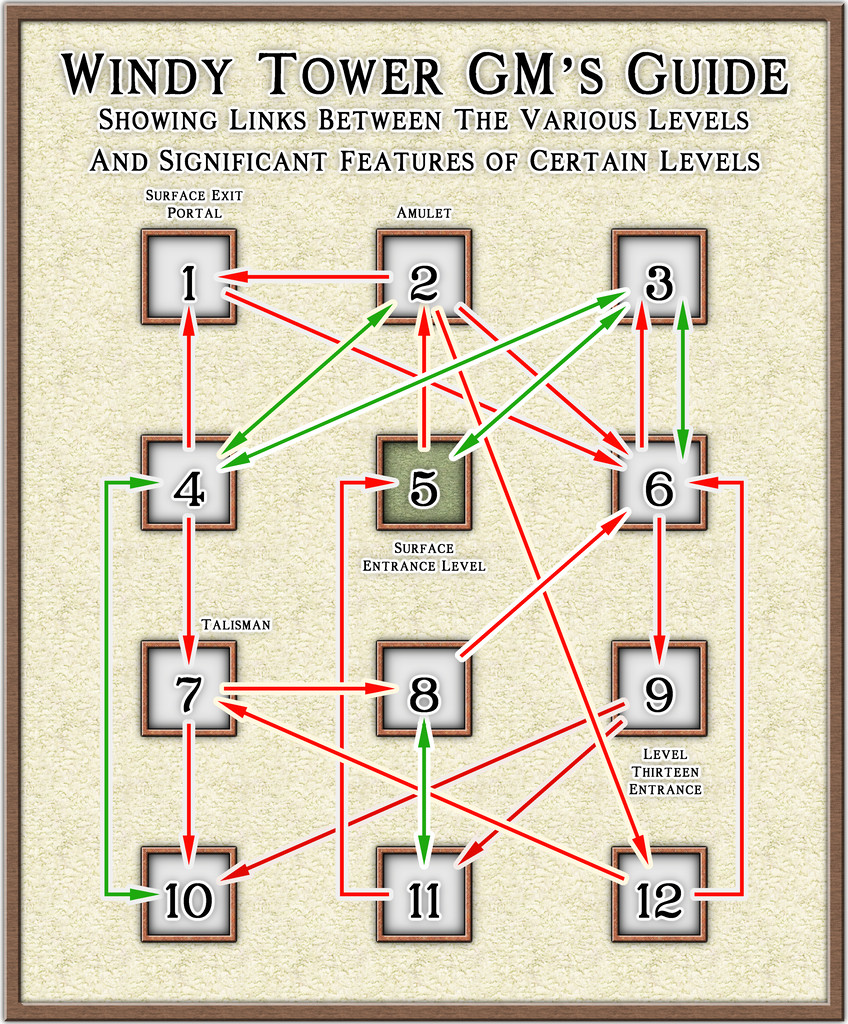
Although it was relatively simple and quick to draw (especially compared with setting up multiple macro hyperlinks per level!), it proved a little more complex than anticipated, thanks to the number of crossing arrow lines. Plus the whole went through around six different hand-sketched iterations before settling on this layout, to try to keep the arrow-line patterning as relatively simple as possible.
Now it's done though, it has been quite entertaining to use it to navigate using the FCW file's hyperlinks between the levels, when checking them in comparison with the text notes ahead of the final Atlas submission.
And so REALLY next time, Level Thirteen!
-
Community Atlas: Kara's Vale, Ethra, Doriant
Level Ten:
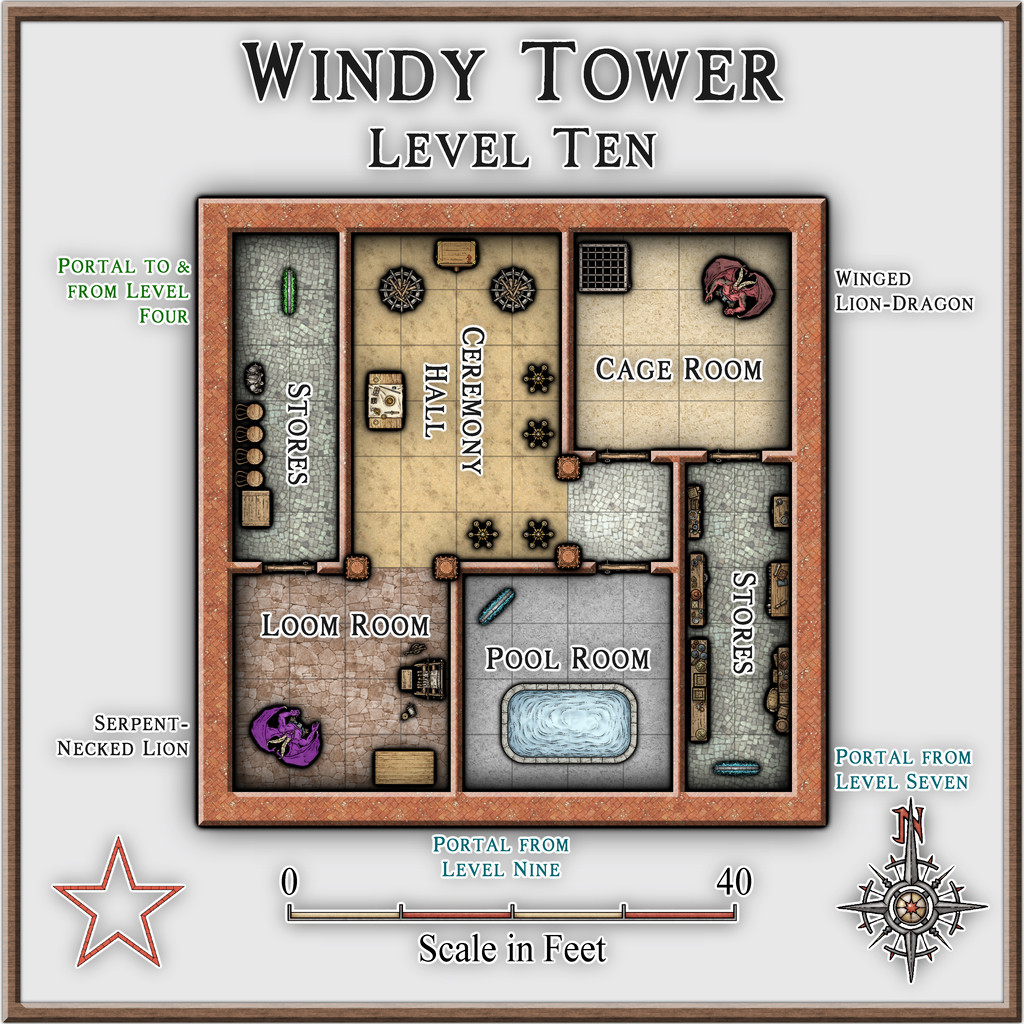
Some of the included elements were simply picked from the available symbols in the Mike Schley style, to flesh-out the bare bones original floorplans, although this level was largely populated from items randomly determined from those Story Engine card decks used earlier for the Kara's Vale map locations. The randomness of a level that has stores, an altar and huge braziers, a cage, a pool and a loom just appealed in that way weirdness sometimes can!
Level Eleven:
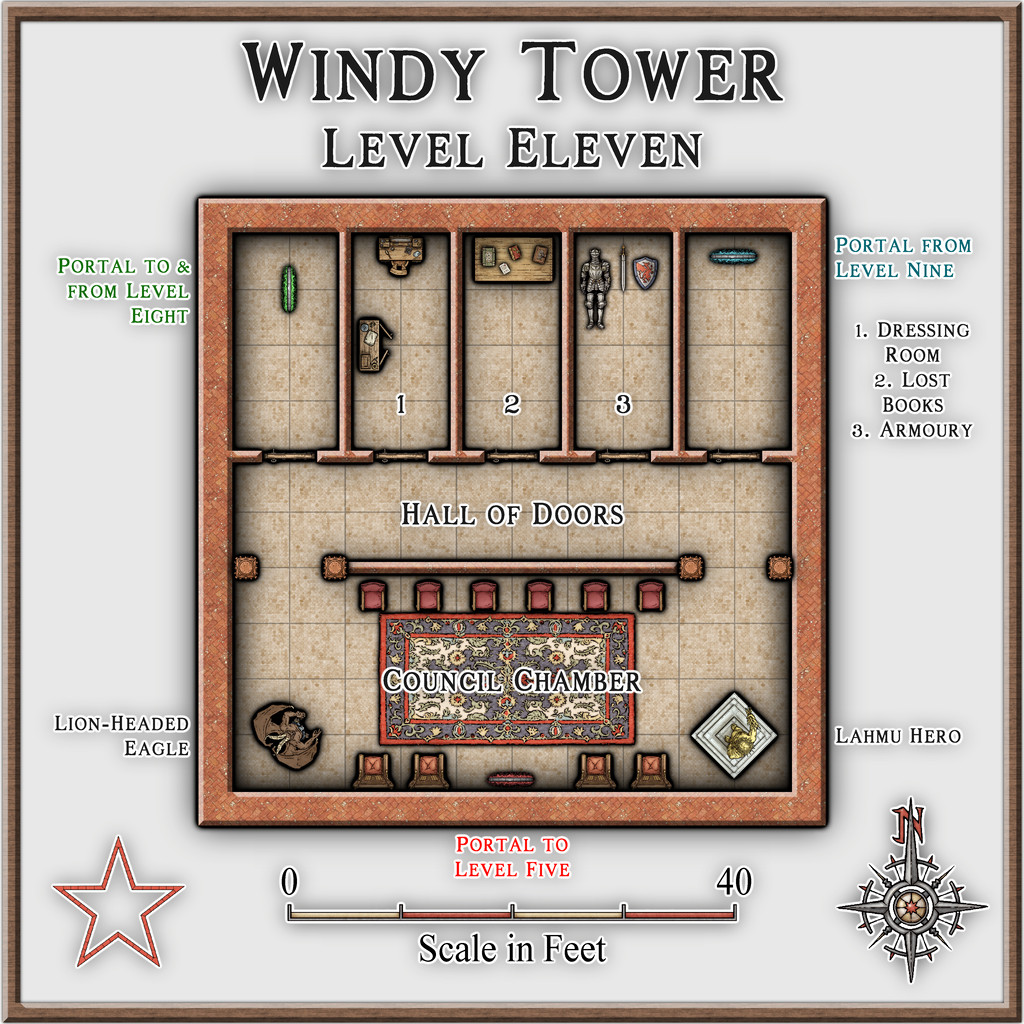
Which randomness was allowed to spill-over here too, with those three rooms of oddities in the north. Plus, be fair, this was the eleventh level in the group!
Bringing us finally to Level Twelve:
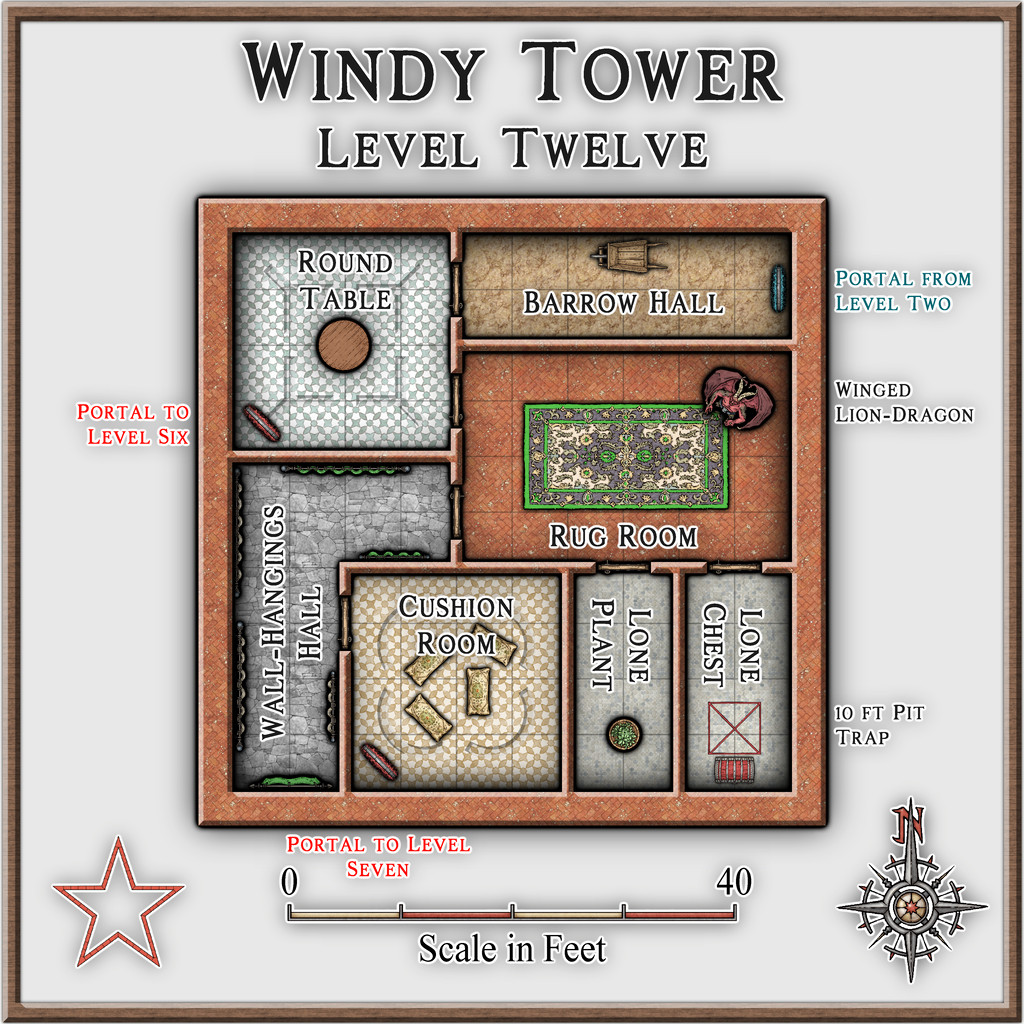
Did I mention the random weirdness? The Wall-Hangings Hall though was done deliberately, because it's a really odd shape for an empty passageway otherwise.
Which concludes the main Tower, leaving only Level Thirteen to come - perhaps next time...


-
Community Atlas: Kara's Vale, Ethra, Doriant
Back to the remaining half-dozen Tower levels with Level Seven:
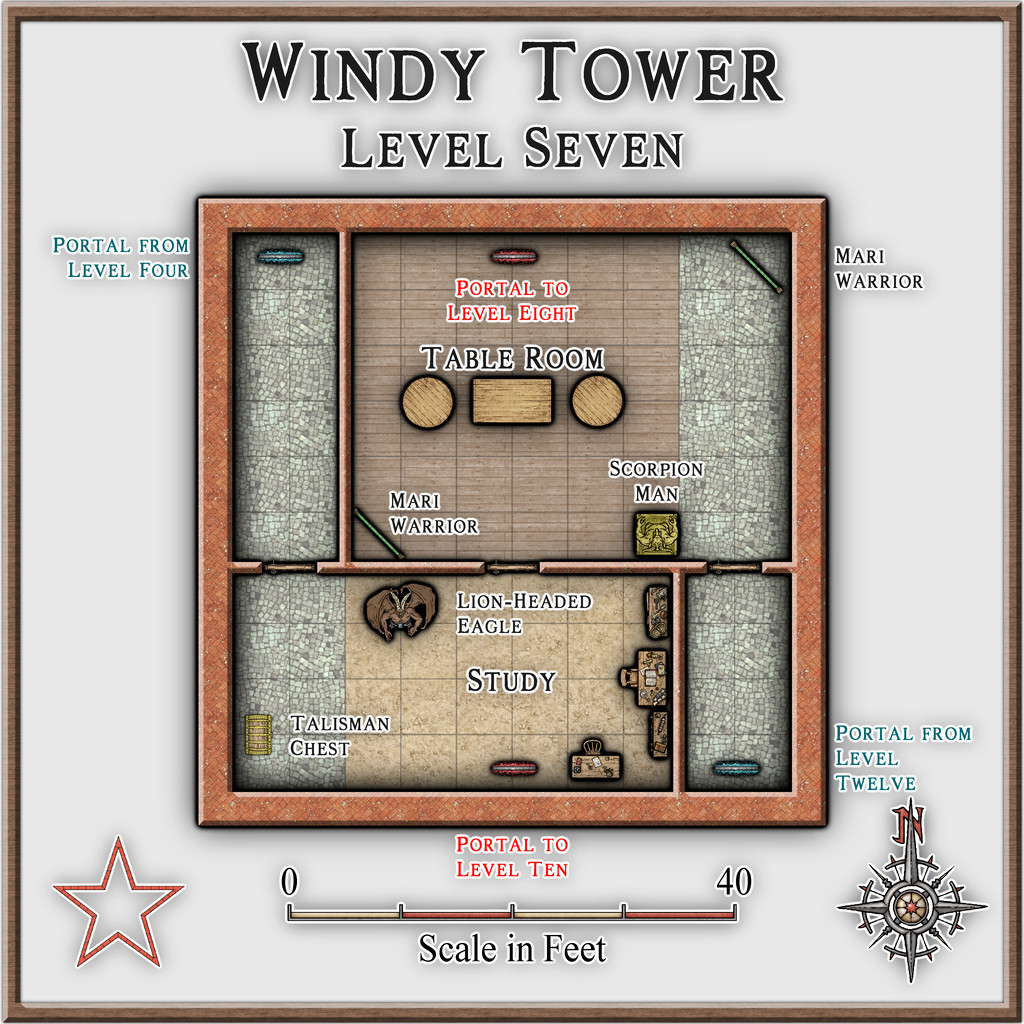
This is the level the magical, golden talisman is on, which is required to activate the portal to access Level Thirteen (coming-up on Level Nine below), and either it or the amulet from Level Two may be needed to regain access to the Tower, if left at any stage. I decided to only wall-off parts of the two outlying cobblestone-floor sections here (derived from the original floorplan), because that helped make this level feel a bit more weird.
Lots of leonine critters in ancient Mesopotamia! The Lion-Headed Eagle though is something special, as it was either a demi-god, or a full-fledged deity (possibly at a period antedating the early 3rd millennium BCE) called Imdugud (later Anzu), which had the form of a giant eagle with heavy claws, a lion's head, and, from at least one myth-text, shining, multicoloured feathers and magical powers.
The Scorpion-Man is a bow or spear-armed humanoid with a human torso, arms and head, set on a chitinous giant scorpion's lower body, legs and stinging tail.
Level Eight:
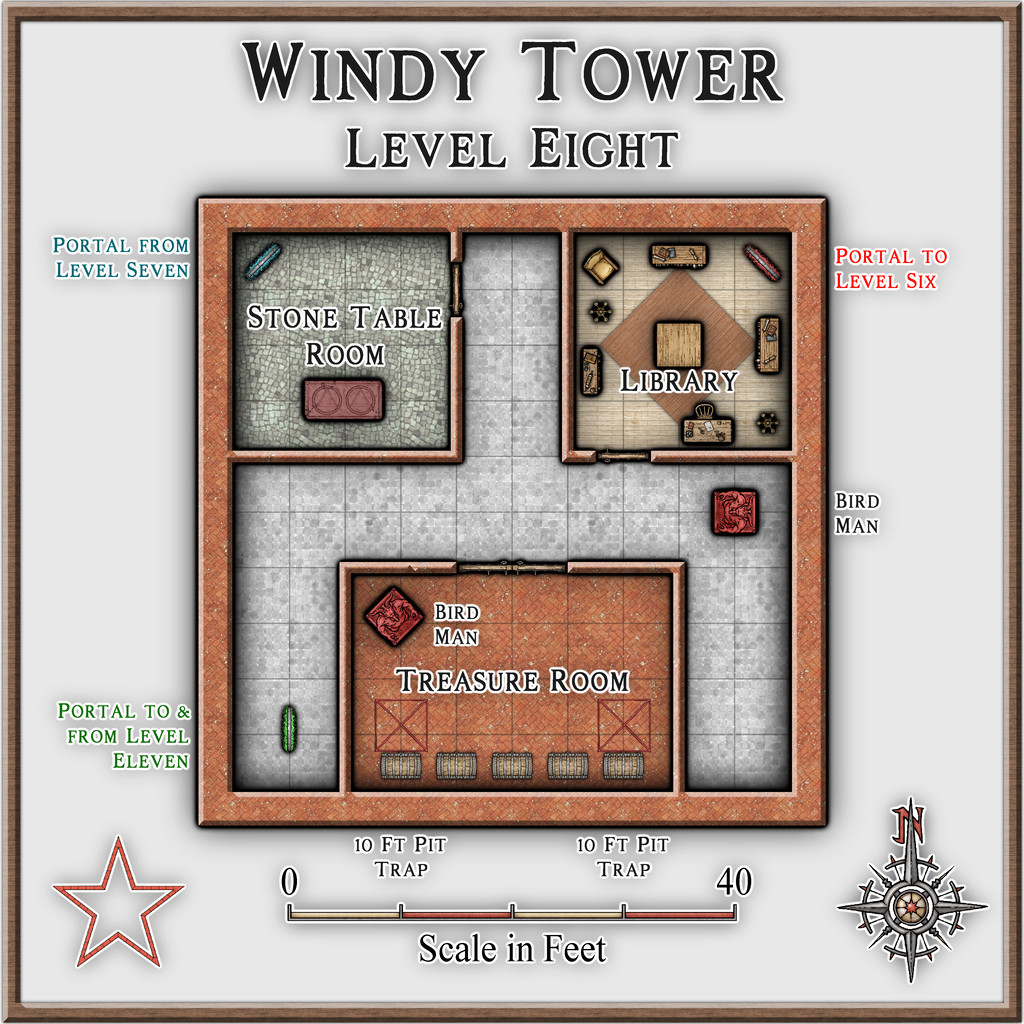
A fairly straightforward level here for once, except for a couple of floor pit traps in front of two of the treasure chests.
Level Nine:
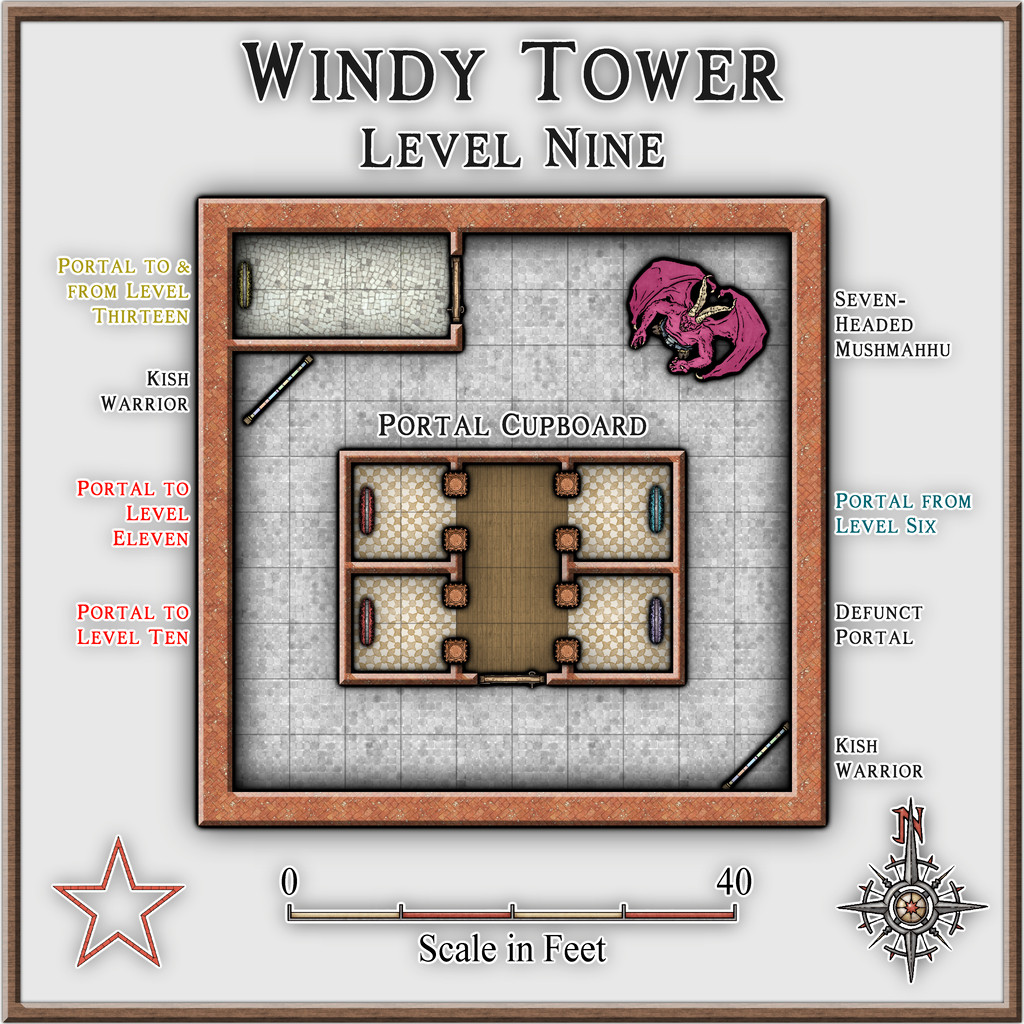
Here we find the portal that goes to Level Thirteen, which of course is the dungeon map that started this set of maps off. That's dealt with by a separate map in the Atlas now, however. Plus for variety, we also have a non-functioning portal.
The Seven-Headed Mushmahhu probably needs an explanation. It's an imposing, hydra-sized creature with a huge lion's body, and seven, writhing, giant serpent necks and heads. Known from several variant artworks from the early 3rd millennium BCE, sometimes such a creature has a purely serpentine body as well, and in either form, one or more - though not all - its heads may be shown as dead. In its lion-bodied form, it has rays rising from its back, which might be magical defences, or simply fire/heat, which rays seem to form one of its own powers. Sometimes shown with one or two deities in combat with it too. It's basically the top predator in the Tower.
-
Community Atlas: Kara's Vale, Ethra, Doriant
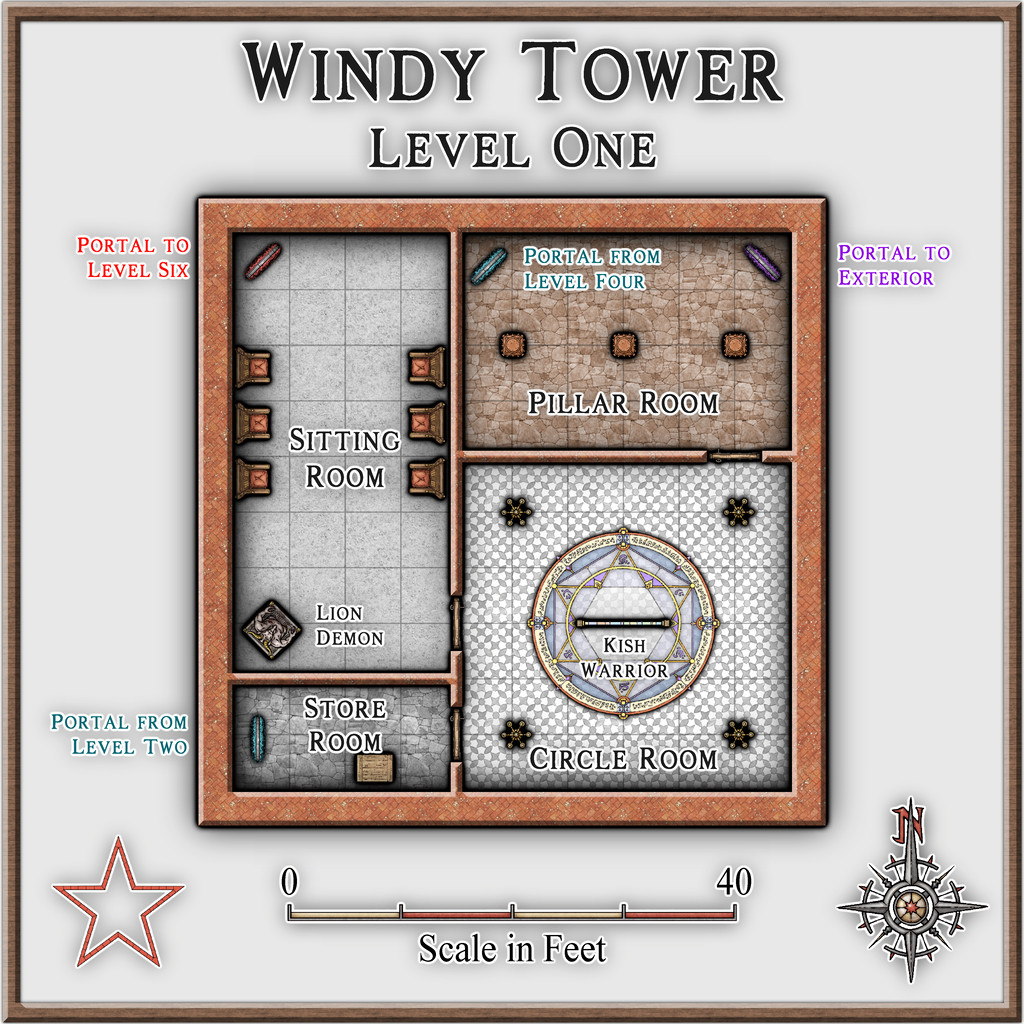
Level One here shows the general pattern adopted for all the non-surface Tower levels, where a neutral sheet has been used to hide the exterior surface features of Level Five, presenting a clearer backdrop for all the remaining levels. As there aren't any windows in the Tower, this also helps maintain a degree of uncertainty as to where each level is in relation to its physical place in the Tower, as there is meant to be a degree of confusion about the whole - seriously magical, after all.
The portal to the exterior drops anyone using it into the stone circle west of the Tower on the Level Five drawing - they can't get back into the Tower that way, and may have problems using the main doors without magic, or possession of the amulet or talisman found elsewhere in the Tower.
Lion Demons are strong, disease-bringing, lion-headed humanoids with raptor-clawed feet and legs, and upright donkey ears. This latter gives them powers of strength and alertness, judging by their use elsewhere in Mesopotamian art and some texts.
That flat panel labelled "Kish Warrior" is the marker for one of the nominally Human defenders. Rather than having this be a fully 3D creature, because the Kish, and on subsequent levels Mari, warriors are based on 2D inlay artworks only, I thought it would be fun to have them appear in 2D panels, and then come to life still as 2D creatures as well - albeit ones with human fighting abilities appropriate for the artworks. To clarify, I've added illustrations of such artworks to the PDF notes, that I drew and published in a series of journal articles around a decade ago now, discussing aspects of ancient Mesopotamian warfare. This is the Kish Warrior one:
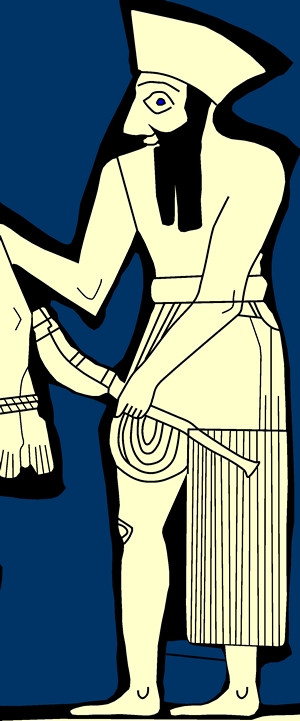
It was drawn on the computer, because I wanted to better show it fully restored, with the coloured inlay background and the carved and filled bone inlay pieces, as the originals had quite a bit of damage to them.
This is the Mari warrior, a scan of the hand-drawn original on tracing film for the final published version:
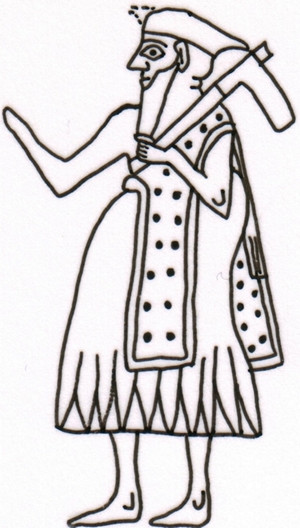
Both original artworks date from the earlier 3rd millennium BCE.
Level Two:
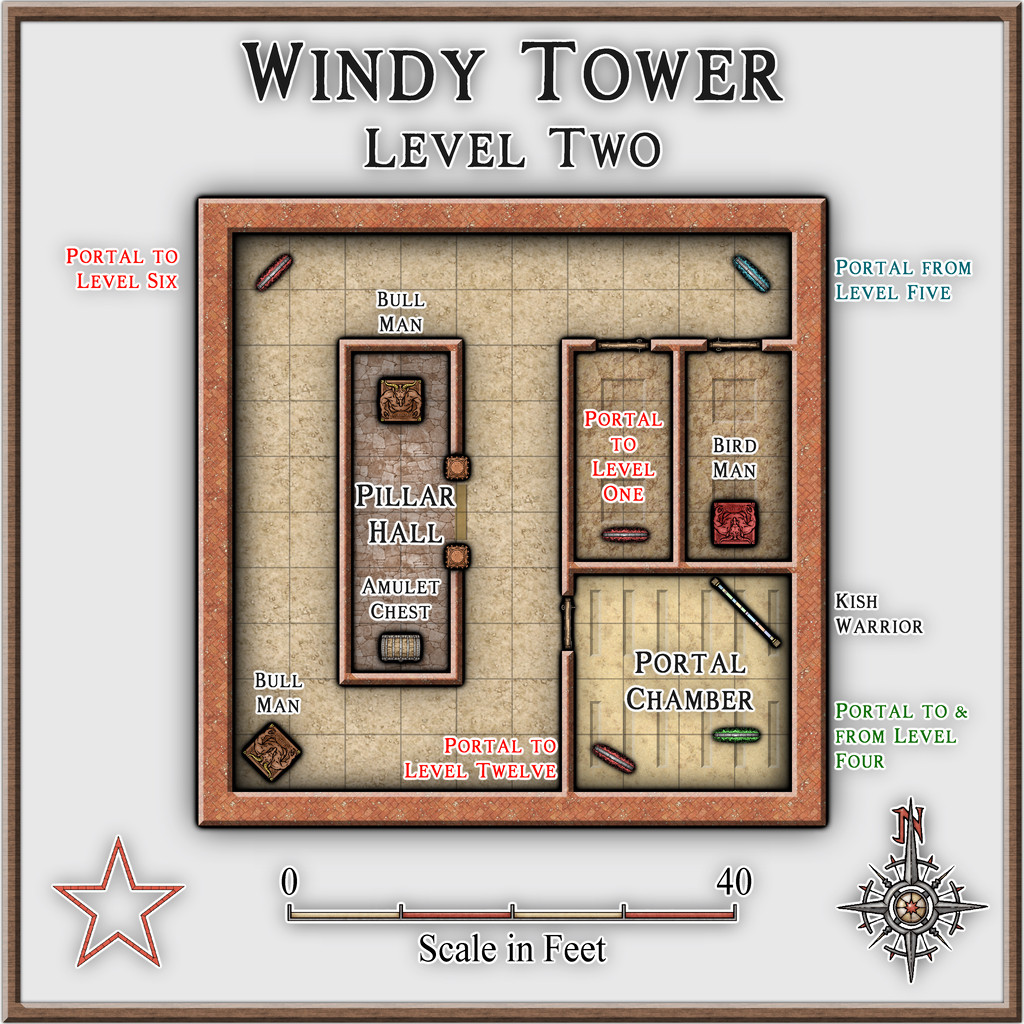
This level has the special silver amulet hidden in a treasure chest. The amulet can be used to regain access to the Tower through the surface doors, and it's also essential to gain access to the Tower's Level Thirteen (yes, there IS another Level beyond Twelve - we'll get to that eventually!).
The Bird Man has here been treated as a trickster demi-god, with a human upper body, head and arms, feathered bird's tail, lower body, raptor legs and clawed feet. He is only known from artworks, where most depictions show him captive, apparently being judged by a seated deity, so some liberties have been taken with why this might be so.
Bull Men are humanoid fighters with a human upper body, head and arms, a bull's head horns and ears, bull's lower body, tail and legs. Such a creature has been sometimes thought of modernly as the legendary wild-man companion Enkidu to the hero Gilgamesh, albeit no period texts confirm this.
Level Three:
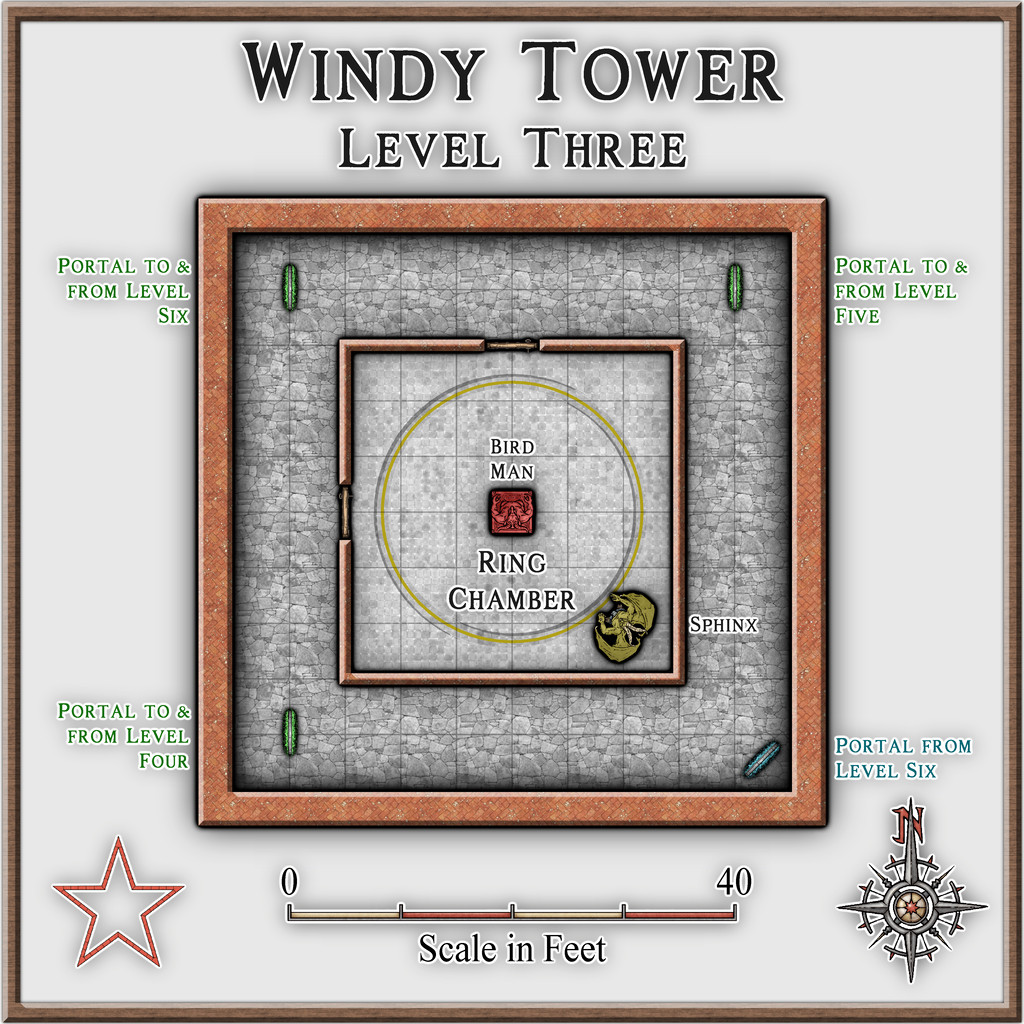
The Mesopotamian Sphinx isn't quite the sphinx you might think, as it's essentially a human-headed, winged, giant lion. Winged creatures aren't quite so cramped here as might be expected, because each Tower level has a 20 ft ceiling or so (6 m).
Level Four:
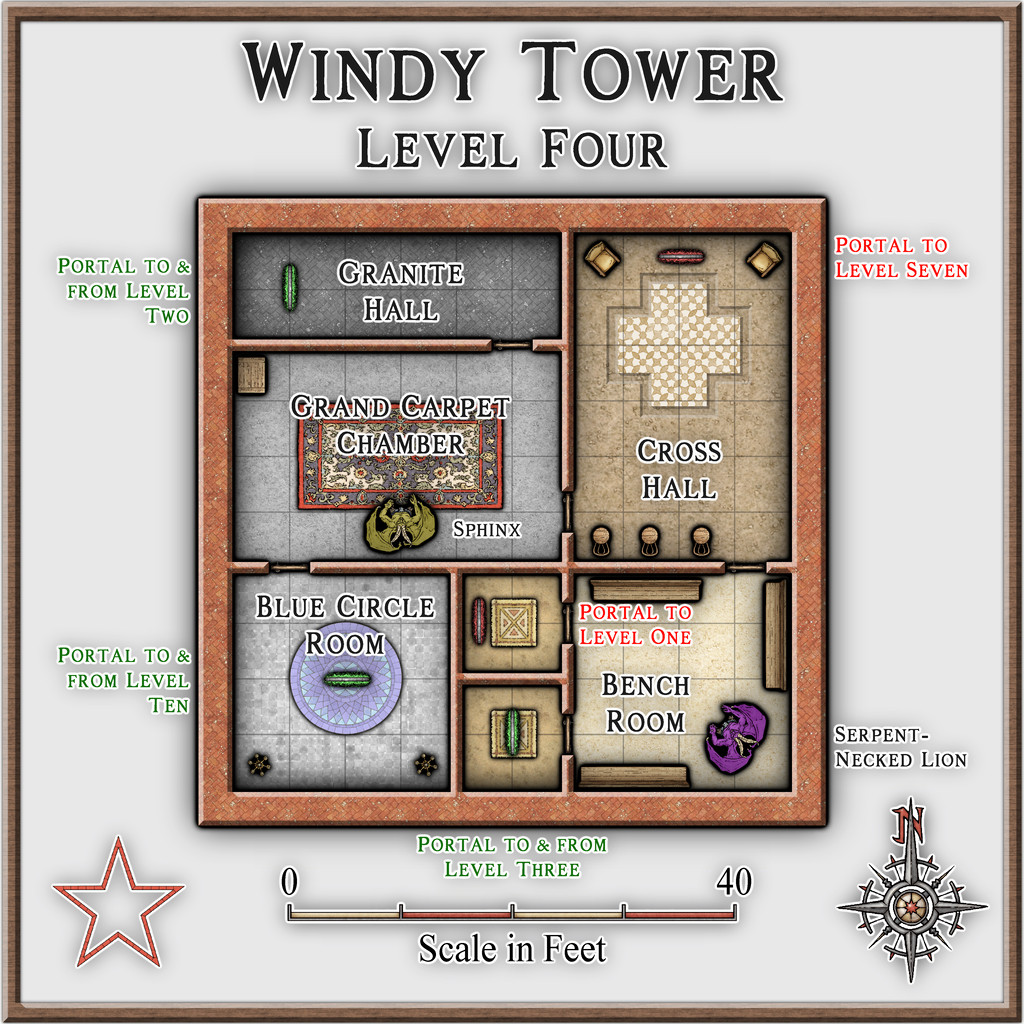
On the original "Citadel" floorplans, there were a few carpets shown, which were added here as well, although in the notes, it's mentioned that only this one on Level Four might also be a magical flying carpet, should GMs desire. As might be guessed, the Serpent-Necked Lion is indeed a lion with a long, serpentine neck. Artworks sometimes show pairs with intertwined necks, possibly as a decorative element only.
Level Five we did already, so next is Level Six:
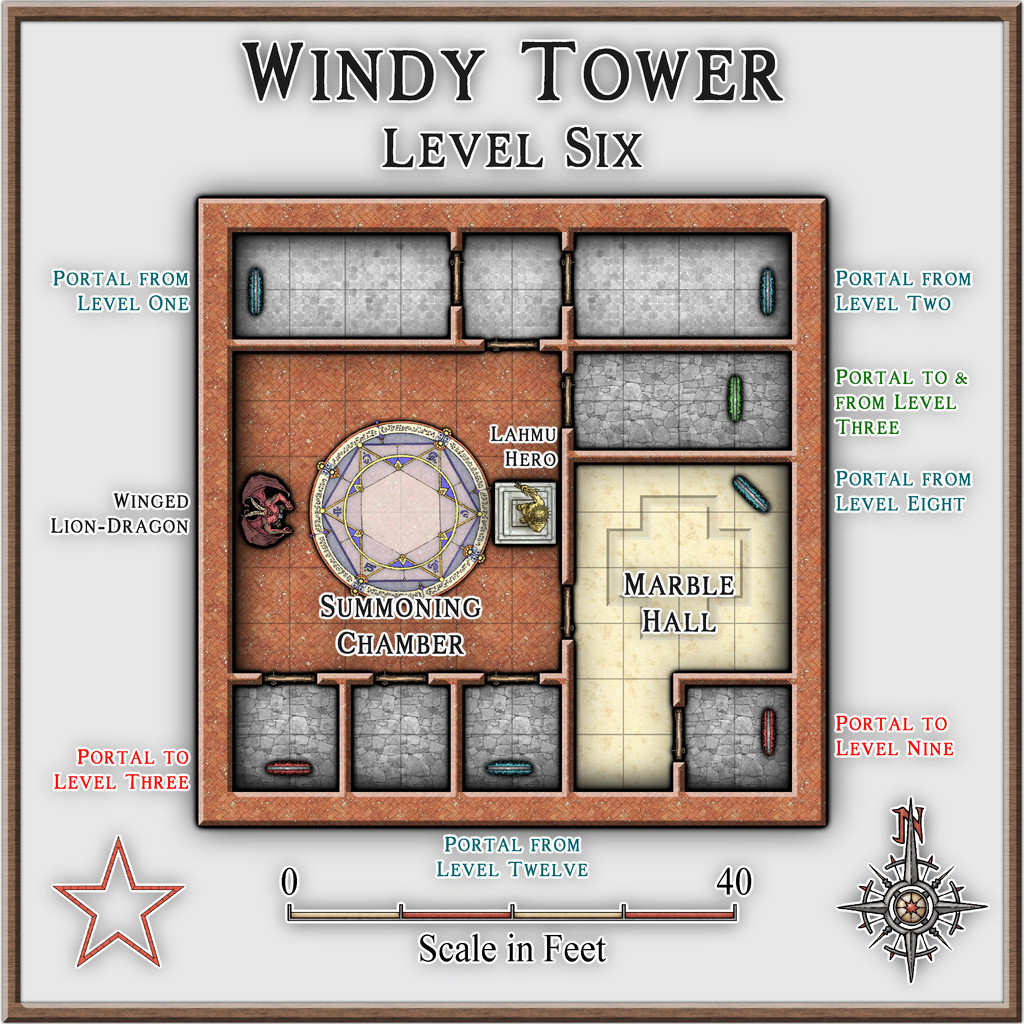
Here, I should probably say what a Lahmu Hero is, and what the difference is between the Sphinx and the Winged Lion-Dragon (also seen on Level Five earlier). The Lahmu Hero is a sword-armed heroic fighter, shown in art with distinctive shoulder-length, curled hair, commonly three curls to either side of their face. They're typically either naked or shown in a simple loincloth, sometimes illustrated having apparently magical control over water and serpents. The Winged Lion-Dragon is a feather-winged lion with feathered giant raptor back legs and tail. Sometimes shown pulling a deity-ridden battle-car or chariot, and sometimes shown breathing something that may be lightning or fire.
The next six levels must wait for another day now though!