

Wyvern
Wyvern
About
- Username
- Wyvern
- Joined
- Visits
- 3,238
- Last Active
- Roles
- Member
- Points
- 5,517
- Rank
- Cartographer
- Badges
- 24
Latest Images
-
Community Atlas: The Marshmalika Area of Kumarikandam
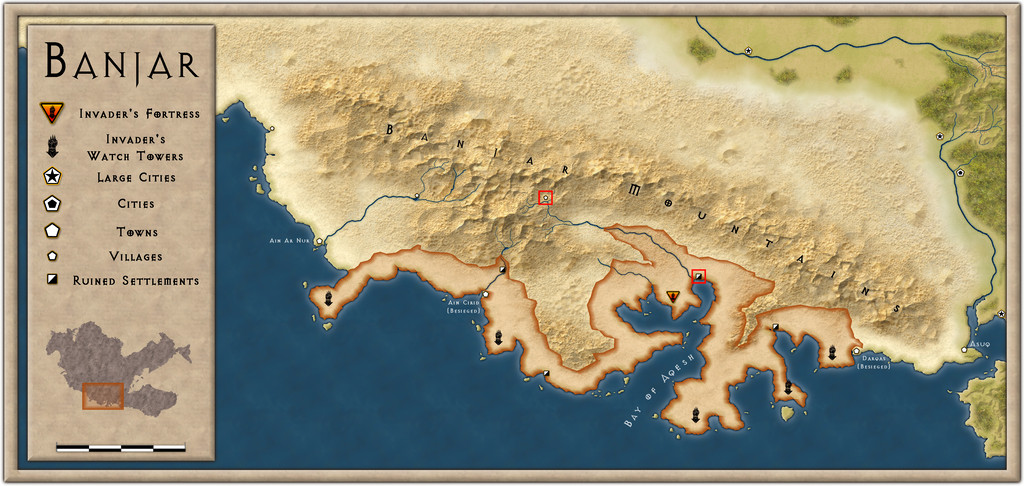
Completing my trip to the Banjar region of Kumarikandam recently, after the Sussara Region, I've now been visiting part of the coast by the mouth of the Kalabanjar River, the tiny red-square-marked ruined settlement at the head of the Bay of Aqesh on the area map from the Atlas (not the one in the mountains - that's Sussara!):
The map I'd generated in advance from the Inkwell Ideas "Ruins" dice set only covered part of the settlement, and given the large scale of the above map, as with the Sussara Region, I knew I'd have to begin with an area map to fit it into anyway. Having already prepared a 20-mile-square map for Sussara, I simply continued the process here, using the same Scorching Sun style for consistency, having generated a list of ideas for features on this map using the same random tables as for Sussara (albeit re-rolling any duplicates with that map), while taking into account the very different circumstances for this part of Banjar - invaded and devastated by incomers in the relatively recent past. Thus we arrive at the Marshmalika Area map ("Marshmalika" = Queen's Cove, incidentally):
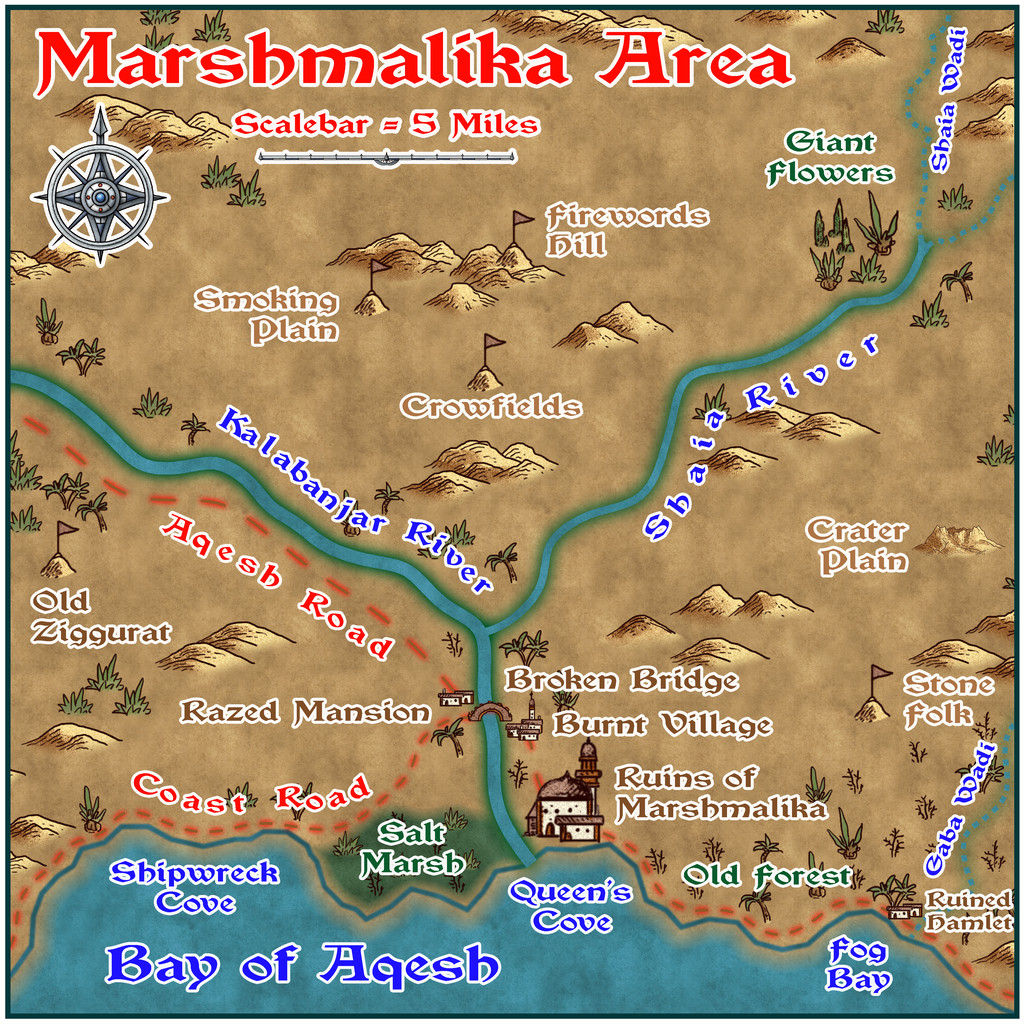
Descriptions of what's where (with how recent some of them are), and the significance of the various items shown will be provided as text and PDF files in the Atlas, as usual, although it's fair to say there are battlefields, and many signs of devastation (not all created by the invaders; war is war, after all). Oh, and there are a LOT of ghosts. They make the invaders feel REALLY uncomfortable, although all they do is stand and stare (mostly). In ever increasing numbers. At any destroyed formerly inhabited place. By day and night, continually. Until the invaders leave.





-
Community Atlas: The Sussara Region in Kumarikandam
All of which preparation finally brings us to the dungeon map, entitled "The Tomb of the Prophet and the Sailor Prince", albeit in the Atlas to be known by the somewhat more manageable name of "Tomb of the Prophet", which some may feel is probably no loss (sorry...):
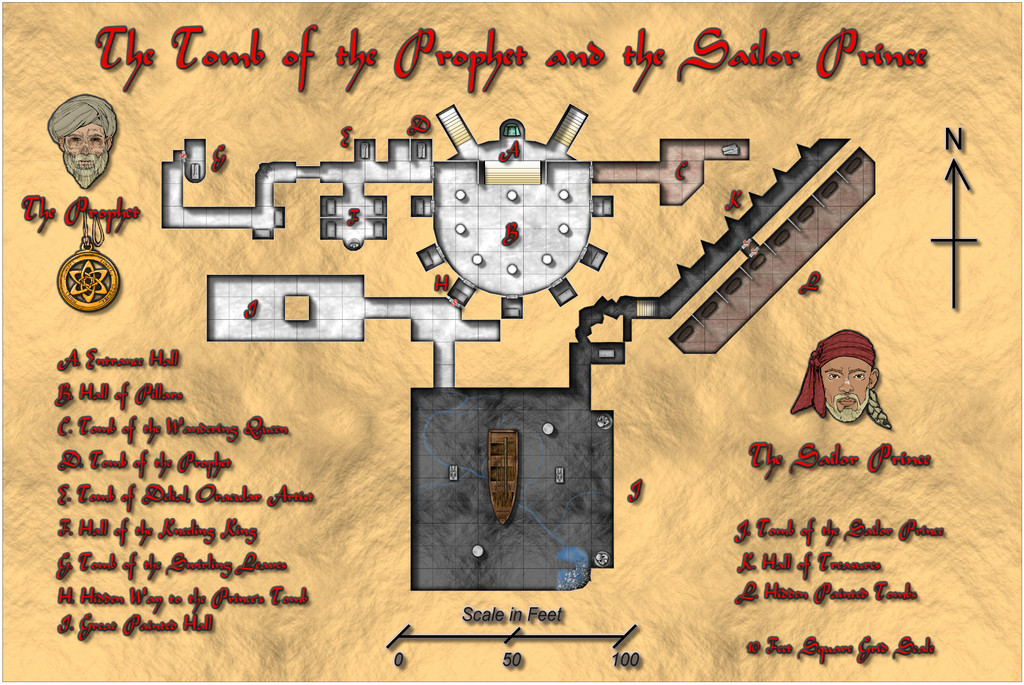
This was drawn using the SS2 Bitmap B style, with a few bits and pieces from its "A" variant, and was selected primarily because I needed a white marble bitmap fill, sarcophagi and coffin variants. The boat was the trickiest feature, as it's intended to be a large river-going vessel, with detached masts (ceiling's not high enough!), whereas the best the "A" style could offer was a rowboat, so that needed a bit of fiddling to look like something closer. The font is "Arabian" from the 2010 Annual.
Adding a mask to half-hide the walls was a late addition, as the shadows "inside" the solid rock surrounds beyond the walls seemed too distracting. This had a serious disadvantage, as the floors and walls had been drawn rather piecemeal, largely thanks to a few quite complex shapes (areas K and L were drawn square to the grid and then rotated, for instance. Areas A and B proved devilishly complicated to get right, particularly as for some reason, during the rotated copy operations for two of those small square peripheral tombs, the room size had slightly shrunk in one direction (well, one, but then that was mirror-copied to the opposite wall), something I didn't realise until I started connecting area H to the chamber between tombs I and J. Thus I couldn't do a simple series of "Trace" commands for a Color Key inner mask, and indeed ran into so many problems with it tracing the wrong bit repeatedly, I gave up trying to do that, and did a couple of external polygons instead, albeit that wasn't much easier...
In terms of the contents and area descriptions (in the map's PDF and text files), I found some of the options for the dice designs I'd used in the accompanying Inkwell Ideas "Dungeonmorph Delves and Descriptions" book for the Crypts, Lairs and Sewers sets very appealing. Most of the occupants and mechanics originated there, with a fair bit of subsequent tweaking in places, and the assorted treasure items scattered liberally throughout - together with the caveats on removing some - also derived from the same book, many as determined from the random tables towards the back.
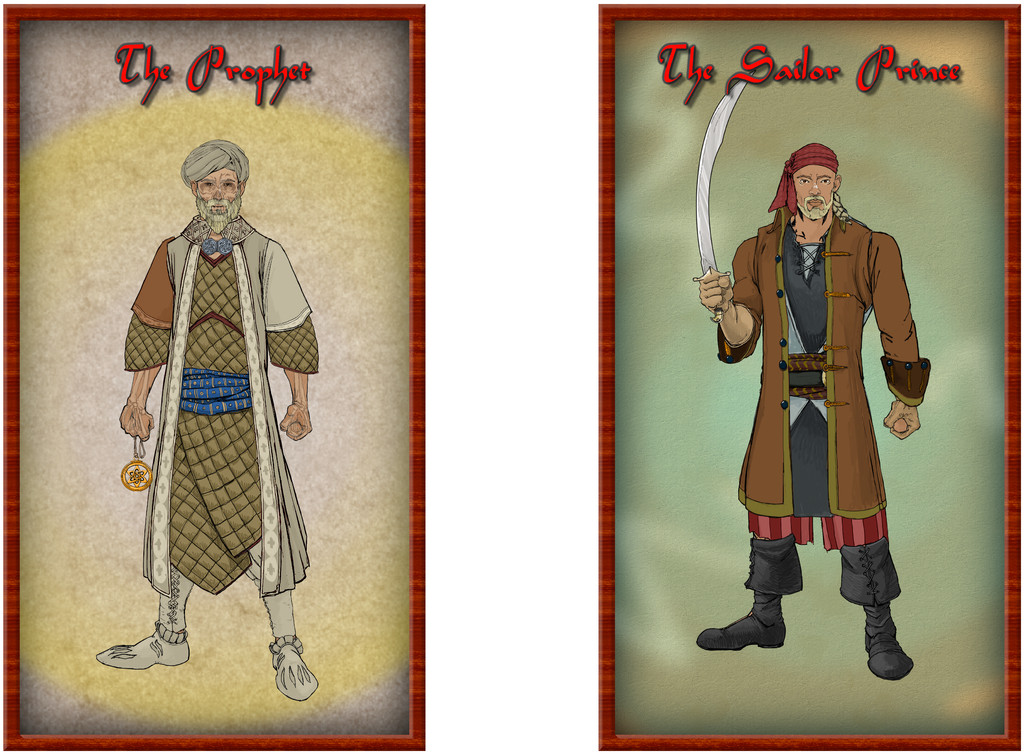
Once the key and scale notes had been added, there was enough space left for portraits of a couple of the people buried here, created using Character Artist 3, naturally. The Sailor Prince is as he appeared in the later prime of his life, while the more ghostly appearance of The Prophet is because that is how he may appear in the Tomb, if the right ceremony is performed, for all he is not an undead creature. His holy symbol features repeatedly in the Tomb, so it was important one version of that should be added too. All those available have an attached cord in CA3, and while I thought of using a mask to disguise this, it proved possible to "attach" this version of it to the caption, to look as if it's hanging there.
Of course, it only really needs a few extra clicks in CA3 to generate full-body character portraits, and as I wasn't sure if I might need necks and shoulders for the versions to be used in the dungeon map, simply went ahead and drew the lot. It seemed a shame to not provide an Atlas version as well, so here they are:
Now, it's off to the ruins by the mouth of the Kalabanjar!

-
Community Atlas: The Sussara Region in Kumarikandam
Continuing the process of zooming-in brings us to Sussara Village, at the heart of the Sussara area map:
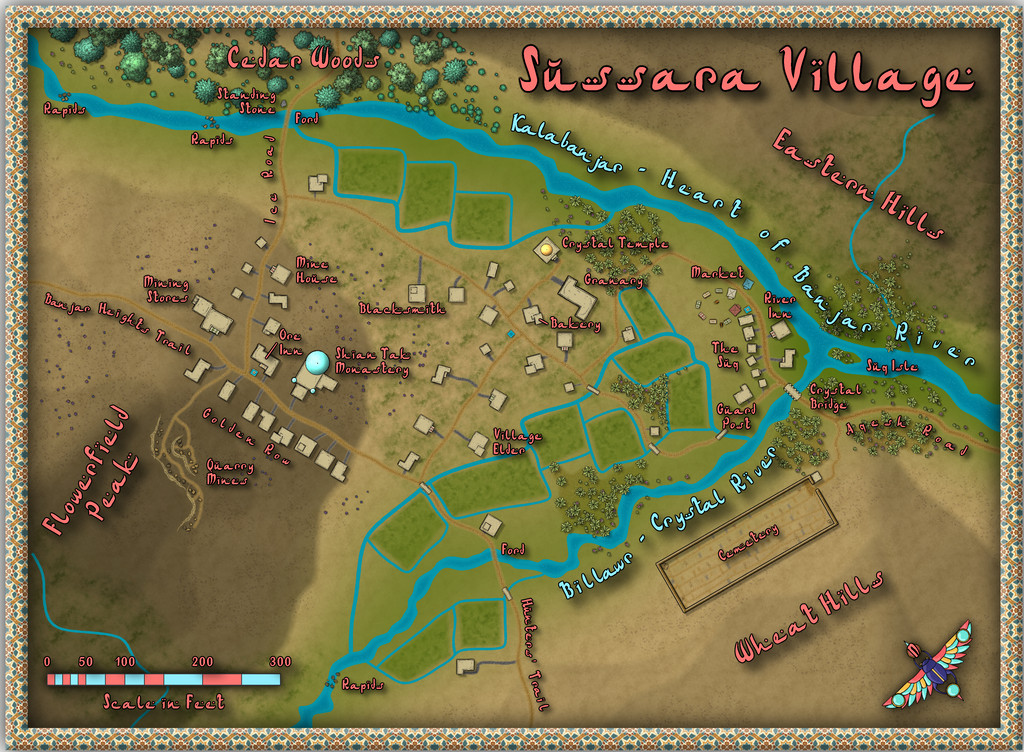
This time, I chose the Desert Oasis Annual mapping style and its accompanying ArabDances font, although I also needed some trees from the Mike Schley Cities (SS5) set, as I wanted to add some cedar-ish trees, while Desert Oasis only offers palms and shrubs. To generate the base map, I combined three old village maps from the venerable Judges Guild "Village" Books 1 and 2, again adapted accordingly, as I wanted quite a scattered community. The population of Banjar overall is tiny, so there seemed little reason not to give most folks plenty of space to build on.
Some features were decided in advance, as the nature of what I'd opted for in the dungeon meant a distinct spiritual element was going to be important here, and I thought it would be fun to add to the mix a small community of monks from the vast, rather distant, but still loosely neighbouring region of Tiantang in Kumarikandam, far to the north of Banjar. Since the folk here are accepting of nomadic wanderers, it seemed natural they wouldn't balk at still more distant people wanting to settle here too. Other items were chosen from random lists in "Village Book 1" and the settlement options in "Sandbox Generator", including the fact there are naturally-occurring flower-like crystal formations "growing" out of the soil in places, especially over and around Flowerfield Peak. Hence names such as "Billawr" (one Arabic-ish variant for "Crystal") and the Village's own name (Sussara = Glass Flower). The irrigated fields were quite fun to set-up, although at this scale, most of the smaller elements (shadufs, water gates, etc.) couldn't be added, even had symbols been available, without making the map seem very cluttered. Similarly, fences, livestock pens and sheds, and small gardens near most houses weren't included. I did though add a couple of carts to the Market, and three small well-fountains, to hint at what such tiny structures might have looked like. Notes on what is visible will be in the Atlas, as ever.
Of course, we also need a means to access the dungeon map that started all these above-ground explorations, so activating the "Village Secret" toggle in the final Atlas FCW version, will reveal a couple of hidden stairwells in the cellars of two separate, and otherwise unremarkable, properties (zoomed-in here for clarity at the usual Forum-acceptable size):
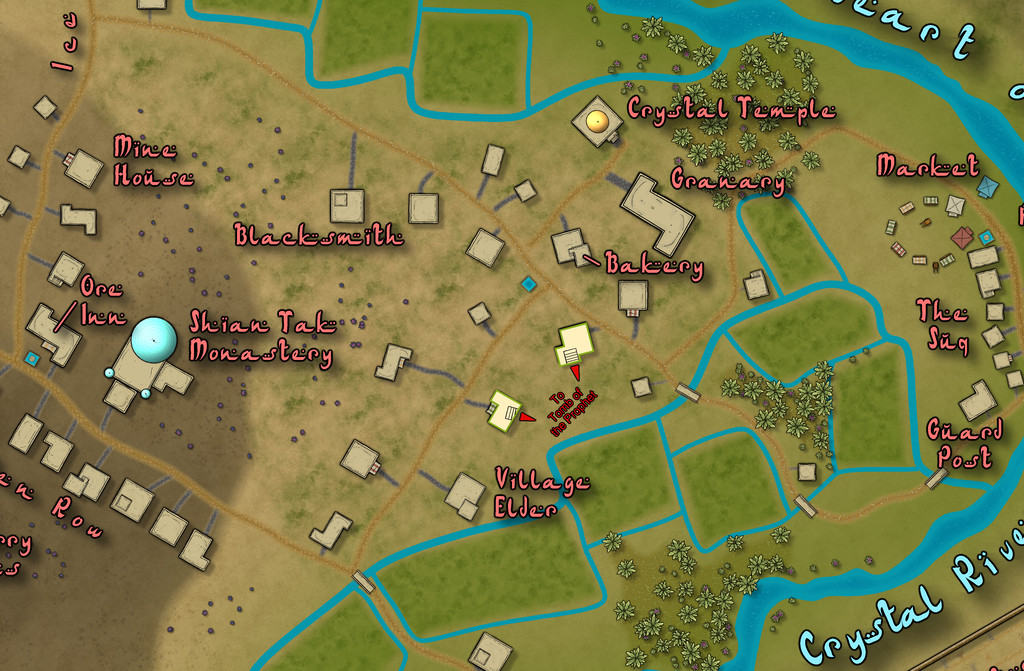
Very few folks here even know they might exist (which doesn't include the current occupiers of either dwelling!), and fewer still know what potential significance the Tomb of the Prophet may hold...

-
Community Atlas: Monseignor District in Kentoria
Thanks very much Remy!
Since I've had a couple of queries about the Inkwell dice sets outside the Forum, and to clarify for those interested here, the simplest solution is to visit the DungeonMorphs page of the Inkwell site. As you'll discover there, the designs are available also as cards and fonts, and there are books with descriptions and ideas for the more recent sets as well.
In addition, and because I think he actually started the whole concept of geomorphs with this ten-space design (that's ten spaces per side on the design), it's worth looking at the past postings on Dyson Logos' blog, as he's provided illustrations showing many - now maybe all - the designs he's produced over the years, including those he's done for Inkwell. There's a "Geomorphs" tab under the "Navigation" sidebar on his blog, but that only covers the 100 designs he did for a personal challenge in 2009-2010, all collected for easy download in one place. Using the "Post Categories" search box, the Geomorph Mapping Challenge has 217 blog entries, which goes WAY beyond those he's been commissioned to do for Inkwell and those 100 earlier maps!
-
Community Atlas: Monseignor District in Kentoria
The reason I opted for a monochrome style for the overland map was that I'd already chosen the Annual 48 Dungeon Black & White style for the underground map. Even if technically, it's not truly underground at all, as it's set into the gigantic dolerite mesa-like rock pillar which is what's actually called "Melgore", with its entrances at surface level on the north side of the pillar, by the rocky beach leading down to the nearby River Wisper, and which extends up into the pillar a short way (a total of less than 40 feet, 12 metres, given the pillar is roughly 500 ft tall, 150 m). Thus the Necropolis map:
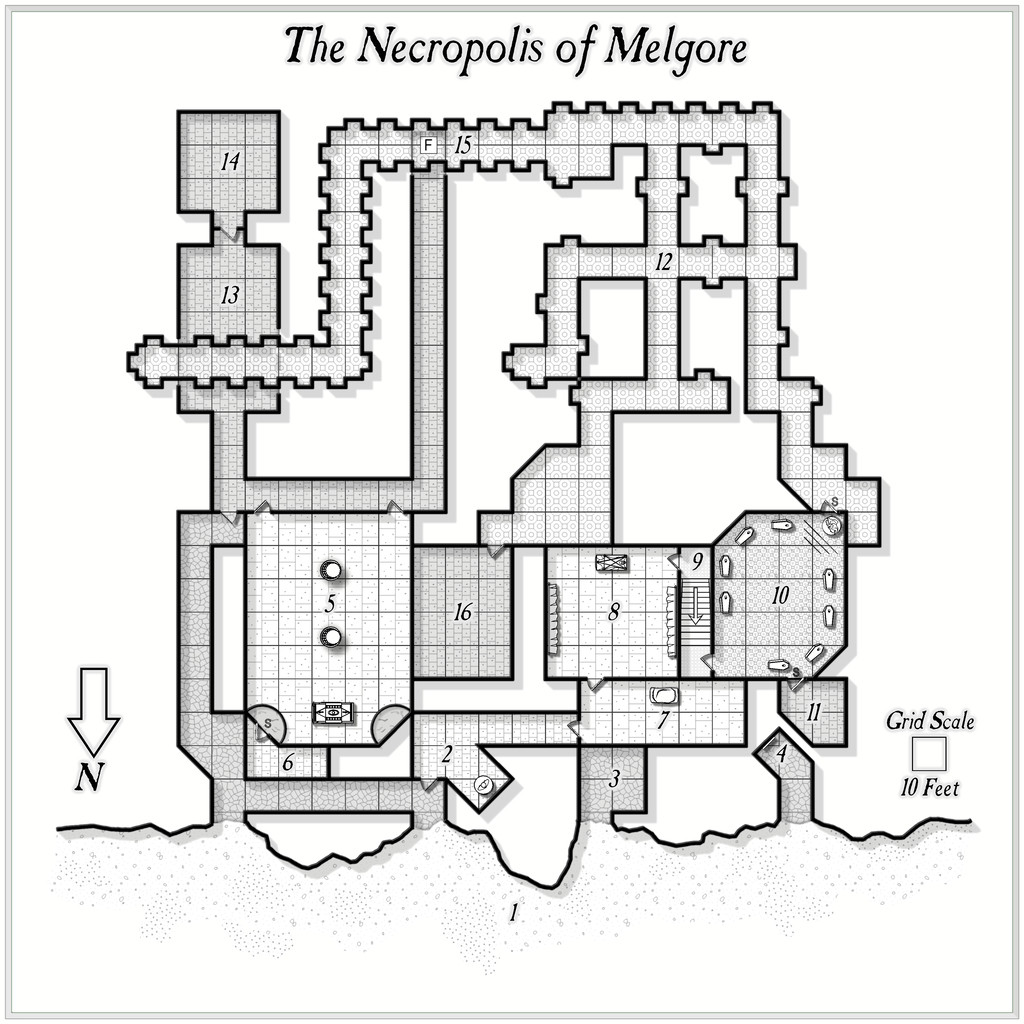
There are, of course, PDF and text descriptions for both maps to go into the Atlas, to provide more flavour and notes on what's where, and what's going on in both. Some of these ideas came from various random design lists, published and personal, although I also drew on inspiration from the book description available from Inkwell Ideas for the "Crypts" dice set used to create the Necropolis map, adapted and amended somewhat here.
Plus the original dice-map was amended, to remove unnecessary blind passages that didn't link together, and to stop the whole from having too much of a "geomorphic dice edge" look in places. In other sections a few new features were added - corridors or rooms extended, shortened or linked, with new doors or secret doors added as well, as my thoughts about what was here developed during the whole mapping process, much as normal.
I wasn't sure at first about leaving the wall shadows visible into the surrounding rock, although this is what the style was designed to show. However, I became quite attached to this look during the mapping, which, with the crispness of the style, gave me the impression of looking at a map set into a sheet of crystal-clear glass. I did a brief experiment with a wall mask to hide the shadows in fact, as part of the process in concealing the bits of the grid that weren't needed, but found that hid too much of the wall lines, and made the whole thing look rather flat overall.
Higher-res copies of both maps are in my Gallery as well, for those wishing them.
My intention is to keep trying out different mapping styles during this project, albeit I am inclined to attempt to retain a stylistic theme where two (or more) maps need to be nested into one, as in this case.
If all goes to plan, I'm next heading off to a continent that's eluded me till now - the tropical heat of Kumarikandam!