
Wyvern
Wyvern
About
- Username
- Wyvern
- Joined
- Visits
- 3,238
- Last Active
- Roles
- Member
- Points
- 5,515
- Rank
- Cartographer
- Badges
- 24
Latest Images
-
Community Atlas competition entry: The Summer Palace of the Winter Queen
As is fairly obvious, I quickly settled on a standard set of seven areas for each Palace map. It is essentially the same Palace each time of course, just with a different design and layout to keep things interesting. Thus I thought some further notes extracted from the forthcoming PDF texts might be an appropriate additional level of explanation here, following on from the general notes last time.
The air throughout the Palace is always fresh and calm regardless of conditions immediately outside the Entrance. While cool, it is of an equitable temperature for whoever physically enters it (something which can feel different for every entrant). The atmosphere is ordinarily solemn and slightly saddening, as if coloured by the ephemeral nature of summer, coupled with the presence of the many passing souls. Ceiling heights, while variable as befits an apparently natural crystalline ice form, are rarely less than 15 to 20 ft (4.5 to 6 m), typically of angular, sometimes spectacular, vaulted nature.
Regardless of its form, there are always seven major areas within the Palace: A guarded Surface Entrance and Reception Area, through which all must first pass, whether physical, immaterial, living or dead; A Ballroom for parties and entertainments; A Banqueting Hall for feasting and its adjoining Kitchen; A Crystal Garden rich with more summer ice-flowers; A Hall of Mirrors of ice; A range of Servant & Guest Quarters; and A Throne Room with the Queen's Chambers nearby.
Surface Entrance: Surrounded by a small garden of summery ice-flowers and foliage, the entrance is always a low, point-topped, open archway around 5 ft tall by 3 ft wide (1.5 by 0.9 m) set in a back-sloping wall of ice. The ice-plants are placed on both this wall and the more level surface just in front of it, always with a cleared path leading a little indirectly to the Entrance, a little wider than the archway. This platform, wall and arch are present even when the Palace is set in the clouds, as they are parts of the Palace itself. The Palace cannot be entered by any means in any other way. Pushing physically into the surrounding clouds, or digging into the ice beyond wall or platform finds no trace of the Palace, for instance, while magical transportation devices and spells will not function into or out from the Palace. Someone who has died in the right environment or circumstances will have their soul pass through here at some stage, although the timing is always uncertain, and usually inconsistent with that in the physical world. Equally, the dead have no control over when or for how long they may be here. Once through the archway, the Palace opens-up immediately as mapped, and the entrant finds themselves at the start of the Reception Area.
Reception Area: This commonly has several awkward, narrow places in it, sometimes with separate ice-walled chambers as well. There are physical guards of various kinds, many to most of magically-animated ice construction, often armed and armoured with ice that has the properties of magically-empowered metal. More typical arctic-environment intelligent creatures may be encountered here at times as well. The numbers involved are always more than a physical group could overcome, and fresh ice-constructs will simply manifest from the ice whenever required. Such constructs are rather like antibodies inside a living creature, whose numbers increase to match the level of the invading threat. This means such constructs may appear from any ice surfaces elsewhere in the Palace in response to threats too. A few guards may be incorporeal spirits, souls temporarily on the Palace's staff, and if so, they may be known to whoever has just entered. This latter is always intentional.
Ballroom: A large, open area for entertainments. When in use, temporary low ice platforms may grow from the floor for performers or an orchestra, say (often made up of passing souls), along with features such as tables and seats with refreshments. Glittering lighting effects, enhanced beyond the Palace norms, can be employed here too. Most guests are normally disembodied spirits, thus the events can have a sombre tone, rather more wake than party, for instance. A literally haunted ballroom.
Banqueting Hall: A substantial ice-table, commonly of angular "C" or "U" shape, is the dominant fixed feature, with fixed ice seats - usually benches - alongside it, and a larger throne-like chair for the Queen at the table's head. Despite most guests at the feasts here being spirits, any physical guests will find the food and drink of excellent quality, albeit the food is exclusively bread and the drink fresh water. However, the bread has an array of forms that include many typical loaf types, and more made to look like meats and fruits. Each has a hint of the taste its appearance would suggest. The bread provides better sustenance than meals of greater variety found elsewhere, and has mildly healing properties for those in need of it, in addition. Similarly, the water comes in an array of different temperatures, colours and tastes, again with beneficial effects that complement the healing powers of the bread. All the tableware is of exquisitely-fashioned ice, while still possessed of a strength and durability closer to metal and pottery than ice. Even the spirits can partake of the food and drink, using the utensils as normal, though only so long as they are seated at this table.
A Kitchen area either adjoins or is close-by the Banqueting Hall. This contains a physical, if seemingly much too small, bread oven, materials and workspaces suitable for preparing bread. The Queen may be here at times, physically making the bread. She prepares all of it daily.
More to follow (if nobody complains this isn't sufficiently map related, at least)!
The bread concept came about largely because of a paper in the latest issue of the journal Folklore, "Winter Crones and Bread-Givers: The Northern Iberian Vieya" by Cristobo de Milio Carrín (can't provide a link, sorry; the journal's subscription-only currently, though you can find a free-access version of the paper's abstract on Semantic Scholar here), which caught my attention recently. It seemed appropriate, particularly as I wanted to keep things minimalist overall, hence the bread & water theme.
![[Deleted User]](https://secure.gravatar.com/avatar/c75d9a245b74d9c59be0999ea81ca541/?default=https%3A%2F%2Fvanillicon.com%2F92add7f8c954488718110edc4896ad39_200.png&rating=g&size=200)



-
[WIP] Post Station
The Cartographer's Annual 94, Vandel's Dwarven Dungeons has an anvil and a furnace in it, and you might find some suitable objects for use as tools in various places - try the weapons catalogues, for instance. The Munson's Mines pack from CA125 has some whole and broken mining tools, as well, for instance. Might take some finding all there could be of interest, and you might run into difficulties getting things to match if they're drawn in different styles, of course. And it depends whether you have all these add-ons, of course!

-
Community Atlas competition entry: The Summer Palace of the Winter Queen
So having chosen my ten snowflake templates, it was time to test things out using CC3+. Summer Palace 1 was drawn using DD3, with the snow fill from SS2 Bitmap A as the backdrop:
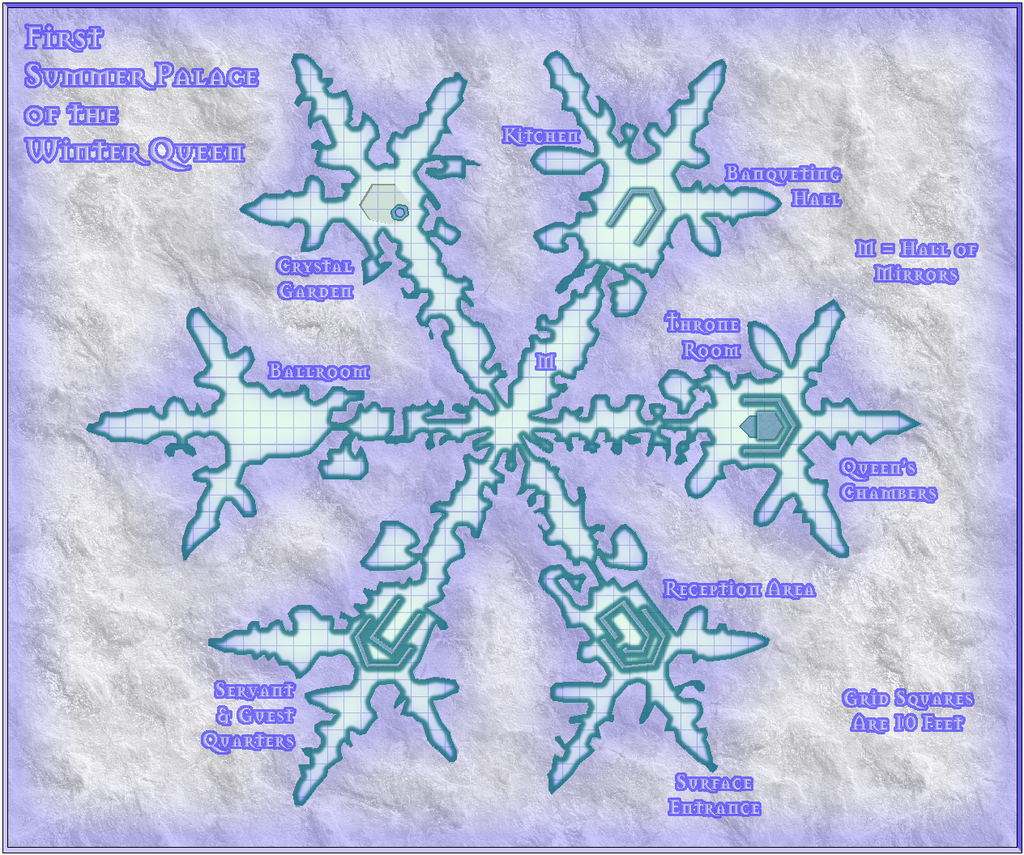
The Palace size doesn't encourage adding too much interior detail, as it starts to look cluttered very quickly, so I settled for showing simply the major, fixed features instead. There'll be text notes and a PDF to accompany all the maps in the final Atlas version, as normal. Each Palace version is intended to have the same seven main areas (Hall of Mirrors is one of the seven, incidentally), though not always in the same order - it is meant to be the same place, just with a different appearance each day, after all.
I was a little concerned about the narrowest passages, for all I'd checked with the grid on as I was drawing it - the narrowest are between four and five feet wide in the connecting passages. I decided early on that it wasn't going to be necessary to ensure access to every nook and cranny that didn't require direct access. It is meant to be a magically-grown, natural creation, and when real snowflakes can be so complex, that seemed an ideal recommendation to follow!
There was a degree of experimentation in this, as I wasn't sure how best to work the complex outlines at first, as you may find when you have access to the FCW file later - such as several overlapping floor segments in places. As I was just using the normal straight polygon drawing tool though, not fractal, I probably shouldn't have been too concerned. That's easy to say after the event though ?

-
Community Atlas competition entry: The Summer Palace of the Winter Queen
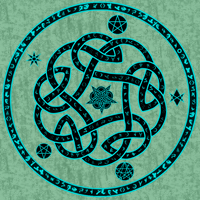
When I started thinking about this, because all my previous Community Atlas mapping has involved a degree of random design, I started looking at random snowflake creation systems online. This is one design I made from the Misha Studios site run by Misha Heesakkers for instance:
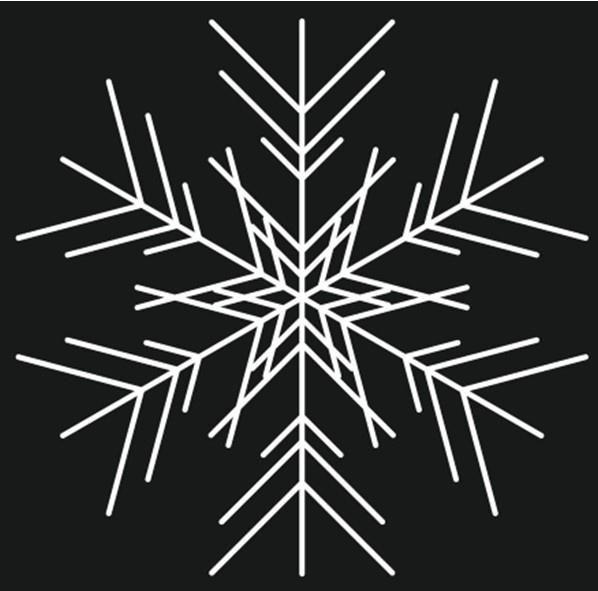
However, this generates only an SVG file if you're using Chrome or Firefox, which is not ideal.
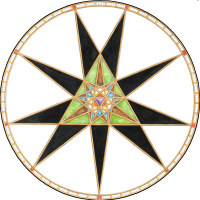
Another interesting site, Snowflake Generator by Fabian Kober creates fractal, fully adjustable, PNG download files, such as this:
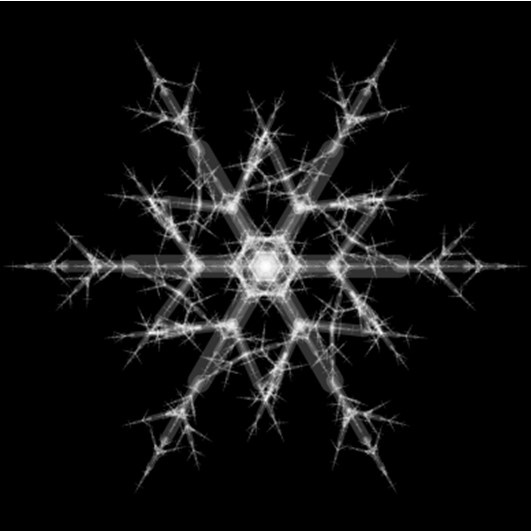
While these are fascinatingly wonderful - and the fractal versions can be incredibly intricate - they're also perfectly symmetrical, which wasn't really what I wanted, so I started searching for images of real snowflakes online. There are a lot of these! However, when I struck upon the many nicely contrasty black and white photos by Wilson Bentley (1865-1931; Wikipedia link), I decided to make my selections for this project chiefly from those. Wikimedia Commons has a lot of options, for instance.
I thought it might be useful to give the two image generators here though, as they may be useful for those wanting to create symmetrical snowflake design mazes or labyrinths, for example.
For the random element in the maps, I opted to stick with that being primarily in where the palace can appear, and in what form.
-
Is there a way to flip a symbol?
Some symbols are fitted with a shadow as part of the symbol, so be aware that this can make them look weird in comparison with symbols that haven't been mirrored though.