

Wyvern
Wyvern
About
- Username
- Wyvern
- Joined
- Visits
- 3,238
- Last Active
- Roles
- Member
- Points
- 5,515
- Rank
- Cartographer
- Badges
- 24
Latest Images
-
Marine Dungeon - a Cartographer's Annual development thread
OK, this is a bit more "tropical seas only" than I was thinking.
The coral overhang is, as far as I recall, only a thing with living corals, not the underlying rocks (which themselves are likely to be largely made up from increasingly compacted dead coral skeletons). The overhang will only survive as long as its own weight/strength and tidal action allows, of course, so collapse of unsupported areas is still liable to happen, especially when there are no longer living coral polyps there to help keep the whole "glued" together. As you'll gather, I was assuming the rocks were "just" rocks, not intended as the immediate substrate for living corals!
Keeping the coral symbols separate from the rocky bit ones would offer greater flexibility, certainly.

-
Marine Dungeon - a Cartographer's Annual development thread
The wildlife looks absolutely brilliant Sue!
Not quite so sold on the geology yet though. The above-sea sand seems a tad too bright, and the white outline looks odd - as also on the surfaced rocks. I think I can see why you've drawn it like this, but actual rocks, and sand, tend to get darker when wet, if sometimes only subtly so, so the line (actually a zone whose size is determined by ripples splashing on the exposed surfaces, were they real) should be darker where the rocks/sand meet the sea.
The stacking of the rocks doesn't look quite right either. Higher rocks should lie at or within the outlines of those below them if supported by only a single rock, as anything else wouldn't be stable, and would simply collapse into a different pattern ordinarily.
Not sure if the rocks are symbols or simply drawn polygons however; if the latter, the stacking problem is easily resolved, and I'd imagine the water-line effect could be handled with an appropriate Inner Glow Effect. If they're symbols, though... sorry!
-
Seeking advice re world map and civilization placement
The topographic advice here is good if you're aiming for a more-or-less duplicate Earth, as far as range and extent of terrains is concerned.
However, the nature of your initial map suggests that may not be what you'd prefer, so it might be interesting to consider the example of the planet Mars here too, as an alternative. The maximum range between the highest and lowest points on Earth (Everest to deepest ocean trenches) is almost 20 km. For Mars, a much smaller planet than Earth, it's 30 km. On Earth, as mentioned already, there are relatively scarcely any mountains, and no substantial clusters of them, when looked at on a global scale. On Mars, more or less the entire southern hemisphere is rugged to mountainous:
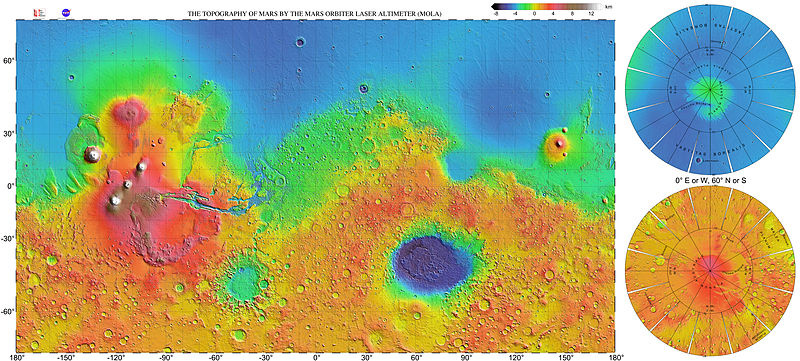
The image above is from Wikimedia Commons, though should you wish, you can find a little more on the topic, with referencing pointers, via the Geography of Mars Wikipedia page as a starting point.
As Sue said, it's less easy finding a decent comparison map for Earth, but this one's a reasonable rough comparison for the Mars one here at least, again via Wikimedia Commons, as found on the Wikipedia Global Relief Model page:
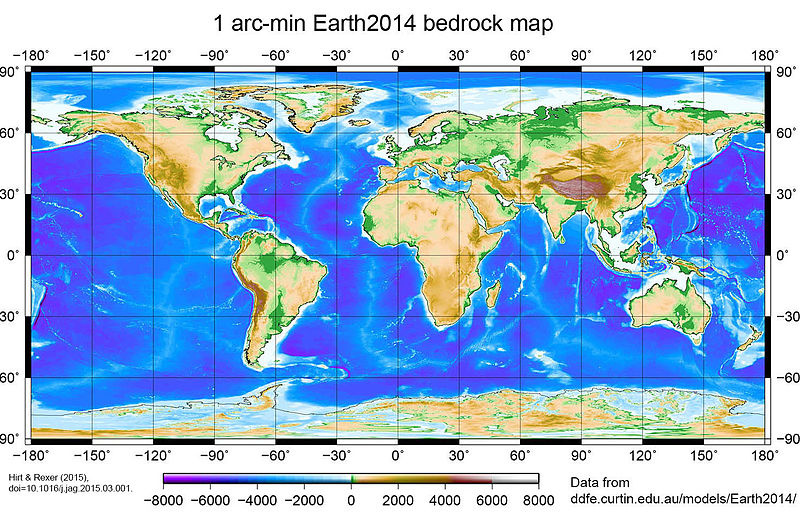
You pays your money and takes your choice!

-
Marine Dungeon - a Cartographer's Annual development thread
I appreciate the problems with getting the symbol to work right, Sue. And this one will look good as the tops of forest kelp and other denser seaweeds, aside from its intended eelgrass, so it's win-win, I think!
Mysterious Island keeps coming round on British TV from time to time still. Perhaps most famous still for containing some of Ray Harryhausen's excellent stop-motion animations.

-
Marine Dungeon - a Cartographer's Annual development thread
Looks interesting Sue, and it'll work nicely as other types of shallow-water sea vegetation, I think.
I'm not overly familiar with eelgrass, so am having to judge by online images only, but this looks a little large and robust for those types that have come up via Google so far (where there's anything to help judge size, at least, and I'm assuming "your" barrel's about 2-3 feet in diameter). Not sure how representative a sample that may be, however!

_with_poles_HiRes.jpg)
