


Royal Scribe
Royal Scribe
About
- Username
- Royal Scribe
- Joined
- Visits
- 9,537
- Last Active
- Roles
- Member
- Points
- 3,353
- Birthday
- February 5, 1968
- Location
- San Francisco, California
- Website
- https://legacy.drivethrurpg.com/browse/pub/31814/Royal-Scribe-Imaginarium
- Real Name
- Kevin
- Rank
- Mapmaker
- Badges
- 16
Latest Images
Reactions
-
Atlas Submission: Doriant - Gold Coast - Tyr Alomere
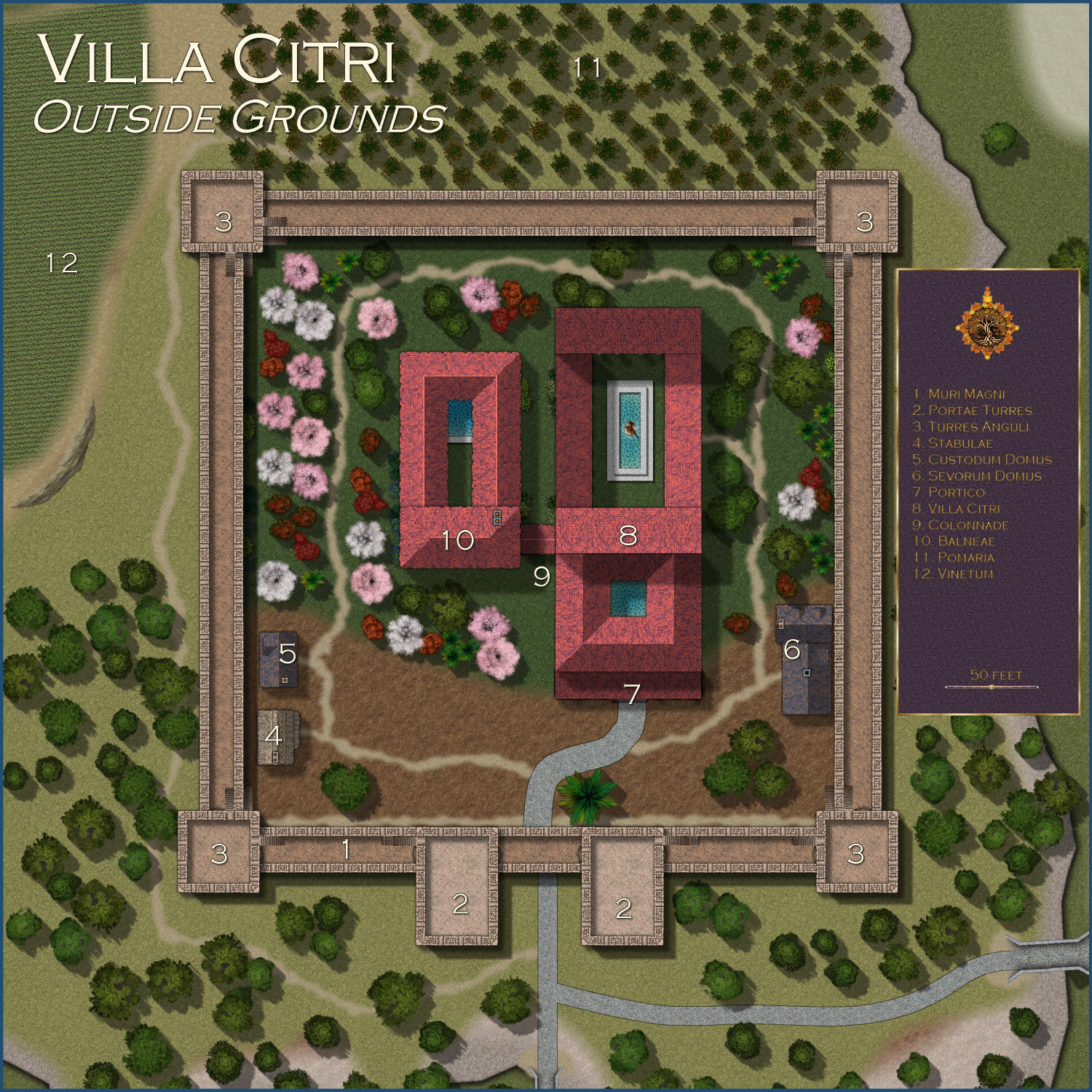
I am ready to submit the maps for the Villa Citri in the town of Tyr Alomere. I will do each map as a separate post in this thread, starting with the main outdoor map.
Toggles
TEXT LABELS (NUMBERS) layer to hide/display the numbered labels.
TEXT LABELS layer to hide/display the legends describing the labeled numbers.
Files
Description
In the village of Tyr Alomere, the Earls of Westford have owned the Villa Citri for generations. The villa is known for its orchards of orange trees as well as its vineyards of wine grapes.
It has at times served as a summer vacation home for the noble family, but at the present is the regular residence of Lady Amfiri Prelcort, Dowager Countess of Westford, widow of the seventh Earl of Westford and mother of the eighth. She lives there with a few close friends, attended by faithful servants and guards, where she receives a steady stream of family visitors and other guests.
The villa’s grounds includes a detached bathhouse, or ballneae, as well as detached quarters for servants and for the guards, along with a barn.
Outside Areas
1. Muri Magni
The great outer wall, called the Muri Magni, is 20 feet thick (with crenellations that extend a bit beyond the edge of the wall), with the parapet rising 25 feet above the ground.
2. Portae Turres
The gatehouse towers extend 15 feet above the parapet. They have ground-floor entrances on the inside of the fortified wall. The gates themselves include an outer portcullis, a metal gate that is generally left open, and an inner portcullis. Each gatehouse has control mechanisms that allow for independently opening or closing the gates, and for raising or lowering the portcullises.
3. Turres Anguli
The corner towers of the fortified wall extend ten feet above the great wall’s parapets. They can be accessed through external stairs that climb fifteen feet to the second story.
4. Stabulae
The stables are sufficiently large to house the Dowager Countess’ horses as well as those of any visitors.
5. Custodum Domus
The residence of the estate’s guards.
6. Sevorum Domus
The residence of the estate’s servants.
7. Portico
The villa’s covered porch, supporting by four columns, two on either side of the stairs.
8. Villa Citri
The villa is three stories above ground.
9. Colonnade
The covered walkway connecting the villa to the balneae is lined with column pillars but has no walls.
10. Balneae
The villa’s bathhouse is used by residents and guests as well as by the villa’s staff (at separate times) for personal hygiene, exercise, and recreation.
11. Pomaria
The orchard has an abundance of orange trees.
12. Vinetum
The vineyard where the estate grows grapes that are then fermented into wine.

-
Accidentally Deleted Sheet Effects Preset
Others here are savvier than I am, but what about reinstalling the main software?
-
[WIP] Villa Citri (Roman-style villa)
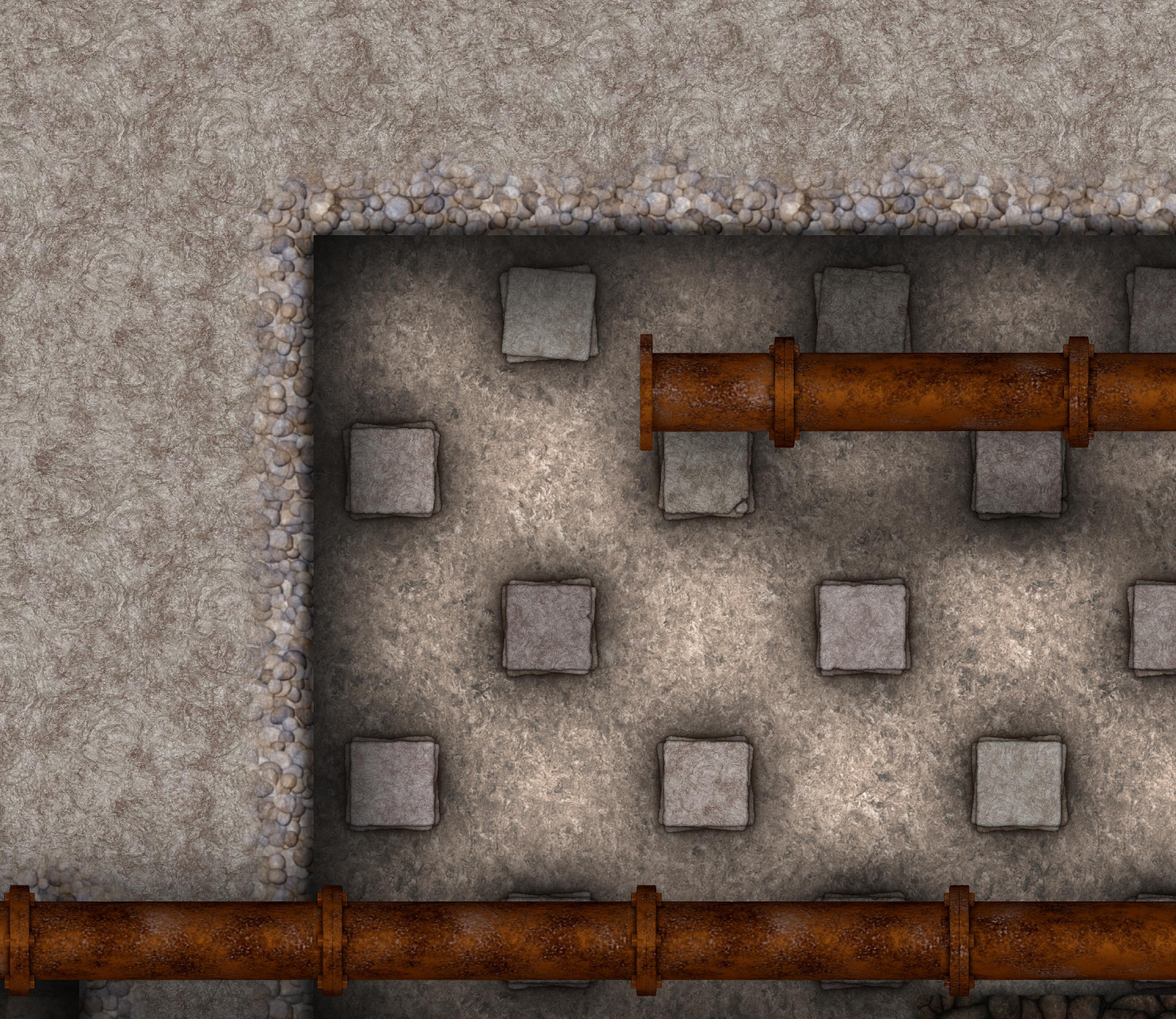
Here are the Pilae Stacks using an outer glow instead of a wall shadow. As with the shadow, the stronger glow is just on the lowest of the three tiles in the stack -- putting it on all of them was just too strong. I set up enough sheets to have ten tiles stacked up for each, but it didn't really gain enough after the third tile to make the effort worthwhile.


-
[WIP] Villa Citri (Roman-style villa)
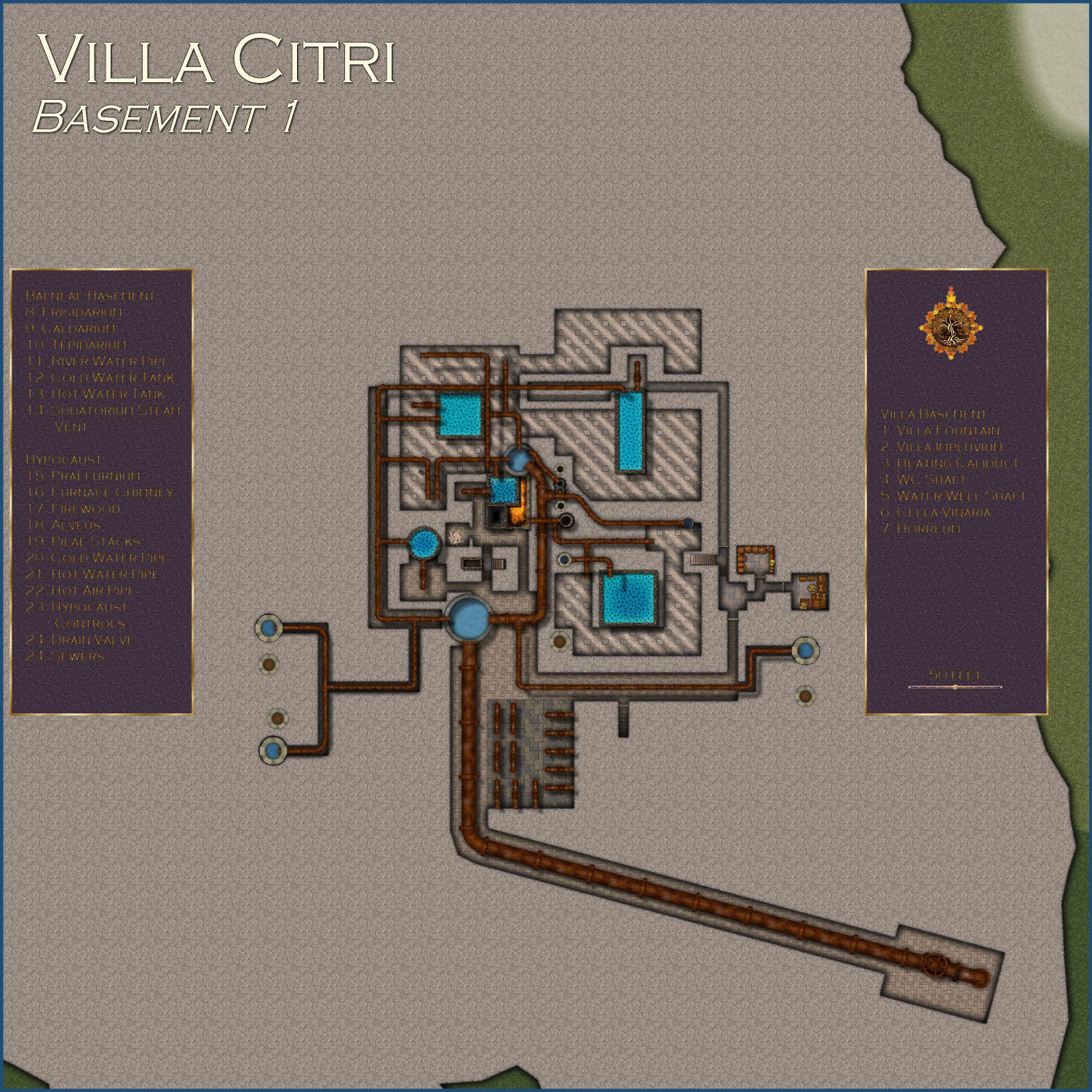
I finished the basement with the hypocaust. This level required extensive plotting to make sure the pipes went to the right places.
First, here it is unlabeled so you can actually see everything, because there are a lot of labels. Note that the pools are supposed to be elevated (hence the drop shadows on them), as this is the lower portion of the pools where water is piped in and drained out.
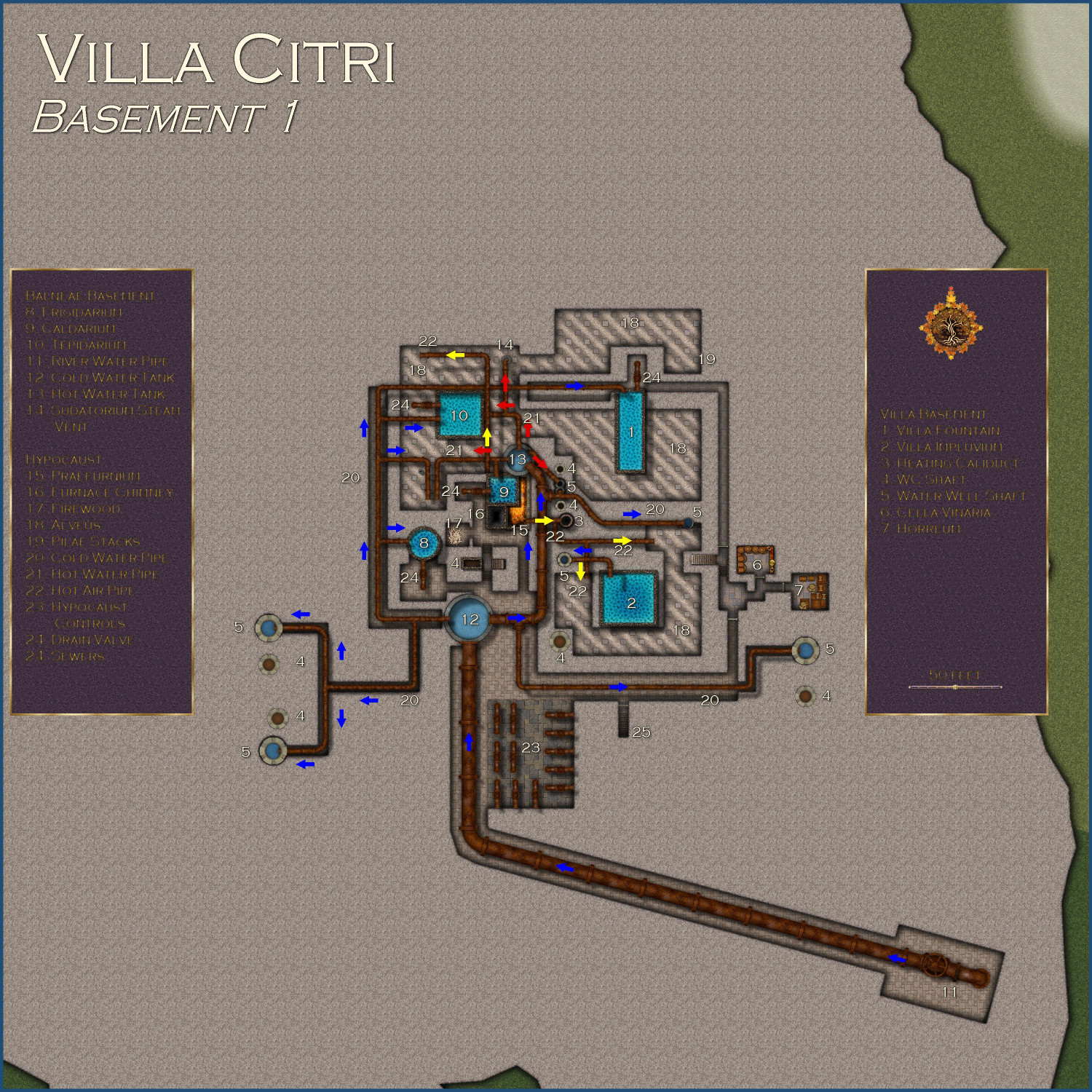
And here it is labeled. The labels include arrows indicating flow: blue for cold water, red for hot water, and yellow for warm air. The labels and the arrows are on separate layers to allow them to be independently hidden or revealed.
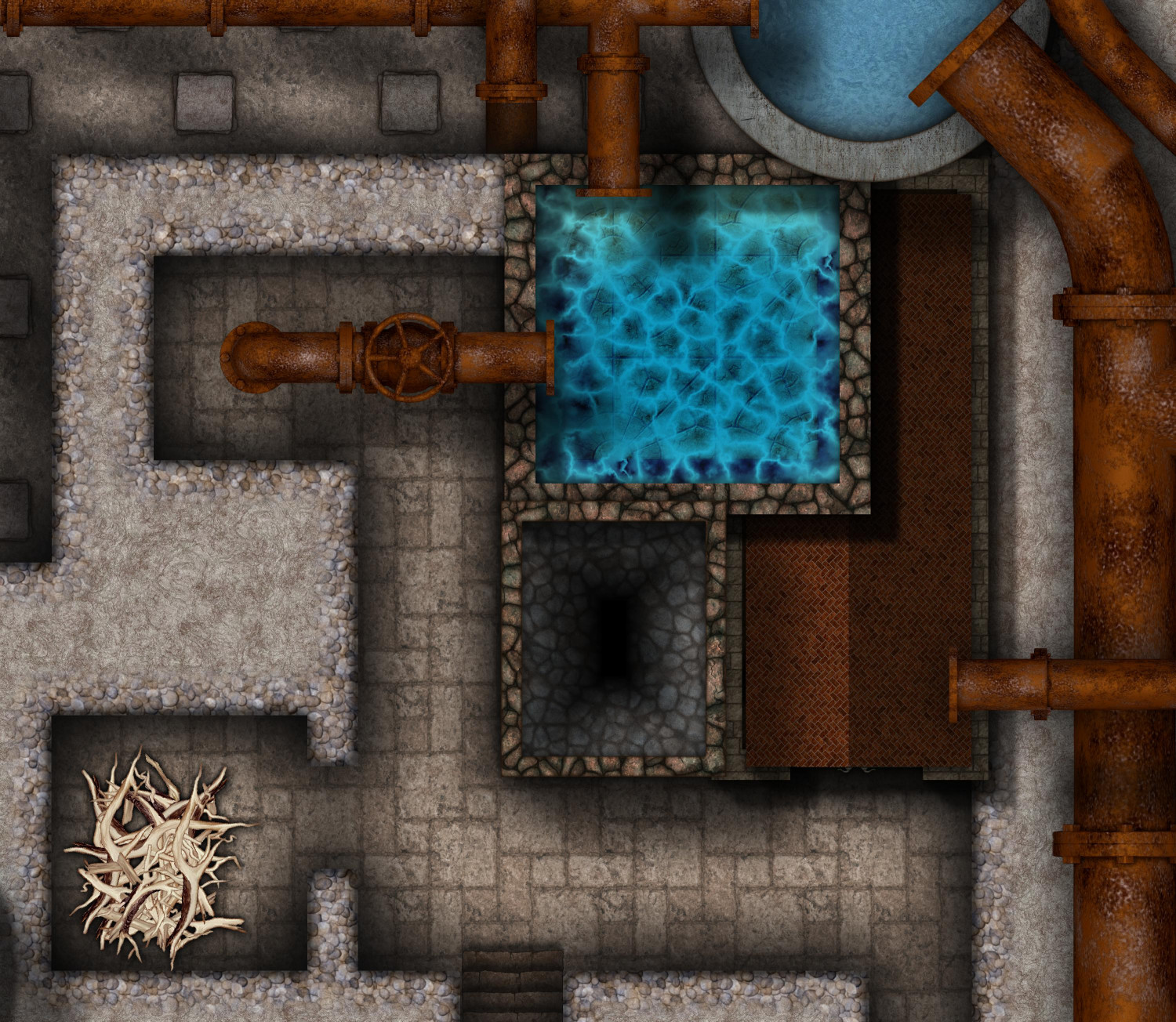
A giant furnace (called a Praefurnium) is used to heat water and air. Here it is covered, and then uncovered.
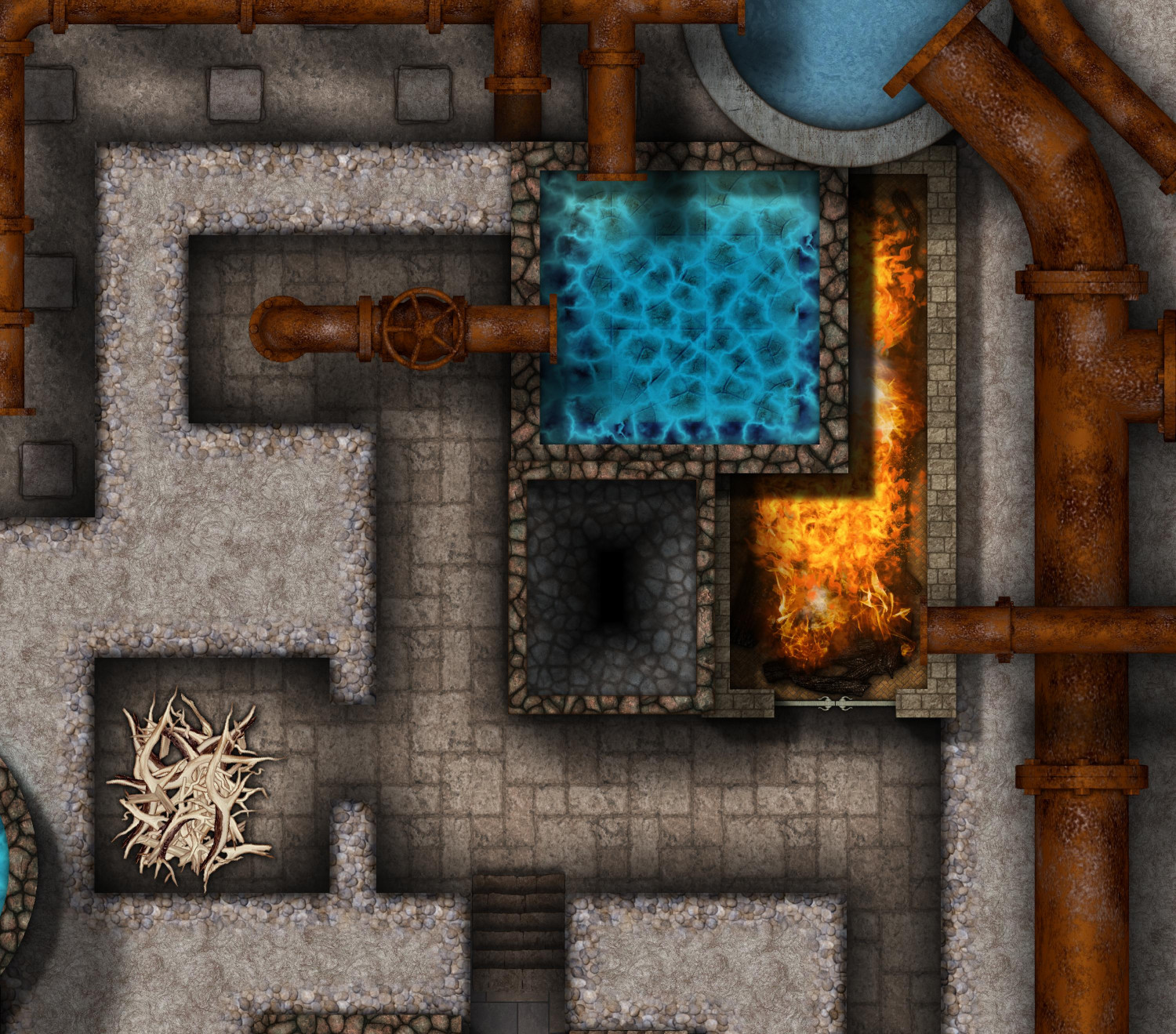
The hypocaust itself is basically a series of chambers through which hot air can flow, warming the floors for the level above, with vents that can bring warm air up to the upper stories of multistory buildings. These chambers are called Alveus. Within these chambers are stacked tiles made into pillars, called Pilae or Pilae Stacks, used to support the roof of the hypocaust as well as to conduct heat to the floors above. (This screengrab also illustrates the technique I used for the subterranean walls, using the cutout effects that Sue developed for Creepy Crypts, but using the stone and pebble fills she developed for Marine Dungeons.)
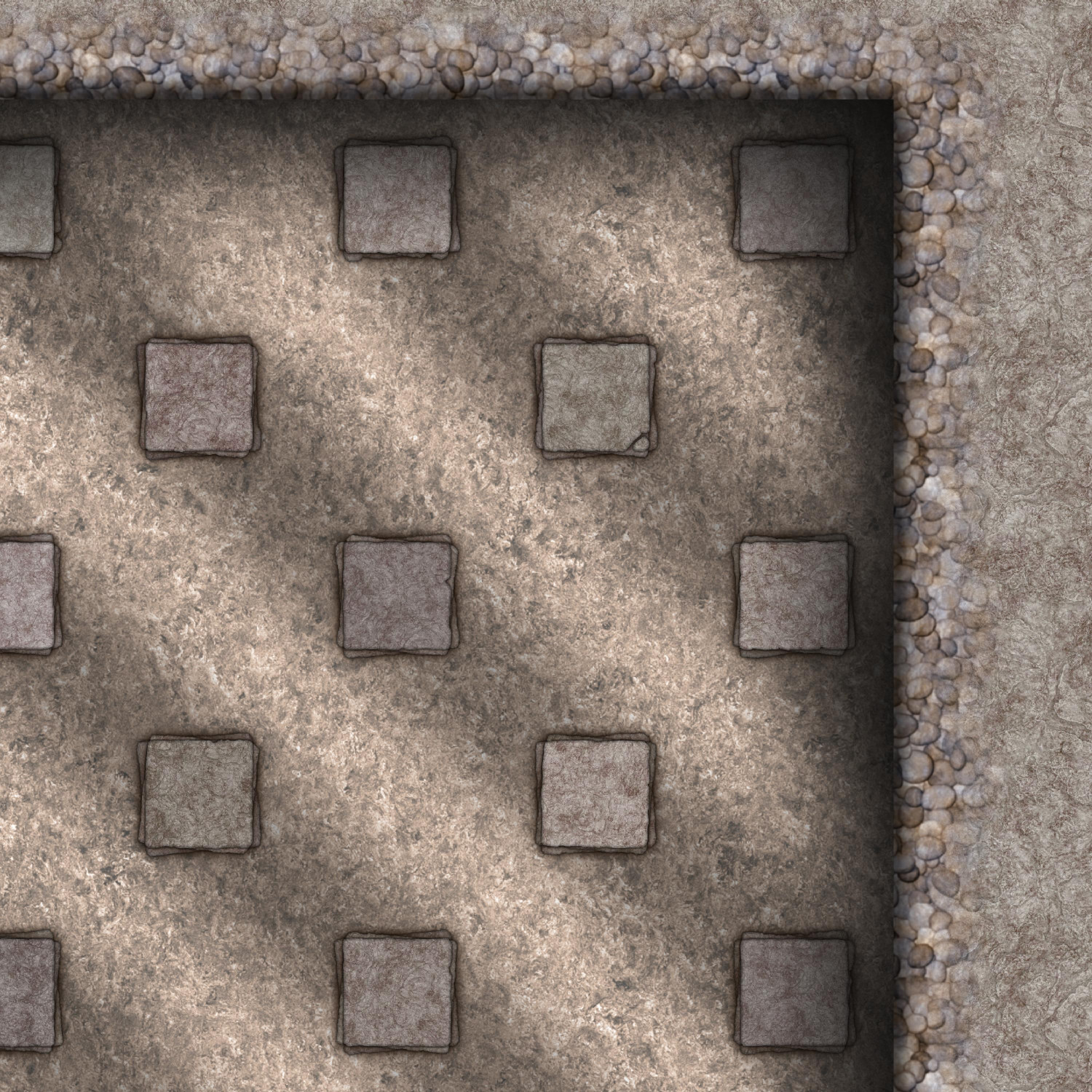
The Pilae Stacks have a wall shadow on them, but I guess it would make more sense to use an outer glow instead since they're underground.
When I was about 10 or 11, I first read about hypocausts from Mary Stewart's The Crystal Cave, the first in her Merlin-focused Arthurian novels. Young Merlin used the abandoned hypocaust on his family's estate as a hideout, inadvertently eavesdropping on adult conversations in the process. I'm delighted to finally be able to design one.
-
Tell me all about your DnD campaigns!
@KertDawg I haven’t really given it thought. I’ve never played with people where I wasn’t already friends with at least most of them in real life. Maybe! I will see how much time this Pathfinder game takes first.

